





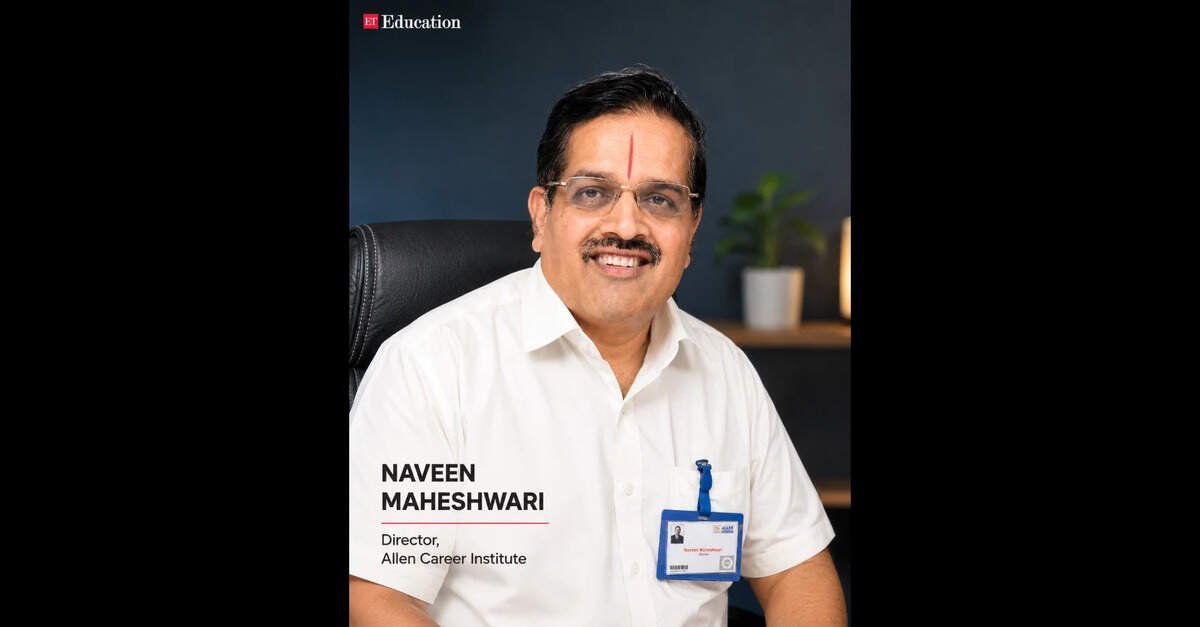
As India seeks to restore public confidence in competitive examinations through the Public Examinations (Prevention of Unfair Means) Act, few voices carry as much weight as those from the coaching ecosystem that prepares lakhs of aspirants every year. Naveen Maheshwari, Director, Allen Career Institute, and one of the four Maheshwari brothers who helped build the Kota-based institute into one of India’s largest coaching networks, believes this year’s NEET re-examination offered an important lesson. While acknowledging the emotional toll of the re-test on students, he says Allen’s internal analysis did not reveal the kind of unexpected outcomes that had occasionally raised questions in previous years. In this exclusive interview with ETEducation, Maheshwari discusses the new law, why technology and strict implementation must go hand in hand, and why he believes the NEET re-examination better reflected genuine merit.Q. The Public Examinations (Prevention of Unfair Means) Act has now come into force. Do you think it addresses the right issues, or is much more needed to curb examination malpractice?
Naveen Maheshwari: Every law is only a beginning. We are still in the phase where its real impact will become clear through implementation. As the law is enforced, we will understand where improvements are required because the examination ecosystem keeps evolving and, unfortunately, so do the methods used by people trying to exploit it.
Whenever a law is enacted, there are always people looking for ways to find loopholes. There are even people who guide others on how to circumvent the system.
That is why strict implementation is just as important as the law itself. At the same time, policymakers should remain open to new suggestions and make timely amendments whenever required. Continuous improvements are essential if the law is to remain effective over time.
Q. Paper leaks have affected competitive examinations for years—from the PMT era to NEET. Where do you think the system has been falling short?
Naveen Maheshwari: This is not a new problem. We saw similar issues during the PMT era and they have continued in examinations like NEET. The biggest missing element, in my opinion, is culture. Our education system has gradually moved away from a culture where merit and integrity were paramount. If we look at India’s Gurukul tradition, teachers judged every student by ability, whether the child belonged to a king’s family or a poor household.
We need to bring those values back. But until then, there also has to be a credible deterrent. Strict punishment is necessary because fear of consequences matters. Punishment alone, however, is not enough.
Technology has to become the backbone of our examination system. Computer-based testing has already reduced many risks associated with printed question papers. Going forward, biometric verification has to become much stronger. Facial recognition should also become part of the process. Artificial intelligence can help make examinations far more transparent and secure.
Q. Some experts argue that even computer-based examinations can be compromised. Why do you still believe technology is the best way forward?
Naveen Maheshwari: These concerns exist, but technology also provides the solution. If vulnerabilities emerge, they must certainly be addressed, but that cannot become a reason to stop adopting technology. Take JEE Main, for example. Around 14 to 15 lakh students appear for the examination across multiple sessions spread over several days. The examination is not based on one fixed paper. There is a large pool of questions of the same difficulty level for every topic.
Suppose an examination has around 320 questions, with ten equivalent questions available for every concept. That immediately creates a pool of more than 3,000 questions. Across multiple sessions, the question bank can run into nearly 6,000 questions. No student knows which particular question will appear in the paper. In such a system, preparation and hard work become far more important than unfair means.
Q. The NEET re-examination created enormous uncertainty for students. How did Allen help students cope? And you also mentioned that this year’s results looked different from what you had observed in previous years. What did you mean?
Naveen Maheshwari: It was an extremely difficult period for students. Many had mentally moved on after the examination and suddenly had to prepare again. Every teacher and mentor at Allen spent time speaking to students individually, counselling them and motivating them.
We kept telling them that setbacks are part of life. Do not panic. Do not lose focus. Some students found it extremely difficult emotionally. I even spoke to a student who had scored 720 marks, yet the developments still affected him deeply.
When we analysed the results of our own students after the re-examination, we noticed something different.
Every year, we closely analyse the performance of our batches. We usually have a fairly good understanding of which students are capable of securing top ranks based on their academic performance. Occasionally, we would come across results that did not entirely match what we had observed. We accepted those results, but somewhere there would always be a doubt.
This year, we did not observe that pattern. Based on our internal analysis, we felt the re-examination ensured that genuine merit was better reflected in the final outcomes.
Q. Coaching institutes have increasingly come under regulatory scrutiny. How do you see the sector’s role evolving? And do you see Allen entering the school education space in the future?
Naveen Maheshwari: The biggest challenge in our education system is that every child still does not have access to the same quality of schooling. Coaching has emerged as an alternative that gives talented students opportunities they often do not receive through the school system alone.
But honesty is extremely important. Some institutions have pursued short-term profits through unfair practices, and that affects the credibility of the entire coaching sector.
People often ask whether Allen will start schools. I believe school education is a very different space. Schools operate within their own academic framework and regulatory structure. Coaching gives us much greater flexibility to support students according to their individual needs.
Even today, nearly 70% of our students are those who complete school and then devote a dedicated year to preparing for NEET or JEE.
I often think of one student whose story was even mentioned in Parliament. He was about to enrol in a BSc programme because he had almost given up on his dream of becoming a doctor. He came to Kota for a year, prepared with us, and today he is studying medicine. His father earned a living by collecting scrap. Coaching gave him an opportunity that he otherwise may not have received.
Until India reaches a stage where every child receives the same quality of schooling, coaching will continue to play an important role. At the same time, regulations relating to student safety, fire safety and other standards should be implemented strictly. We welcome that. But all coaching institutes should not be viewed through the same lens.
Q. If you could recommend one reform to make India’s examination system more transparent and trustworthy, what would it be?
Naveen Maheshwari: Technology is the answer. I do not see any better alternative. Look at what technology has done for banking and digital payments. There may still be isolated issues, but the overall system has become far more transparent than it was a decade ago.
India has made tremendous progress in technology over the last 10 to 12 years. If we effectively use AI, biometrics and other digital tools, we can build an examination system that students and parents trust.


