






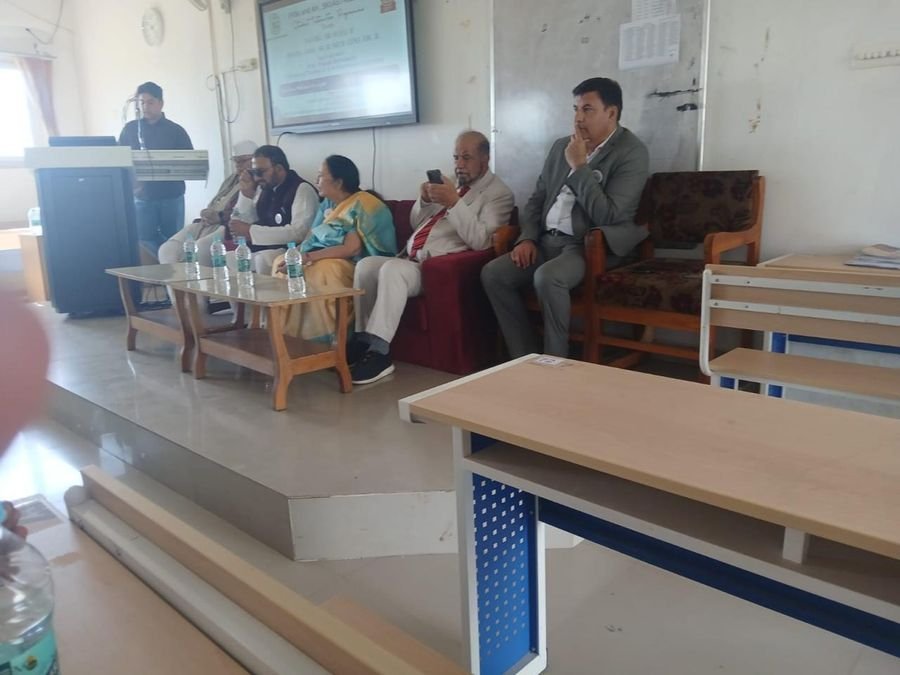
Ganderbal, October 1, 2026: A prestigious gathering of scholars, researchers and social thinkers at the Shuhama Campus of Sher-i-Kashmir University of Agricultural Sciences and Technology-Kashmir witnessed an extensive discussion on non-violence, human equality, justice and Kashmir’s spiritual-humanistic heritage.
The conference was organised by the Kings Gandhi Foundation in association with the Shuhama Campus on the occasion of the felicitation of Shri Prasad and Mrs. Kranti Prasad, founders of the Kings Gandhi Foundation, on their arrival in the Valley.
Speaking on the occasion, Khwaja Farooq Renzushah ,protagonist of the renaissance of Kashmir’s Sufi and Rishi traditions, presented a research paper on the influence of the fourteenth-century spiritual and humanistic traditions of Kashmir on the broader philosophy of non-violence and human dignity.
Renzushah emphasised the need to enlighten people across the world about the importance of non-violence, human love, Ren (humanity), equality and justice, while working towards the eradication of hatred from human minds.
He said that the philosophical traditions associated with Kashmir’s fourteenth-century spiritual renaissance provide an important framework for understanding the universal human values reflected in the lives and teachings of personalities such as Mahatma Gandhi, Martin Luther King Jr., Nelson Mandela, Lal Ded, Hazrat Bulbul Shah and Amir-e-Kabir Mir Syed Ali Hamdani.
“The inspiring ray of light of Kashmir, Ren Humanity and Kings Gandhi reflects a fundamental unanimity with the ideals of Martin Luther King, Mahatma Gandhi, Nelson Mandela and other iconic personalities. This moral vision emerges from the Renaissance philosophy of Kashmir of the fourteenth century” Renzushah said.
Founder of the Kings Gandhi Foundation, Shri Prasad, spoke about his travels across the world and his experiences while pursuing the Foundation’s mission of highlighting similarities between the philosophies of Mahatma Gandhi and Martin Luther King Jr. He underlined the role of Gandhian principles in inspiring movements for equality and non-violent social transformation.
Renzushah, while appreciating the efforts of the Kings Gandhi Foundation, said that his research seeks to explore the “ray of spiritual light” in Kashmir and its relevance to contemporary efforts aimed at strengthening a culture of non-violence.
He clarified that the comparison between Martin Luther King Jr. and Kashmir’s Sufi traditions should not be understood as a claim that King directly inherited his philosophy from Kashmiri Sufis. Rather, he described it as an exploration of an ethical affinity between traditions that challenged injustice through **moral courage, spiritual conviction, non-violence and faith in human equality.
According to Renzushah, King’s concept of the “Beloved Community”, Gandhi’s philosophy of non-violence and the Kashmiri Sufi-Rishi tradition share an emphasis on transforming social relationships through compassion, justice and the rejection of hatred.
He said non-violence should not be understood merely as passive submission, but as an active moral resistance based on the disciplined refusal to reproduce the hatred and cruelty of the oppressor.
“Peace without justice remains incomplete, and freedom without equality remains an unfulfilled promise,” he said, referring to the broader ethical principles associated with King’s philosophy.
Presenting his research on “Ray in Kashmir” and the concept of Ren—humanity, Renzushah said that Ren represents the recognition that human worth cannot be determined by religion, caste, ethnicity, social status or political power.
He described Ren as a foundational principle through which Kashmir’s spiritual renaissance can be interpreted, stressing the values of compassion, humility, mutual respect and a shared sense of human destiny.
He further observed that Kashmir’s Hindu, Buddhist and Muslim traditions developed through complex historical encounters that included both periods of harmony and conflict. However, he said, the region’s spiritual and literary traditions preserve enduring aspirations towards coexistence and transcendence of narrow identities.
Renzushah said the legacy of Bulbul Shah, when viewed through this framework, forms part of a wider history of spiritual dialogue in Kashmir, where religious transformation and social solidarity could coexist without diminishing the humanity of people belonging to different faiths.
He also drew parallels between King’s Beloved Community, Gandhi’s non-violence, Bulbul Shah’s spiritual legacy and Lal Ded’s poetic universalism, describing them as different approaches to the enduring human questions of justice, compassion and coexistence.
“The renaissance of humanity begins when compassion becomes stronger than prejudice and justice becomes more enduring than revenge,” Renzushah said.
He stressed that for contemporary Kashmir, Ren should become more than a historical or philosophical expression and should find practical meaning in equal citizenship, religious freedom, protection of minorities, rejection of discrimination and preservation of shared cultural heritage.
He said these principles could also contribute to a wider global dialogue among Muslim, Hindu, Buddhist, Christian, Sikh and other communities.
Renzushah said his ongoing research examines the spiritual and humanistic traditions of Kashmir from the fourteenth to the twenty-first century. He informed the gathering that three research articles on the “spiritual ray of light” in Kashmir and its relevance to global human equality and unity are being developed for wider publication.
During his address, he described the history of humanity as being illuminated by extraordinary individuals who transcended barriers of religion, race, nationality and social hierarchy to affirm the dignity of every human being.
“No civilisation can attain its highest glory unless it recognises the humanity of every individual**,” he said.
He added that civilisation should not be measured merely by monuments, kingdoms, conquests or material achievements, but by the dignity it affords the weakest, the justice it extends to the excluded and the compassion it preserves for those who differ from it.
Mr. Ayub Matto and Dean of the Shuhama Campus Mr. Riyaz Shah were appreciated for their role in organising the conference. Ms. Kranti Prasad, Mr. Shahid, Mr. Ahtisham, Mr. Hilal Khan, Mr. Riyaz Malik and Mr. Aijaz Malik were also present and participated in the presidium and interactive sessions.
The conference concluded with a broader call for continued research and dialogue on Kashmir’s spiritual-humanistic heritage and its possible contribution to contemporary global conversations on **peace, non-violence, equality, justice and human unity.


