






Justice delayed: Acknowledging women pioneers in science
For a discipline so wedded to reason and fact as science is, it has fiendishly guarded its gender bias. Over centuries, pioneering women in science have been ignored, their achievements overlooked or usurped by male colleagues, their names left out of scientific publications; they have been underpaid and undervalued, denied promotions and advancements in careers, sometimes consigned to housekeeping roles about the office in order to keep their jobs.
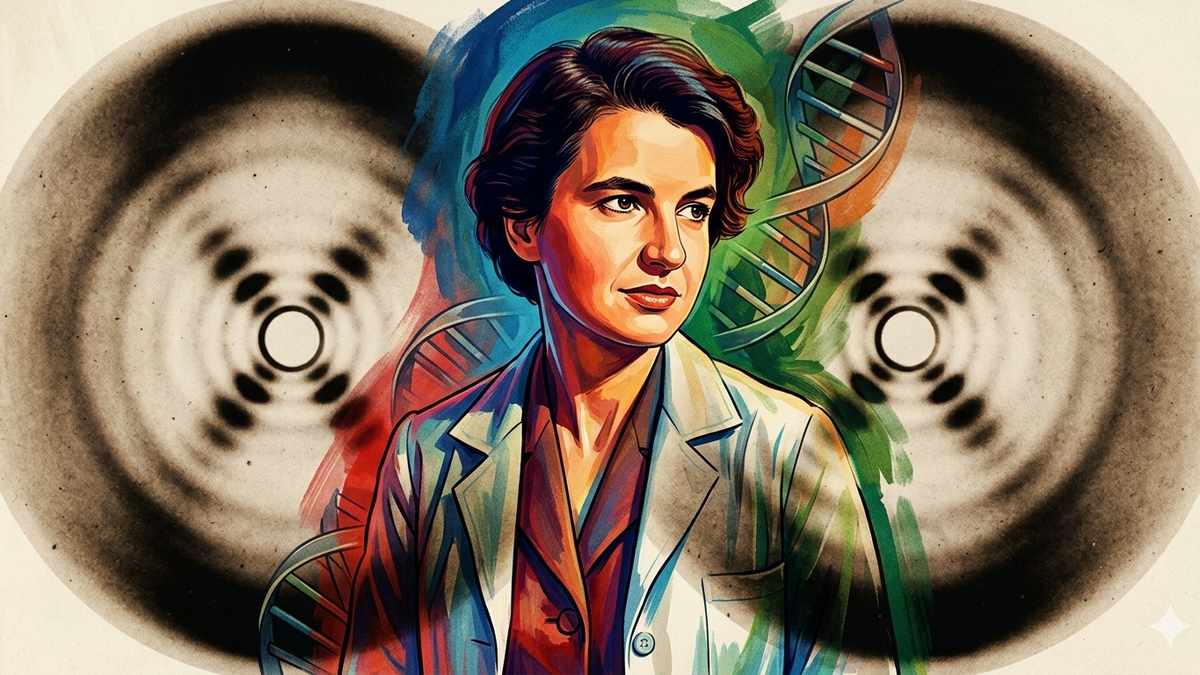
In a compilation of such women in scientific research through the ages, Rosalind Franklin would probably be right on top of the list. It was Franklin’s X-ray diffraction image that lore says, was crucial to discovering the DNA’s double helix structure, enabling advances in genetics and molecular biology, with vast applications in medicine. And yet, when the Nobel Prize for Physiology in 1962 was announced, the names on that list were Watson and Crick, shared with Wilkins. It was decades before her true role in this path-breaking discovery came to be known to the world.
Today, Franklin stands testimony to the power of women, as she is representative of the ‘woman wronged by science’, but not just that – her achievements in science (in other fields) have broken new ground that researchers have since travelled on. As we unveil the achievements of women in science, particularly those whom their present refused to acknowledge, it is important to get her story out there, more so since she was vilified and mocked by the very men who benefitted from her work.
At King’s College
Franklin was a British chemist and X-ray crystallographer. In 1951, she joined the team at King’s College London, biophysicists led by John Randall, and Maurice Wilkins as his deputy (who would later share the Nobel prize), that were using X-ray diffraction to study the structure of the molecule, recount Matthew Cobb and Nathaniel Comfort, two researchers looking into the past of Watson and Crick to craft their biographies, in an article in Nature.
Franklin, had already been trained in this technique, having used it earlier to study the structure of coal, which she advanced by many lengths with her work. Cobb and Comfort detail in their article: “Franklin was able to exploit a discovery that Wilkins had made earlier — DNA in solution could take two forms, what she called the crystalline or A form, and the paracrystalline or B form. Franklin found that she could convert A into B simply by raising the relative humidity in the specimen chamber; lowering it again restored the crystalline A form.” A B form X-ray image it was that provided great clarity on the actual structure of the DNA.
Photograph 51
The distorted story of Franklin’s role was spread, thanks in good measure, by Watson’s best selling book The Double Helix. In the book, Watson infantilised Franklin, claiming that she did not realise the importance of the photo she took – the life altering, or life-explaining Photograph 51. Let’s refer to what Kings College London records about this photograph: “Photograph 51” is an X-ray diffraction image of DNA taken by Rosalind Franklin, together with her PhD student Raymond Gosling, at King’s College London in May 1952. In fact, the camera was set up to take the photograph on Friday 2 May and it was developed on Tuesday 6 May: as Franklin reported in her lab notebook, the DNA was exposed to X-rays for a total of 62 hours to take Photograph 51.”
Photograph 51 was reportedly infinitely clearer than any of the earlier images, and also with other data from Rosalind’s work during her time at King’s it was possible to make the leap to the double helix structure, notes the college’s website. This entire body of work was key to building the structure of DNA but never properly acknowledged until much later, after her death. Records have it down that James Watson was shown this photograph (without her permission) and it reportedly spurred both him and Francis Crick to attempt to build a model, which was then feted across the world as a path-breaking discovery.
Cobb and Comfort however challenge Watson’s narrative: “[It] contains an absurd presumption. It implies that Franklin, the skilled chemist, could not understand her own data, whereas he, a crystallographic novice, apprehended it immediately.” While implying that the whole story constructed around the Eureka moment from Photograph 51 was probably an exaggeration, they add: “Moreover, everyone, even Watson, knew it was impossible to deduce any precise structure from a single photograph — other structures could have produced the same diffraction pattern… In fact, it was other data from Franklin and Wilkins that proved crucial, and even then, what really happened was less malicious than is widely assumed.” However, malice, wilful sexism, or a casual miss, the fact remains that Wilkins was co-named for the Nobel, while Franklin was not.
On the website of the Rosalind Franklin Institute, set up in Franklin’s honour Professor Patricia Fara, president of the British Society for the History of Science (2016-18), Clare College, University of Cambridge, writes on the life and work of Rosalind Franklin: “Since her early death at the age of 37 [of cancer], Rosalind Franklin has become mythologised as the victim of male prejudice, the unsung heroine who took the crucial X-ray photograph enabling James Watson and Francis Crick to build their double helix model of DNA, and was unjustly deprived of a Nobel Prize. She would neither have recognised nor endorsed this soundbite description. Franklin regarded herself first and foremost not as a woman, but as a scientist, and her DNA research occupied a relatively brief period in her successful career working on a variety of topics. In particular, on top of her famous investigations into DNA, she also made foundational contributions to modern understandings of coal, graphite and viruses.”
Since her death however, Franklin’s story has been freed from the cloisters it was trapped in. It has traversed the mythical seven seas and seven mountains to sound in the corners of the world. Several honours have since been heaped on her, in recognition of her immense contributions to science in a short life. Not least of them, was a 1989 Swedish stamp features an image of the DNA double helix based on Photograph 51.
Published – March 15, 2026 01:54 pm IST


