


Hello and welcome to Regions Calling, your guide to news beyond the Russian capital from The Moscow Times.
This week, we are unpacking the recent police raid on a Tibetan Buddhist festival in Moscow and what Russia’s southern republic of Kalmykia has to do with it.
But first — the latest news:
The Headlines
A court in the Siberian republic of Buryatia on Tuesday sentenced a local man who survived 66 days adrift at sea on a small boat to three years of correctional labor for document forgery and causing deat by negligence.
Mikhail Pichugin was rescued by a fishing vessel off the Kamchatka coast in October last year, more than two months after he set off on a trip from Sakhalin Island to the Shantar Islands in the Sea of Okhotsk with his brother and 15-year-old nephew.
Both relatives died, while Pichugin managed to survive on rainwater.
In the North Caucasus republic of Dagestan, recovery from recent catastrophic floods is still ongoing. More than 500 people displaced by the floods remain in shelters.
On Tuesday, the flood death toll rose to six after Russian authorities confirmed the death of a 19-year-old local volunteer who was fatally injured while helping flood victims in the village of Mamedkala.
State environmental watchdog Rosprirodnadzor on Monday greenlighted an apatite ore mining project in the republic of Buryatia despite objections from local residents and scientists.
Members of the Russian Academy of Sciences previously warned that proposed mining near the Selenga River, the main tributary feeding Lake Baikal, could pollute the world’s largest freshwater lake.
In the Krasnodar region, more than 400 oil-covered birds were admitted to a rehabilitation center near the Black Sea resort town of Anapa in the past week, independent Russian media reported, citing volunteers.
While authorities previously linked the contamination to an oil spill caused by Ukrainian drone strikes on Russian tankers, satellite imagery analysis cited by exiled outlet Vyorstka suggested the spill may instead be connected to the shadow fleet vessel Sofia.
Independent environmental experts say the injured birds could still be suffering the effects of the catastrophic December 2024 oil spill in the Kerch Strait.
The Russian government earlier said that it hopes to reopen beaches along the Black Sea coast this summer despite a federal-level emergency over the 2024 spill still being in place.
The Spotlight
‘Pain and Bitterness’ in Russia’s Buddhist Community After Popular Festival Shut Down
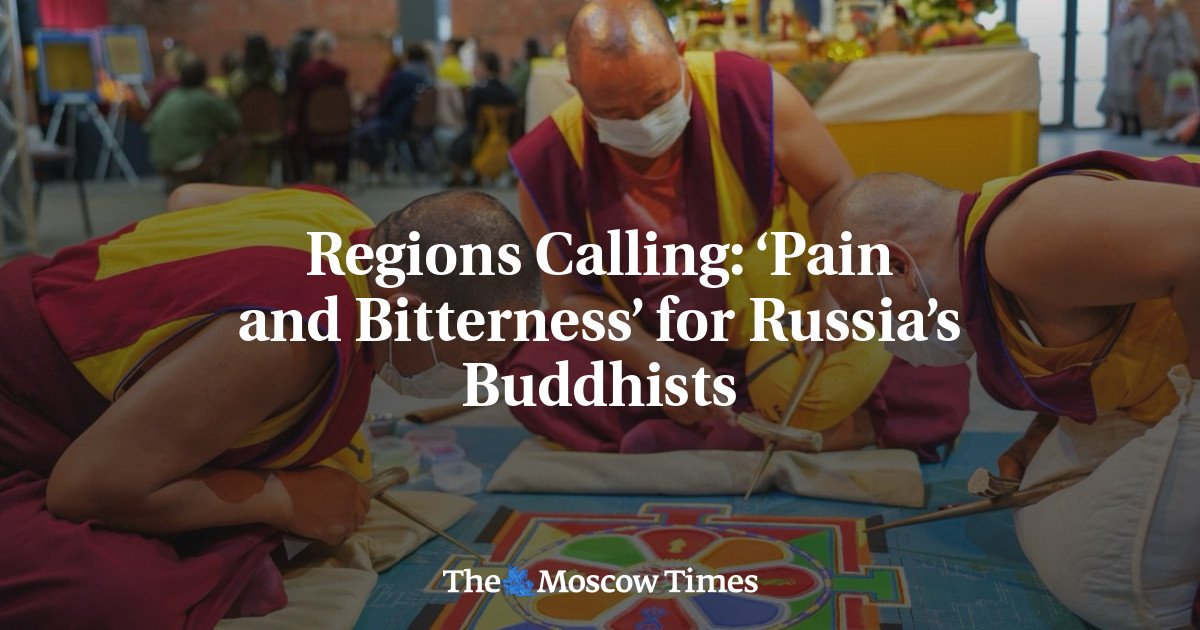
Moscow police on April 6 busted a Buddhist festival at the Rassvet cultural hub in the city center, detaining several participants and organizers, Russian media reported.
The Buddhist Festival of Good Fortune was meant to take place on April 4-15 in the Russian capital, but its organizer, the Nalanda Foundation, said Sunday that the event would not go on following the raid.
“We think it would be inappropriate to continue the festival in the absence of its main participants, the monks of the Gyudmed Tantric Monastery,” Nalanda said on VKontakte.
It said a group of Tibetan monks from India, who had been due to lead group worship and create mandalas, were deported on April 8 after being accused of conducting “unauthorized missionary work.”
While organizers said the monks entered Russia on religious visas and that their documents “were processed in compliance with all required procedures,” law enforcement said they were being deported because they had not obtained a special license to hold a religious event at a secular venue.
“Offending Buddhists, especially on such a flimsy pretext, is a measure of last resort. They [authorities] are ignorant people, and there’s nothing we can do to help them,” user Dina Kozhukhova wrote under Nalanda’s VKontakte post.
“I really hope the monks weren’t completely disappointed and that they’ll come back sooner or later. We’re always looking forward to seeing them,” she added.
buddafest / Telegram
While dozens took to social media to decry the abrupt closure of a popular festival, the news has hit especially hard in the Buddhist-majority republic of Kalmykia in southern Russia.
Before Nalanda announced the monks’ deportation, several media outlets offered an alternative reason for the festival’s shutdown: the organizers’ decision to sell a book by Telo Tulku Rinpoche, the former Supreme Lama of Kalmykia who was forced to resign in 2023 after being labeled a “foreign agent.”
Around 1% of Russia’s population identifies as Buddhist, according to an October 2025 survey by the Levada Center, the country’s last major independent pollster.
Most of them live in the Siberian republics of Buryatia and Tyva, as well as in Kalmykia, where Buddhism is the traditional religion of local Indigenous communities.
Functioning under Moscow’s patronage, the Buryatia-based Buddhist Traditional Sangha of Russia positions itself as an umbrella organization for all Russian Buddhists.
In reality, the Buddhist communities in Tyva and Kalmykia have historically operated independently, with the latter’s self-rule being particularly problematic for the Kremlin.
Russian authorities have sought for centuries to limit ties between domestic Buddhist communities and foreign religious centers, particularly in Tibet and Mongolia.
Kalmykia’s Central Khurul has long resisted this policy, maintaining a degree of political and financial autonomy by relying on the monastic community and financial assistance from parishioners.
In the 1990s, when Buddhists across Russia were reviving their faith after decades of Soviet repressions, Kalmykia’s Buddhists gained a new leader in Telo Tulku Rinpoche, who also served as the Dalai Lama’s representative in Russia.
“We had no monks of our own after perestroika, so services in newly constructed temples were led by Tibetan monks from India,” said Dr. Maria Ochir-Goryaeva, an Oirat (Kalmyk) historian and human rights advocate.
Rinpoche, who was born in the U.S., “was received especially warmly” in Kalmykia, said Ochir-Goryaeva.
“After all, he is an ethnic Kalmyk, born to the descendants of migrants forced to leave their native steppes during the [Russian] Civil War,” she said.
In 2023, Rinpoche, who was recognized as a reincarnation of the Buddhist saint Tilopa by the Dalai Lama, became the first high-ranking religious leader in Russia to condemn the invasion of Ukraine.
This decision led him to be labeled a “foreign agent,” cost him his position and forced him to leave Russia altogether.
For many Oirats (Kalmyks), the deportation of Tibetan monks and the treatment of their former spiritual leader offer reminders of a relatively recent and painful past.
“For Kalmyks, our religion means a great deal…Buddhism serves as the main pillar of everyone’s life and a manifestation of ethnic identity,” Ochir-Goryaeva told The Moscow Times.
With all historical Buddhist temples in Kalmykia razed to the ground by the Soviet government in the 1930s, the recently regained ability to “communicate and worship together with the lamas of famous monasteries is truly a celebration and a revelation for every Kalmyk,” she said.
“The dispersal of this holy service in the name of Good Fortune [in Moscow] cannot help but resonate with pain and bitterness in the hearts of every believer,” Ochir-Goryaeva added.
Photo of the Week
Chinese workers carry a Russian-language banner reading “Putin, help us” during a protest in the Far East Khabarovsk region.
At least 200 employees of the Russian-Chinese contractor Petro-Hehua marched through the city of Komsomolsk-on-Amur to demand unpaid wages on Sunday. Local officials later said they had “established contact” with the protesting workers and promised to “provide assistance.”
Culture & Entertainment
- The Moscow Times is hosting “Back to the USSR: When Russia Took a Wrong Turn,” an exhibition of photographs from our archive, from April 17 to June 10 in Amsterdam. Entrance is free. Location: Localie Hub, Rudi van Dantzigstraat 3, 1095 PK Amsterdam.
- The Women Against War exhibition by Feminist Anti-War Resistance will be on display at Madách Imre Square in Budapest until April 30.
- The Russian Anti-War Committee is opening PERM GALLERY, a new art space in Brussels curated by art gallerist and former Kremlin adviser-turned-critic Marat Gelman. The inaugural event is scheduled for April 28. More information is available here.
A Message from The Moscow Times:
Dear readers,
We are facing unprecedented challenges. Russia’s Prosecutor General’s Office has designated The Moscow Times as an “undesirable” organization, criminalizing our work and putting our staff at risk of prosecution. This follows our earlier unjust labeling as a “foreign agent.”
These actions are direct attempts to silence independent journalism in Russia. The authorities claim our work “discredits the decisions of the Russian leadership.” We see things differently: we strive to provide accurate, unbiased reporting on Russia.
We, the journalists of The Moscow Times, refuse to be silenced. But to continue our work, we need your help.
Your support, no matter how small, makes a world of difference. If you can, please support us monthly starting from just $2. It’s quick to set up, and every contribution makes a significant impact.
By supporting The Moscow Times, you’re defending open, independent journalism in the face of repression. Thank you for standing with us.
Continue
Not ready to support today?
Remind me later.
×
Remind me next month
Thank you! Your reminder is set.
