


Hello and welcome to Regions Calling, your guide to developments from beyond the Russian capital by The Moscow Times.
This week, we are looking at how fuel shortages triggered by Ukrainian attacks on oil refineries and supply networks have begun to transform the lives of people across Russia’s regions — and what long-term impacts of the disruption are yet to be seen.
But first, the latest news:
The Headlines
- A major landfill fire in the Far East republic of Sakha (Yakutia) burned for a week, blanketing the regional capital Yakutsk in smog and hazardous air pollution.The blaze was likely caused by chronic overcapacity at the landfill, where waste volumes had long exceeded safe limits, according to local environmental expert Yekaterina Sivtseva.
- In the North Caucasus republic of Kabardino-Balkaria, local activists asked the region’s head Kazbek Kokov and parliament members to oppose constitutional amendments pushed for by local Prosecutor Nikolai Khabarov. Earlier this month, Khabarov called for removing five clauses from the republic’s constitution, including guarantees of its territorial integrity and statehood.
The republic’s parliament is due to consider the changes later this year. If adopted, Russia’s federal government in Moscow will be legally allowed to redraw the borders of the republic or merge it with any of the neighboring regions, local activists warn.
- A military court in Moscow on Tuesday ordered the pre-trial arrest of Wisam Ali Bardwil, the former head mufti of the republic of Karelia and chairman of the Union of Islamic Organizations of Russia. Bardwil was initially arrested in Moscow’s Sheremetyevo Airport in May. Authorities then claimed that he refused a police request to show his ID before attempting to flee the scene.
Before being sent to pre-trial detention this week, Bardwil was repeatedly subjected to “carousel arrests” — a repressive tactic in which authorities impose consecutive administrative arrests instead of launching full criminal proceedings.
Though charges against Bardwil have not been publicized, the case is believed to be linked to the escalating standoff between Russia’s two leading Islamic authorities.
- In the Sverdlovsk region in the Ural Mountains, the small town of Kushva was hit by a rare tornado on Tuesday, leveling dozens of homes and damaging nearly 100 others. Videos shared on social media captured the funnel cloud moving through a populated area, while subsequent images revealed a landscape of uprooted trees, crushed vehicles and destroyed houses.
- Animal rights activists in Siberia’s Irkutsk region staged a protest to urge the local governor against signing a bill that would allow for stray animals to be euthanized during states of emergency, instead calling for more humane population control measures like sterilization.
The bill, which was passed by the Irkutsk regional assembly earlier this month, would allow authorities to declare a state of emergency in response to dog attacks. Any animals captured during this period would be euthanized after 11 days if their owners don’t come forward to claim them. Similar measures in other regions have also sparked protests in recent years.
As Fuel Rationing Spreads, Some Russians Fear the Worst Is Still to Come
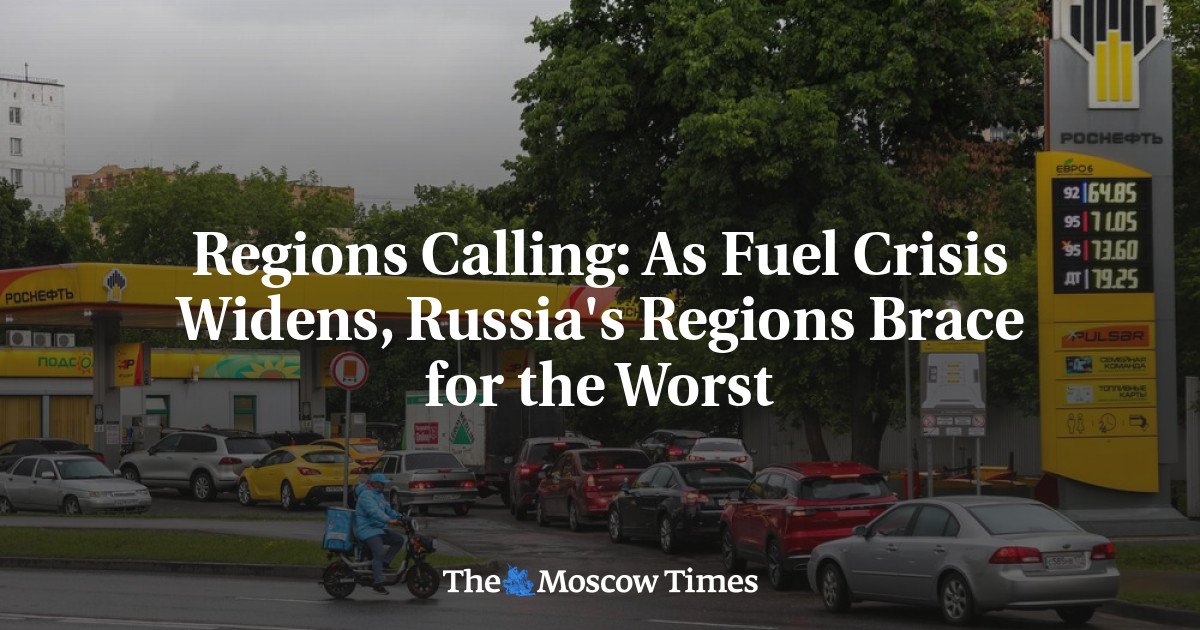
A fast-growing number of regional officials and gas station chains across Russia are restricting gasoline and diesel sales as Ukrainian drone attacks on oil refineries and supply networks take a mounting toll on supplies.
Fuel rationing measures were in place in at least 56 Russian regions as of Thursday, according to open-source data analyzed by The Moscow Times.
In dozens more regions, residents are complaining about fast-rising gasoline prices, closed filling stations and miles-long lines, while some local authorities and major retailers remain hesitant to enact rationing.
“In some districts of our republic, there is no fuel at gas stations right now, so people go to [the capital] Kyzyl to refuel,” said a resident of Tyva, a southern Siberian republic roughly the size of Tunisia.
Gasoline prices in Tyva have risen by 9.2% between June 16 and June 22, reaching an average of 90.63 rubles ($1.21) per liter, the highest price in any of Russia’s regions, according to the latest weekly data from state statistics agency Rosstat.
As of Thursday, Tyvan authorities and gas station chains have not introduced any purchase limits. The region’s head Vladislav Khovalyg has not yet commented on the situation.
Because there are no operating railways in Tyva, a vast region bordering Mongolia, all consumer goods and petroleum products have to be delivered by truck or plane.
For ordinary residents of one of Russia’s poorest regions, rising gasoline prices mean that the cost of all basic goods — the majority of which are shipped in from elsewhere — will also keep increasing.
“Our peak prices have already risen above all imaginable peaks. For four years now, we’ve been stocking up on everything, just in case. And it seems like it was all for today,” the resident of Tyva told The Moscow Times, speaking on condition of anonymity for safety reasons.
“The coming fall will probably be very hard,” he added. “And I won’t even mention winter, I’m afraid that famine will soon come.”
While some Tyvans said they seek out cheaper fuel, food and basic goods in the neighboring republic of Khakassia, one resident of the region told The Moscow Times that their life, too, has been transformed by rising prices.
“I had to sell my car because of the rising gas prices,” said the Khakassia resident, who requested anonymity. “Of course, prices have increased for everything. We no longer buy processed meats, fruits or fish, which have become luxuries. We…buy everything at discount stores — that’s the only way [to survive].”
Thousands of kilometers west in the Kursk region, residents of Ukraine-bordering districts said the gasoline rationing has made it impossible to use portable generators during frequent power outages caused by air raids.
Evacuating from these border districts during drone attacks has also become extremely challenging after local authorities capped gasoline sales at 20 liters (5.3 gallons) per car earlier this month.
Nor have Russia’s wealthier regions been spared by the fuel crisis.
“I, as a Russian citizen, think this is complete bulls**t,” a resident of Raduzhnyi, an oil-producing town in the Khanty-Mansi autonomous district, told independent news outlet Govorit NeMoskva. “We’re up to our ears in oil, the wells are being shut down because there’s nowhere to put the oil, yet there’s no gasoline.”
Authorities in Khanty-Mansi, one of the largest oil-producing areas in the world, announced restrictions on fuel sales at “a number of gas stations” across the region on Tuesday.
Gasoline prices in the region stand at an average of 74.74 rubles ($1) per liter — 4.94% higher than the national average, according to Rosstat’s latest report.
The Sakhalin region, a major oil- and gas-producing hub that relies on maritime fuel shipments from mainland Russia, introduced “preventive” fuel rationing in the northern part of the Kuril Islands on Thursday.
“There has been an unreasonable rush among residents to purchase fuel at gas stations — fuel was being purchased in clearly excessive quantities,” the Severo-Kurilsky district administration said on Telegram.
“These restrictions are not related to an actual fuel shortage…The next fuel delivery is expected next week,” it added.
In the republic of Tatarstan, home to Russia’s fifth-largest oil producer Tatneft, authorities introduced fuel rationing measures following the June 12 Ukrainian attack on Tatneft’s flagship Taneco refinery in the industrial city of Nizhnekamsk.
The attack, which forced Tatneft to limit gasoline and diesel purchases at its gas stations nationwide, sparked panic-buying at filling stations across the republic, according to reports by independent news outlets and social media users.
“My sister calls me: ‘Alsu, go get gas quickly.’ I scrambled [to get out of the house] and haven’t even changed…I work in real estate, friends. I need gasoline like air,” one woman from Tatarstan recalled in a video posted on social media.
Despite the reports emerging daily from across Russia, the scope of the ongoing fuel shortages is still smaller than that of the fall 2025 crisis and the situation remains “not that bad — if you discount serious shortages in the annexed Crimea,” wrote Sergey Vakulenko of the Carnegie Russia Eurasia Center.
“The amount of gasoline available in Russia at the moment is determined by a race between Ukrainian drones and Russian repair teams. If the frequency of Ukrainian attacks can be maintained, and the damage from each attack increases, then the advantage swings toward Kyiv,” said Vakulenko.
Meanwhile, Deputy Prime Minister Alexander Novak said Tuesday that the government is now weighing a full ban on diesel exports alongside existing restrictions on gasoline and jet fuel exports to stabilize the domestic market.
Though Novak appeared to downplay the growing number of fuel rationing measures across the country in his comments, some regional officials are expressing far less optimism about how the current crisis will develop.
Tatarstan’s Agriculture Minister Marat Zyabbarov advised local farmers to maintain a 10-day to two-week supply of fuel at all times “to avoid stress” during the harvesting season.
“Everyone can see the situation in the country clearly on television…Of course, we got comfortable working with Tatneft and TAIF [refineries] — farms get fuel immediately [and] don’t keep large stockpiles, but they always need to have some 1782403876,” said Zyabbarov.
The Sakha, a Turkic ethnic group indigenous to Russia’s republic of the same name, perform the ohuokhai circle dance during celebrations of yhyаkh, the traditional summer solstice festival, in the region’s northernmost Bulunsky ulus (district).
