



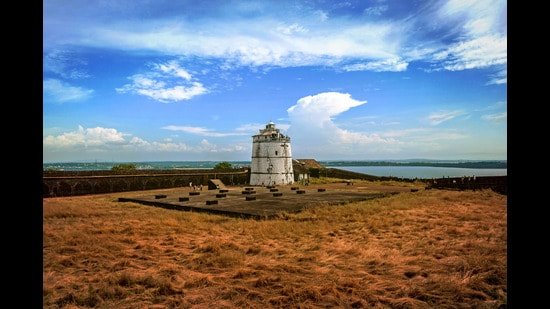
While Goa ceased to be a Portuguese colony on 19 December 1961 – now observed as Goa Liberation Day — it became the 25th state of the Indian republic on 30 May 1987. The state has its fair share of chroniclers across literary forms who have focussed on, in the late Goan historian Valmiki Faleiro’s words, this “pimple on the face of the Indian empire”.


Non-Goans are familiar with The Brave New World of Goan Writing & Art edited by Selma Carvalho, the oeuvre of Konkani writer and Jnanpith Awardee Damodar Mauzo, and Reflected in Water: Writings on Goa edited by Jerry Pinto. Here are a few more titles that present insights into the place and appeal to readers.
At Home in Two Worlds: Essays on Goa by Maria Aurora Couto
An exceptional literary critic, Aurora Couto’s reflective pieces in At Home in Two Worlds represent the multiple identities that Goans celebrate. In his introduction, Ranjit Hoskote notes that Couto’s prose “attests to the author’s lifelong ability to play two roles: objective outsider and passionate insider”. Published posthumously, this collection completes the trilogy that, in the words of the author’s son, Vivek Couto, “began with the publication of Goa: A Daughter’s Story in 2004 and was followed by Filomena’s Journey: A portrait of a marriage, a family & a culture in 2013”. In his foreword, he notes that his “parents often felt they were silent witnesses to, and even complicit in, the decline of Goa.” This submission captures the essence of this collection of 12 essays. It’s neither charitable to those who preserved whatever can be called Goan authentically, nor does it blame ‘others’ completely for the deterioration.
Each piece illuminates a unique aspect of Goa. An Ideal Duality cements facts about Goa’s colonial history and presents the evolution of its contemporary image. Virgin Territory focuses on what attracted important literary figures like Umberto Eco and Orhan Pamuk to the place. The exceptional Gaunkari meticulously outlines the role of caste in land possession: “land belonged to the community as a whole [in Goa], and although people belonged to different clans (‘vangodd’), they were equal among themselves.”
In When Space Becomes Place she writes: “The tragedy of Goa is that its distinctive history has now become its liability: it is seen to embody pre-industrial values where fun and frolic are the raison d’être of happy-go-lucky people.” She goes on to say that “The politics of identity and today’s definitions of a nation create insecurity and a sense of being an outsider in one’s home.” While this is about the Goan context, the reader realises it’s wider applicability in a nation experiencing breakneck growth.
A vein of grief runs through the book with the author reminiscing not only about her past but also mourning her husband who predeceased her. Couto lived in their ancestral family home in Aldona village until her death, aged 84, on 14 January 2022.
Becoming Goan: A Contemporary Coming-Home Story by Michelle Mendonça Bambawale
On the surface, there are several similarities between Aurora Couto’s posthumous collection and Mendonça Bambawale’s first book. While both authors travelled across the world, they were nourished by the rich past and their connection with Goa. The 15 literary pieces that constitute Becoming Goan are heartfelt. The first one titled Who Am I? A Real Goan or a Pandemic Migrant? is especially arresting. Every concern facing a Goan or even the “Goa enthusiast” is tackled in this volume that briefly takes on the history of Goa, current debates shaping its perceptions, the stereotyping of Goa and Goans, and the depth of feeling infused in the Portuguese words susegad and saudade. Oral history is explored in Finding Siolim; Stories and Legends, which is amazingly illustrated. Towards the end, Mendonca Bambawale states that “storytelling is based on strong emotions, romantic memories, sweeping generalisations and shameless eavesdropping”. The reader can’t help but agree.
Goagr@m: Misadventures of an Influencer by Bina Nayak
Bollywood often influences our choices. Several movies set in Goa have helped in making it a popular travel destination. Chapora Fort has probably witnessed innumerable final-year college students posing like the male leads in Dil Chahta Hai (2001). But what made Nayak witness the disturbing site of a flock of tourists in the “coconut-tree-lined road in my village Parra, in North Goa” and hang a boon on that peg? Remember, a similar road featured in the Shahrukh Khan and Alia Bhatt-starer Dear Zindagi (2016). But instead of being frustrated about people armed with selfie-sticks and an appetite for everything ‘authentic’ in Goa, the author decided to explore the psyche of such tourists in Goagr@m. From its first chapter titled Dear Zindagi Road, the novel follows the life of the protagonist, a Youtube influencer named Madhu Chopra aka Maddie, who has to live and survive in Goa during the COVID-19 pandemic. Juxtaposing conventional wisdom with lateral thinking, Goagr@m, surprisingly, turns out to be more than just an interesting summer read.
The late, great Nobel Laureate VS Naipaul once called Goans a people “without a literature”. Clearly, he hadn’t read widely enough.
Saurabh Sharma is a Delhi-based writer and freelance journalist. They can be found on Instagram/X: @writerly_life.


