


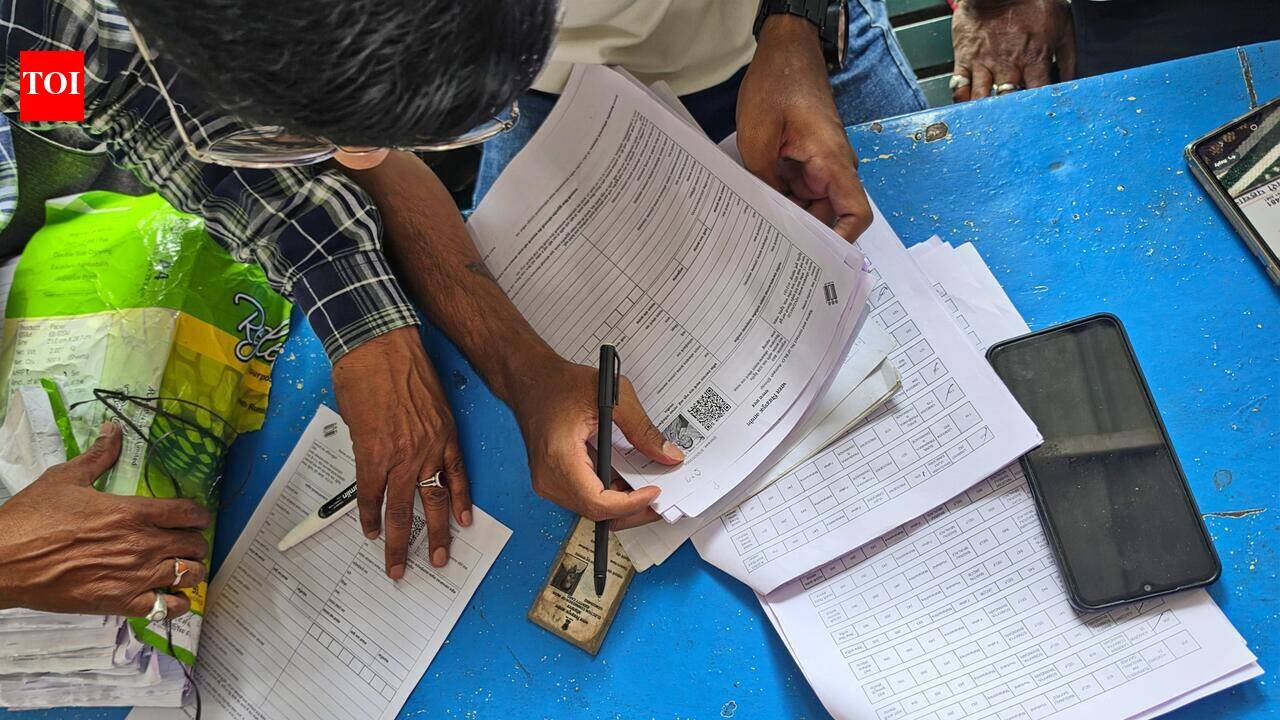
Pune: A staggering 2.07 crore electors in the uncollected category, which includes voters marked absent, shifted, dead, duplicate and others in the state, have set off a string of questions.Could diligent house visits by BLOs have kept this number low? Was there enough awareness about the SIR drive? Could the online process have been a better experience or better leveraged? Were the BLAs used effectively in the voter drive?Of the 2.07 crore voters, 1,5 crore are in the absent-shifted category and 50 lakh in the dead-duplicate and others group. Across 36 districts, there are 9.8 crore electors and 1,00,253 BLOs. Pune district, with 90,80,173 lakh voters, has 8,417 BLOs, one for every polling station, and the average workload was between 1,200 and 1,400 voters per BLO.Political parties and activists now want to know whether the exercise reached every voter’s doorstep as promised by the election authorities. They claimed that in several urban pockets, BLOs either did not visit households or told voters to report to camps to submit their forms.“The biggest question is how many doors did BLOs actually knock on?” Maharashtra Pradesh Congress Committee general secretary Sandesh Kondvilkar, who has been monitoring the SIR exercise, said.Kondvilkar said inadequate public awareness compounded the problem. “For the Census, there were full-page advertisements in newspapers. We did not see anything similar for SIR. We have been demanding an extensive awareness campaign since May,” he added.He said BLOs were expected to make repeated attempts to contact voters before they were placed in the ASDDO category. “The Election Commission of India should provide proof that BLOs visited households three times. In many places, particularly in urban areas, BLOs did not go door-to-door,” he said.Kondvilkar said BLAs of political parties could only assist the election machinery and could not substitute BLOs. “The process was complicated and put a heavy burden of proof on the voter. Maintaining a clean and updated electoral roll is ECI’s primary responsibility through its BLOs. BLAs can only assist. ECI must own up to its responsibility and ensure that names wrongly left out are restored,” he added.A voter who filled his family’s enumeration forms online said they have two deceased members but since no BLO visited them they could not provide the update and the documents.In Pune, political leaders flagged gaps in coordination between BLOs and BLAs. Nilesh Nikam, leader of the opposition in Pune Municipal Corporation, said BLAs were roped in, but coordination remained weak in several areas.“BLAs did help BLOs, but even then, coordination was not very effective in many areas. This could have been improved. More groundwork and people-to-people contact by the authorities could have SIR more effective,” he said.A BLO, who did not wish to be named, said he had 1,700 electors to trace. “These numbers are too high, and the voters are widely spread across different housing societies. How does one reach out to so many people? The part numbers should have been properly organised so that electors from the same society or building are assigned to one polling station. This should be done after the SIR to make the process easier. In some cases, members of the same family have been assigned to different BLOs which should not have happened,” he said.He said grouping voters society-wise would make verification easier, allowing BLOs to reach out to several electors at one location. “Moreover, most EPIC numbers did not have phone numbers linked to them, making it difficult to contact electors,” he added.Shatrughna Kate, BJP city unit chief in Pimpri Chinchwad Municipal Corporation, agreed that the scale of the exercise made it difficult for BLOs to reach every voter. “It was tough for BLOs to reach out to all the voters in their jurisdictions for several reasons, including their apathy. Many preferred to organise camps rather than visit houses,” he said.Kate said closer coordination with political workers could have helped streamline voter outreach. “It would have given more manpower for the commission to reach out to the voters,” he added.Narendra Bansode, Congress city unit chief in PCMC, alleged that house-to-house visits were not carried out promptly. “Some BLOs avoided home visits,” he said, adding that shortcomings in outreach directly affected voter registration during the SIR.Party representatives said several voters whose forms remained uncollected were marked as permanently shifted or untraceable despite no BLO visit to their homes. They also questioned the limited time available to parties to verify the lists.“Political parties were given only four days to check the names. That is not adequate for such a large exercise,” representatives said.Activists said they received complaints from several districts about BLOs holding camps instead of visiting households. “There should be proof that they visited each and every voter and acknowledgements should be taken from them,” a Mumbai-based activist said.A voter said, “I had no idea about the SIR process as there was no BLO visit. I travelled to another state last month and returned only today. Obviously, I could not complete the process. Now, I will apply through Form 6.”Election officials, however, refuted claims that efforts for house-to-house verification were limited. They said BLOs faced practical hurdles, including unavailable or incorrect addresses, poor cooperation from housing societies and lack of awareness among citizens about the SIR.Deputy election officer Minal Kalaskar said, “Though camps were organised, the BLOs also made it a point to cross-check the data and voter details on the ground. Some BLOs visited the given addresses three times, but could not get the registration done for several reasons.”Political Parties Plan Next MovePolitical parties have sought hard copies of the ASDDO list and the list of voters likely to receive notices over anomalies or lack of mapping. They have also sought assembly constituency-wise data on voters marked dead, duplicate, permanently shifted, absent and untraceable.With the field exercise over, parties said their immediate focus would be on scrutinising the draft electoral roll and category-wise exclusion data. They said mechanisms must be put in place to ensure that genuine voters missed during the door-to-door exercise are not left out of the final roll.
