


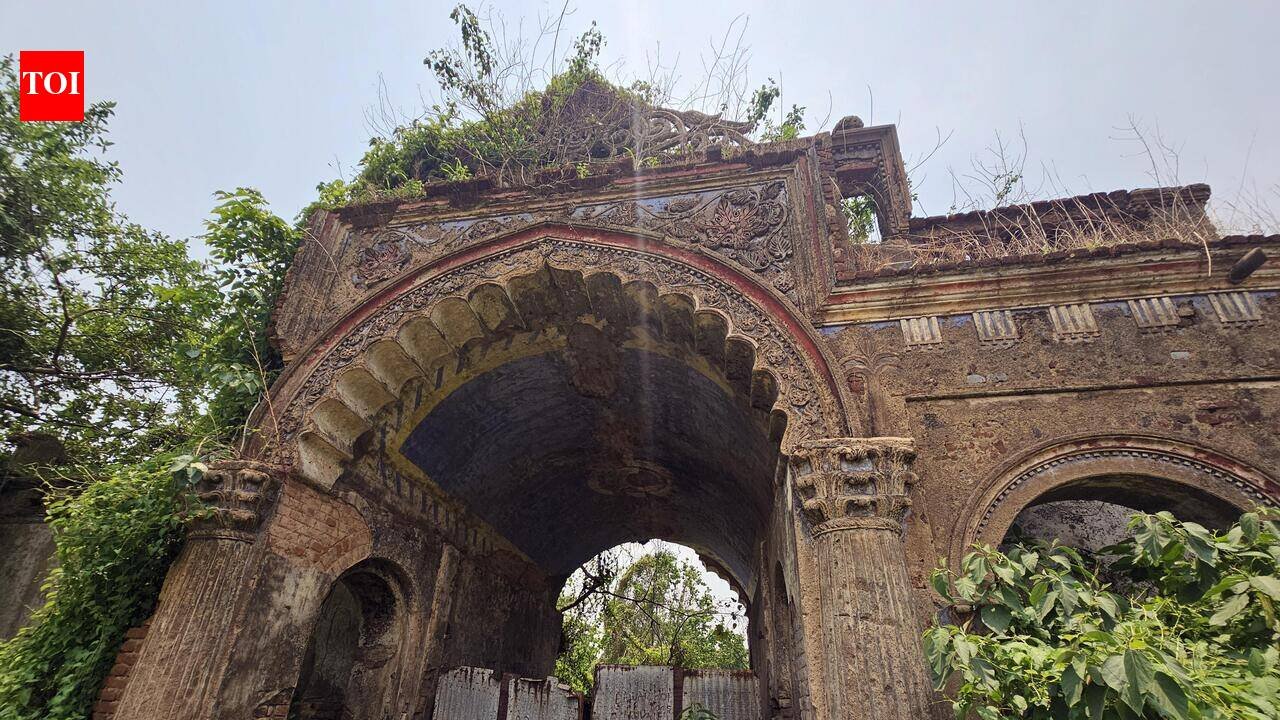
Tucked away amid emerald hills and lush green fields, far away from the hustle and bustle of city life stands the royal palace of Gadamadhupur, also known as Rajbati of Gadamadhupur.Set amid scenic rural environs, a mere 15-minute drive off NH-16 from Dharmasala in Jajpur district, this magnificent slice of history portrays the story of the palace’s rich past and royal migration.Though it resembles a palace, the 600-year-old heritage monument was not a luxury palace but one of the four historic military forts or ‘quillas’ in Odisha, the others being Aul, Kanika and Dalijoda.Sprawling across over 13 acres, this sprawling edifice is a hidden gem that has not been widely discovered.
Gopal Jew temple inside the palace
Legend transports one to the history of Quilla Madhupur in 1400 AD, when Raja Shekhatwaj Singh of the Amer dynasty came to Odisha from Jaipur in Rajasthan for a darshan of Lord Jagannath. After hearing about the beautiful landscape of Odisha, Raja Udaya Karan Singh, his son, came to Odisha and permanently settled after receiving an estate from then Puri king Gajapati Pratap Chandra Deo.Narayan Singh, the eldest son of Udaya Karan Singh, was born in Odisha and was later known as Niladri Singh by then Puri Gajapati, who considered him the first king of the Madhupur dynasty.Generations passed and by 1530, king Gopinath Singh built Champabhadra Palace atop Gadamadhupur hill. After it was ravaged by fire, his successor, Raja Sudarshan Chandra constructed the current structure known as Quilla Madhupur and the Jagannath temple, which is a miniature model of the Puri Jagannath temple.Subsequently, his son Raja Ramachandra Dhir Narendra constructed the Gopal Jew temple, and four more palaces inside the Quilla for four queens, and Chandra Mahal (king bedroom). Then in 1913, Sheesh Mahal (glass palace) was built for British guests and officers. After 18 generations, the current custodian of the ‘quilla’, Rani Aparna Dhir Bharadwaj, has been waging a solitary and exhausting battle to keep the heritage alive.“Our ancestors hail from the Amer dynasty in Jaipur, came to Madhupur, lending a unique blend of both cultures which we still follow. For example, the food and dressing habits, the language and lifestyle, all have been influenced by both Odisha and Rajasthan,” said Rani Aparna Dhir Bharadwaj.Describing it as quite a challenge to maintain a balance and carry it forward through generations, the queen said, “The legacy and the idea of inheritance of my culture run very deep in our family roots. As the family scion, it is my responsibility to ensure proper adherence to all royal family rituals and customs. No doubt it is difficult to strike a balance but traditions need to be carried forward from generation to generation.”The fort is an architectural marvel with a unique blend of Rajput grandeur and traditional craftsmanship of Odisha. Divided into four parts, the fort has a residential portion, a four-storey block including Hawa Mahal, Chandra Mahal, Surya Mahal, and Gajadanta Mahal and private chambers of kings and queens. The administration block housed an armoury, a traditional weapon practice area, a traditional mandap and Jay-Bijay dwara (entrance).Behind the administrative block is Rani Uaasa, the highly secured queen’s palace. The residential quarters for extended members of the royal family is Saanta Sahi. Of nearly 100 original rooms, only 48 are in livable condition. The rest of the building including courtyards are facing several structural deteriorations.Moreover, there is a sudanga — an underground secret tunnel—near Rani Uaasa (queen’s palace) for the royal family’s emergency exit, which was opened on the other side of the hill. There were barracks for army personnel, everything was protected safely by a 30-foot high boundary wall known as Quilla ka Diwaar or Meghanaad Pacheri.The palace had four gates — the main entrance was a beautiful Duhudi gate, another was christened Gopal Jew gate, the third was Gundicha Mandir gate and the fourth was Saanta Sahi Gate, which was at the back side of the palace. Duhudi gate, which was guarded with gunmen from a circular tower structure, is now completely damaged and needs renovation.“We managed to renovate the civil portion of the dilapidated administrative building and reconstruct the museum matching the original architectural design but it was done with immense difficulty,” said Rani Bharadwaj.The pillars of the mandap have been stolen and everything have been damaged. The Rani Uaasa behind it is still completely dilapidated and desperately needs repair,” she said.The palace complex is spread across 13-plus acres and houses a number of magnificent monuments, including Jagannath temple, Gopal Jew temple and Gundicha temple and can be developed as a perfect hub for ‘temple tourism’.“I am really interested in preserving ancient temples. There are three stepwells on the campus that must be preserved and promoted so visitors can experience the beautiful architecture. Repairing historic temples is a Herculean task. We do not know the intricacies of ancient temple architecture. We need technical assistance from the state archaeology department, Archaeological Survey of India and conservation experts. I have written to every level of govt but in vain,” she said.Though the state govt has a provision to give capital investment subsidies to convert pre-1950 heritage properties into homestays, cafes, museums, it is hardly executable. “The current policy offers subsidies only on bank loans. To get a loan, I have to invest a massive base deposit first. I have already spent over a crore of rupees of personal funds on renovation. Even a loan of Rs 1 crore is a drop in the ocean for a fort of this size. More importantly, what is the govt’s plan for tourist footfall to help us recover that loan?” she said.Bharadwaj said the place has huge potential to be developed and promoted as a thriving tourism hub for those who love exploring stories of kings and queens and nature lovers, trekkers and bird watchers. Recently, celebrity singer Arijit Singh visited the palace while taking a detour from his road trip and was so fascinated by the beauty of the place.“There are ruins of the old palace on top of the hill which has steps till the top and offers an amazing viewpoint that needs to be developed. There is very high potential for tourism in this place. If the 1,500-acre lake right in front of the palace, destroyed by locals over the years, could be restored, it would be a birds’ paradise during winter. All this can be developed with the help and support of the govt,” she maintained.The huge locked iron gate in front of the Quilla Madhupur, its weak protective boundary wall and its defensive gunner towers are examples of the govt’s indifference towards preservation and conservation of history and heritage.
