



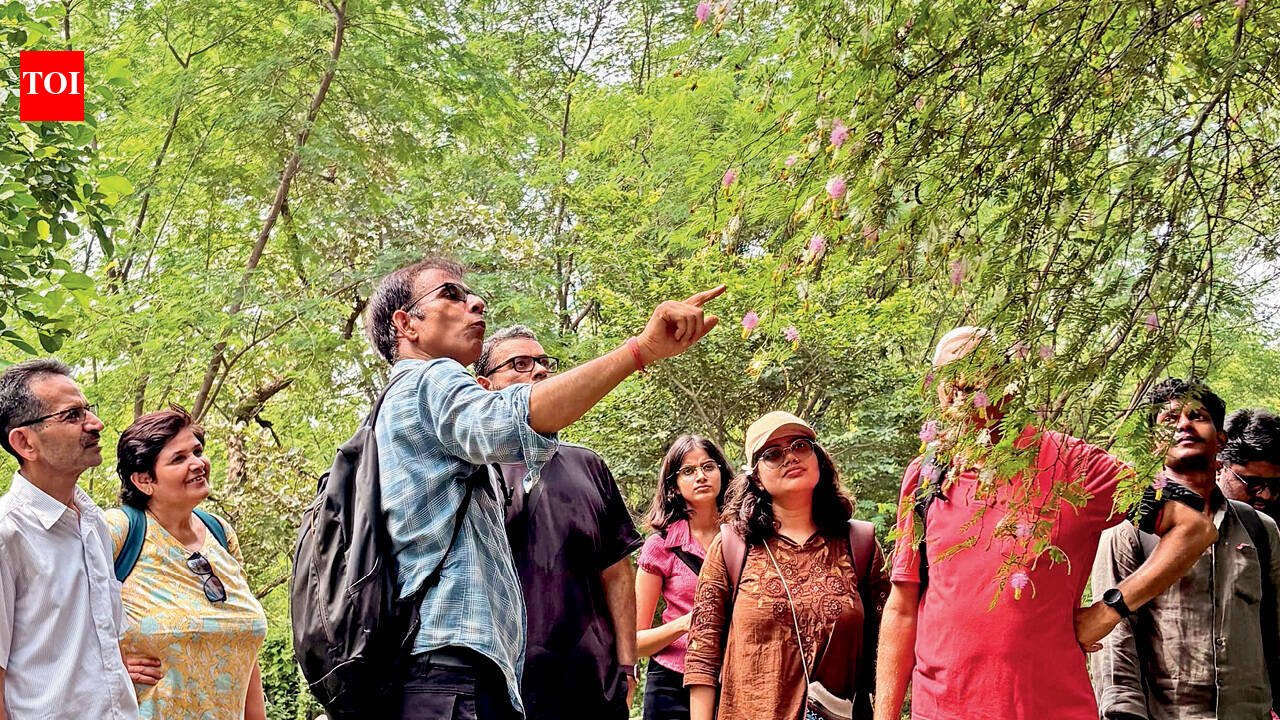
In the season of Malhar, Delhi reveals a side of itself that summer keeps hidden. While summer keeps people indoors, the rains draw them out – monuments washed clean, gardens in hues of green, forest trails dotted with fungi, and streets where seasonal treats like ghevar make for the perfect pit stop. So, grab a colourful umbrella or carry a raincoat and step out. The rains offer a fleeting chance to see Delhi at its greenest and brightest.‘Monsoon makes heritage walks a sensory experience’“Rain changes the rhythm of a city. Stone monuments deepen in colour, the fragrance of wet earth returns, birds become more active, and stories that often go unnoticed in summer suddenly come alive,” says Sachn Bansal, founder and chief revivalist, Delhi Walks, adding, “Monsoon transforms a heritage walk from a sightseeing activity into a sensory experience.
Instead of simply visiting monuments, the season encourages people to slow down and absorb the surroundings (Pic: @iamdpc)
Ramit Mitra, founder of DelhiByFoot, leads the Monsoon Masarrat walks to connect Delhi’s heritage with nature. The series explores historic wells, geography, and architecture alongside monsoon romance featured in charbaghs, poetry, and seasonal ragas. “Nature affects our cultural experience during this greenest time of the year,” he says, adding, “We’re looking at the charbagh as a connecting thread to monsoons, romance, heartache for the beloved, ragas and poetry associated with the season. It’s about understanding how nature shapes our cultural experience during the greenest time of the year.”Inspired by the rains, Enroute Indian History founder Anoushka Jain launched new itineraries around Hauz-e-Shamsi, Jahaz Mahal, and open gardens, shifting focus away from crowded Old Delhi. “The monuments become cleaner, and nature is in full bloom,” she says‘The rains reveal overlooked details’For photography enthusiasts, monsoon brings some of the year’s best light. Virendra Shekhawat of Delhi Photography Club says the group regularly hosts photo walks at Sunder Nursery, Purana Qila, Lodhi Garden, Qutub Minar and Mehrauli Archaeological Park during the season.
‘The light is amazing during the monsoons’ (Pic: @iamdpc)
“The light is amazing during the monsoons. We see more greenery, less pollution and monuments look cleaner after repeated showers. The rains reveal details we often overlook,” he says.
As rains revive NCR’s green spaces, weekend birdwatchers gather to spot active species like the Indian pitta, paradise flycatcher, golden oriole, bitterns, pied cuckoos, and rain quail across various habitats (Pic: Chhaya Bali)
Beyond standard nature walks, the monsoon encourages a closer look at post-rain mushrooms. Malavika Bhatia, host of Fungi Forays across Delhi’s gardens and forests, uses these walks to shift perceptions of fungi.“Many of us grow up believing mushrooms are dangerous or dirty. But fungi recycle nutrients, build soil and make new life possible,” she says. As participants observe closely, fear turns into curiosity and appreciation. These walks offer a welcoming space for queer participants to connect with nature and discover misunderstood, essential organisms. “More than anything, fungi offer us a way of thinking beyond rigid categories. Their incredible diversity – in form, life cycle, reproduction, behaviour, and periods of dormancy – reveals just how expansive life can be,” says Malavika.
Beyond standard nature walks, the monsoon encourages a closer look at post-rain mushrooms (Pic: @mycodyke)
Follow the ghevar trailNo saawan is complete without ghevar. Food enthusiasts Abhishek Bhasin and Rohan Monga from Namastey Culture recommend beginning a ghevar trail in Old Delhi. “Scout the best ghewars in Purani Dilli at Chaina Ram, Shyam Sweets, Kishan Lal Halwai and Ghantewala. In Central Delhi, Kaleva at Gole Market, Nathu’s at Bengali Market and Madan Lal Halwai remain popular stops. Evergreen in Green Park is a favourite in South Delhi, while Hira Sweets and Shagun Sweets serve East Delhi. In West Delhi, Dilli Sweets and Grover Sweets are worth a visit, and Pitampura’s Bansal Sweets and Gulab Wala round off the city’s monsoon dessert trail. Whether you like your ghevar plain, topped with rabri or loaded with nuts and saffron, the fun lies in discovering your own favourite.”


