



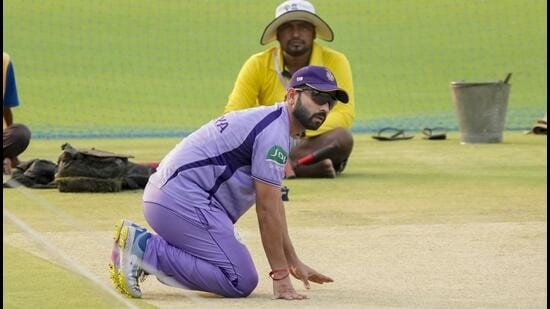
Kolkata: Towards the end of another uneasy night, when the press conference room of Eden Gardens smelled faintly of sweat and impatience, Ajinkya Rahane smiled in the way unassuming leaders do when they know the joke is partly on them. Kolkata Knight Riders had just slipped again, their campaign threatening to dissolve before even the norwesters had had their say in this part of the world.
A reporter, perhaps trying to lighten the mood, congratulated Rahane for “working hard” despite the losses. The room murmured awkwardly. Rahane paused, looked up, and delivered the line that instantly ricocheted through the room. “Thank you,” he said. “Someone has finally appreciated me for my hard work.”
It was funny because it was dry. It was devastating because it was true. Rahane has always existed in Indian cricket as a kind of contradiction: technically elegant in an age of randomness, emotionally restrained in a sport that increasingly rewards performance theatre.
In T20 cricket— the loudest, most impatient version of the game—he has long seemed almost an aberration, a man carrying Test-match eyes into a carnival. And yet here he is, at 37, quietly becoming the emotional center of KKR’s season that was perceived to be lost before even the halfway mark. Not through domination or charisma, but through old school endurance.
Which is rare because in an age where captains expand to fill a room, Rahane does the opposite. At press conferences this season, he has often looked like a man listening to the weather. Calm, composed, calculative, direct. His face rarely changes shape dramatically, but his eyes do. They narrow at lazy questions, soften when speaking of younger players, flicker briefly when discussing criticism.
“Every season brings its own expectations and challenges,” he said before the tournament began. “For me, the key has always been to stay positive… I’m taking everything in my stride.” It sounded, at the time, like the standard preseason captaincy filler. But KKR’s season quickly turned into something more complicated than a cricket campaign. It became an examination of temperament.
Because too early in the season, KKR had begun to look like a side constantly bordering on emotional collapse. Their batting lacked structure, the bowling plans drifted. Every defeat reopened familiar questions about the franchise’s identity after years of rebuilding without fully settling on what exactly they wanted to be. And hovering above all of it was the persistent suspicion that Rahane himself represented cricket’s past rather than its future. The critique is well known by now—too classical, too measured, too careful, not destructive enough. A batter and a captain apparently designed for another decade.
The odd thing is that Rahane has responded to all this not by reinventing himself, but by becoming even more recognisably himself while being at the heart of the chaos. Again and again this season, KKR lost matches and Rahane walked into the press room first. Not evading questions, not blaming schedules or workloads, no vague references to intent. After a defeat to Sunrisers Hyderabad early in the season, he did not blame dew, tosses or luck. “We needed a couple of big partnerships,” he said plainly. After criticism over tactical decisions, he fronted the cameras again. After the bowlers lost form, he defended them. “His attitude is right,” Rahane said of Varun Chakravarthy during a rough stretch.
In a world where franchise cricket prefers to speak in metrics, Rahane still talks like a domestic captain from another era, one who believes confidence is a resource that must be guarded carefully. This makes him distinctly different from the alpha captains the IPL has produced over the years, men who project certainty loudly enough that uncertainty disappears around them. MS Dhoni perfected it. Virat Kohli turned it into a public art form. Hardik Pandya tries to weaponise it. Not Rahane though.
Which is perhaps why this KKR campaign, bookending the early lows and the subsequent recovery, has begun to feel oddly compelling. Possibly because Rahane’s career has always been built around recovery.
Once celebrated as the future of Indian batting, Rahane had quietly receded before being unexpectedly recalled and then rediscovered whenever Indian cricket required his calm in collapsing conditions. Rahane became a cult figure after captaining India to that extraordinary Test series victory in Australia in 2020-21, only to drift toward the margins again soon after. Every time the game seems to move on from him, Rahane somehow persists, but only on his terms.
That persistence now sits at the centre of KKR’s season. This turnaround under Rahane hasn’t resembled a revolution but more like stabilisation. Field placements have sharpened. Young bowlers appear calmer. Batters speak about clarity rather than freedom. The side no longer seems emotionally combustible.
In high-pressure tournaments, this matters. Franchises often chase captains who manufacture intensity. Rahane does something rarer—he reduces panic. An aberration, but also a useful reminder that such aberrations can still influence tournaments.


