



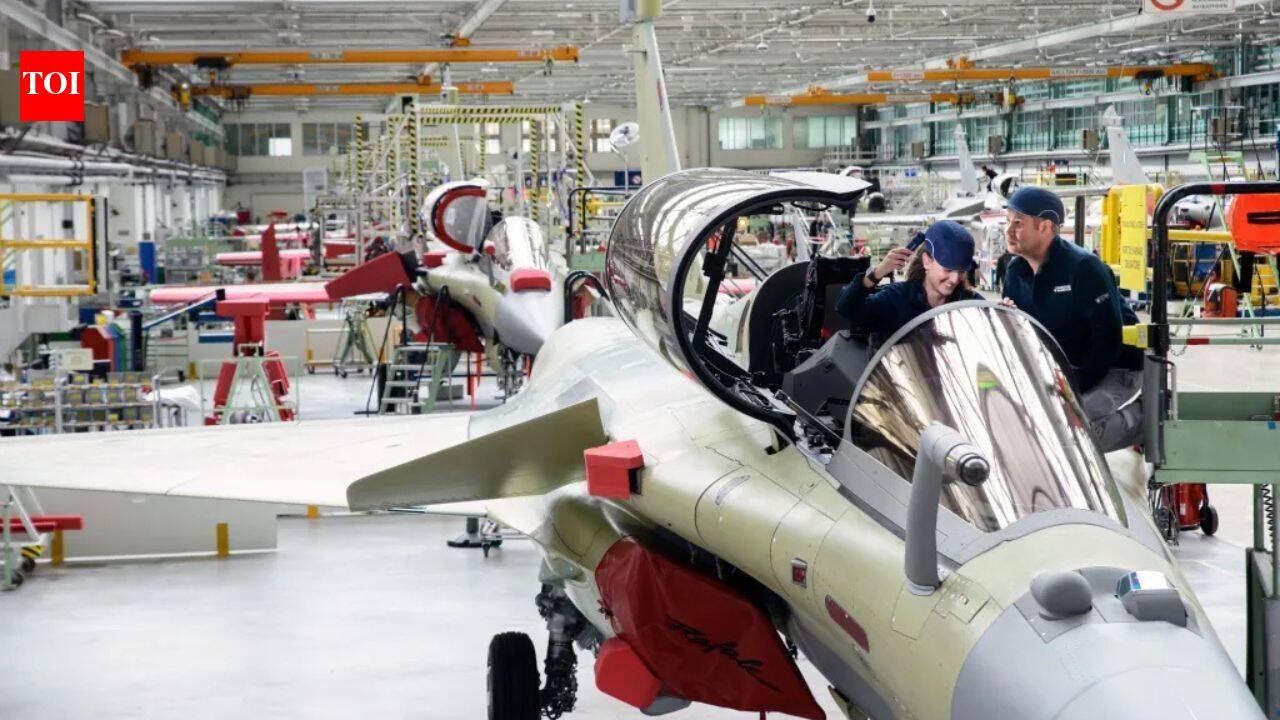
France has accelerated preparations for the Rafale F5, the next major upgrade of its Rafale fighter, with the country’s defence procurement agency awarding contracts for key technologies ahead of the programme’s formal development phase.According to France’s Directorate General of Armament (DGA), preparatory contracts have been awarded to Dassault Aviation, Thales, Safran and MBDA. The Rafale F5 development phase is expected to begin by the end of 2026.The upgrade is set to bring major improvements to the fighter’s radar, electronic warfare, propulsion, connectivity and weapons capabilities.Rafale F5 upgradesThe Rafale F5 is being developed as a major mid-life upgrade designed to improve the fighter’s ability to operate against increasingly sophisticated threats.One of the key changes will be the introduction of the Thales RBE2-XG radar. According to The War Zone, citing the French DGA, the radar is expected to use gallium-nitride (GaN) technology, providing greater power and detection range while improving the identification of targets with extremely low radar cross-sections.The radar will also have greater computing capacity for artificial intelligence applications and is being designed to support collaborative combat, allowing sensors to work together with reduced pilot intervention.The Rafale’s SPECTRA electronic warfare suite will also undergo a major redesign. The War Zone reports that the F5 version, being developed by MBDA and Thales, will adopt a fully digital architecture to improve threat detection and jamming capabilities.The DGA says the upgrade is intended to counter the increasing density of threats and the growing complexity of hostile radar waveforms expected by 2035.The fighter will also receive a new Inter-Vehicle Data Link (IVDL) developed by Thales. France’s DGA describes the system as a high-speed, discreet and jamming-resistant communications link.For propulsion, Safran is developing the M88 T-Rex engine. According to The War Zone, the engine is planned to increase maximum thrust from around 75 kN to nearly 90 kN, an increase of roughly 20%.The additional thrust is intended to support the Rafale F5’s more demanding sensors, electronic systems and weapons.On the weapons front, the F5 is being developed around the ASN4G, France’s future air-launched nuclear missile. The War Zone reports that the missile is expected to reach speeds above Mach 5 and have a range of more than 1,000 km, with entry into service planned around 2035.The F5 is also expected to receive a successor to the Meteor beyond-visual-range air-to-air missile.Why F5 matters for IndiaThe accelerated Rafale F5 programme comes at a significant time for India, which is preparing to substantially expand its Rafale fleet.India is planning to acquire 114 Rafale fighters under the Multi-Role Fighter Aircraft (MRFA) programme. According to reports, Dassault Aviation submitted its proposal in August 2026, with 18 aircraft to be delivered from France and the remaining 96 to be manufactured in India.The F5 upgrade could be particularly relevant to India as its new Rafales are expected to be delivered initially in the F4 standard, with a potential upgrade path to F5.If the MRFA deal goes ahead, India could eventually operate a much larger Rafale fleet while gaining access to the F5’s upgraded radar, electronic warfare systems, connectivity and propulsion, alongside future weapons being developed for the aircraft.
