



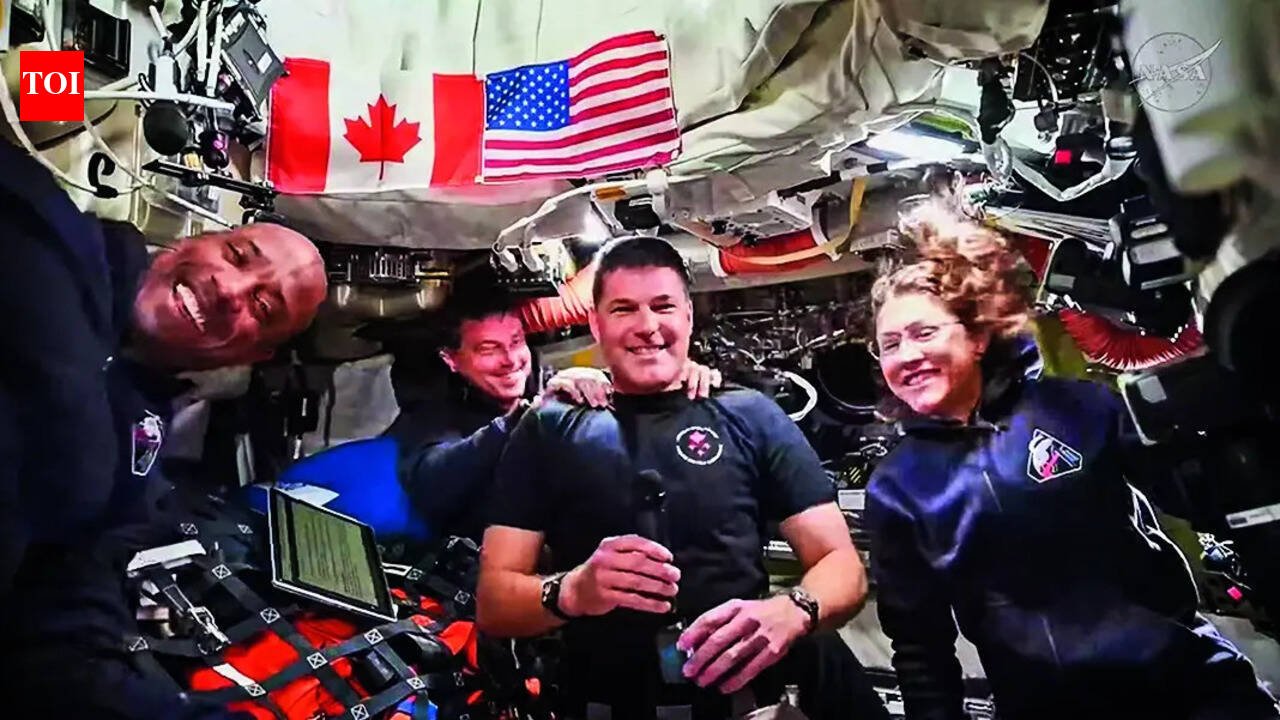
Artemis II astronauts are set to break the record for travelling the farthest distance from Earth to the Moon on a crewed mission, surpassing what Apollo 13 achieved by more than 4,100 miles (6,600 kilometers).During their journey, the four-member crew will spend about six hours flying around the Moon on Monday, capturing clear views of its far side—areas that were too dark or difficult to see for the 24 Apollo astronauts who flew similar missions more than 50 years ago, the last one being Apollo 17 in December 1972.Artemis II was launched on April 1, marking humanity’s first crewed trip to the Moon since then.
What will happen during the flyby
The Artemis II crew—American astronauts Reid Wiseman, Victor Glover, Christina Koch, and Canadian Jeremy Hansen—will work in pairs, taking turns photographing the Moon through the spacecraft’s windows. At their closest approach, they will come within 4,070 miles (6,550 kilometers) of the lunar surface.On the other hand, Apollo 13’s Jim Lovell, Fred Haise, and Jack Swigert reached a maximum 248,655 miles (400,171 kilometers) from Earth before making their life-saving U-turn on Apollo. During the flyby, the Artemis II astronauts will witness a total solar eclipse that won’t be visible from Earth, only from their Orion capsule. This will give them several minutes of views of the Sun’s outer atmosphere, the corona. They will monitor for unusual solar activity and use their “unique vantage point” to study and describe the features of the solar crown.The crew has packed eclipse glasses to protect their eyes, and, like the Apollo missions before them, will be out of contact with Mission Control for nearly an hour when Orion passes behind the Moon. NASA’s Deep Space Network, which uses giant antennas in California, Spain, and Australia, will lose direct communication with the spacecraft for about 40 minutes while it is out of sight.
What’s next after lunar flyby
After completing the lunar flyby, Artemis II will begin its four-day journey back to Earth. The Orion capsule is scheduled to splash down in the Pacific Ocean near San Diego on April 10, nine days after launching from Kennedy Space Center in Florida.During the return flight, the crew will connect via radio with astronauts aboard the orbiting International Space Station (ISS). This marks the first time a Moon mission crew has had colleagues in space simultaneously. The conversation will include Christina Koch aboard Orion and Jessica Meir on the ISS, both of whom participated in the first all-female spacewalk in 2019.
Apollo 13 mission
Apollo 13 missed its planned Moon landing in 1970 after one of its oxygen tanks ruptured during the journey.With the lives of commander Jim Lovell, Fred Haise, and Jack Swigert at risk, Mission Control quickly shifted the spacecraft onto a free-return lunar trajectory to bring them home as safely and efficiently as possible. This path uses the combined gravity of the Earth and the Moon, requiring minimal fuel to return the crew to Earth.(With AP inputs)


