


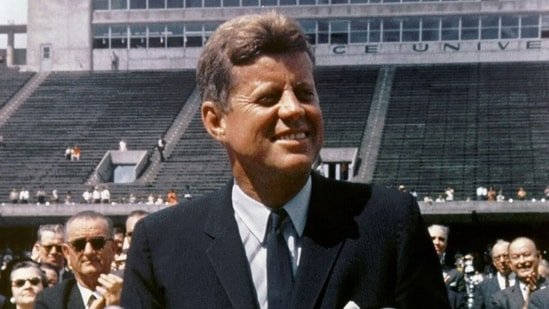
May 29 marks the birth anniversary of John F Kennedy (JFK), the 35th President of the United States. While the world he inhabited — defined by black-and-white television — seems distant, one specific warning he delivered to the United Nations in 1961 feels as though it was written for this morning’s headlines. Also read | Quote of the day by Abraham Lincoln: ‘Give me six hours to chop down a tree, and I will spend the first four…’
What did John F Kennedy say?
On September 25, 1961, he stood before the UN General Assembly and delivered a speech that has since become a cornerstone of global diplomacy. He said, “War appeals no longer as a rational alternative. Unconditional war can no longer lead to unconditional victory. It can no longer serve to settle disputes. It can no longer concern the great powers alone. For a nuclear disaster, spread by wind and water and fear, could well engulf the great and the small, the rich and the poor, the committed and the uncommitted alike. Mankind must put an end to war — or war will put an end to mankind.”
John F Kennedy wasn’t just being poetic; he was being mathematical. He argued that the invention of nuclear weapons changed the rationality of conflict. In his view unconditional war could no longer lead to unconditional victory, and nuclear disaster would not respect borders, wealth, or political alliances. It would be ‘spread by wind and water and fear’.
Why JFK’s logic applies
It is easy to dismiss a 1961 quote as a relic of the past, but the logic JFK applied is more relevant in 2026 than it was during the Cold War as more nations possess nuclear capabilities today than in 1961, increasing the statistical risk of ‘accidental’ war.
Moreover, modern warfare is no longer ‘contained’. A digital or automated strike can cripple global infrastructure, proving JFK’s point that war ‘can no longer concern the great powers alone’. Our economies and environments are so intertwined that a major conflict in one region creates a butterfly effect of starvation and inflation globally.
His message was a plea for diplomacy over destruction. JFK believed that because man created these problems, man could solve them. As we look back on his life today, the choice he presented remains the only one that matters: we either evolve beyond our instinct for conflict, or we allow that instinct to be our final act.
JFK was a part of the Kennedy family, often called ‘America’s Royal Family’, a massive, high-achieving Irish-Catholic dynasty that dominated US politics for decades. In 1953, JFK married Jacqueline ‘Jackie’ Bouvier, who would become one of the most iconic ‘first ladies’ in US history. JFK was assassinated on November 22, 1963, in Dallas, Texas, US — he was shot while riding in an open-top presidential motorcade.
