



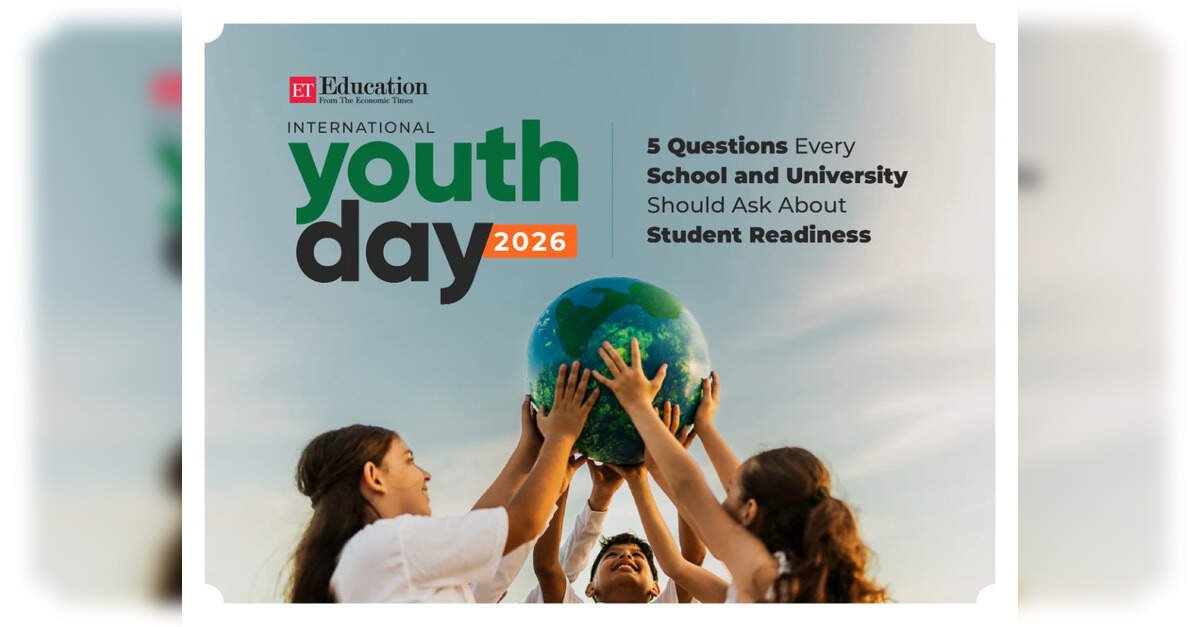
Every August 12 since 2000, the world pauses to ask a question it too often answers on autopilot: are young people actually being set up to thrive? International Youth Day was established by the United Nations following a recommendation from the 1998 World Conference of Ministers Responsible for Youth in Lisbon, and it exists precisely to force that pause to convert youth from a statistic into a subject.
This year’s UN theme, “Different Contexts, Common Aspirations,” is a quietly radical one. It insists that a first-generation learner in any least developed country and a student walking into a well-resourced university in India are, structurally, living very different lives and yet are reaching for the same things: dignity, meaningful work, an education that means something, and a fair shot at shaping their own future. The theme’s three pillars – global solidarity, shared challenges, and youth innovation are a reminder that readiness is not a single template to be rolled out uniformly. It has to be built locally, contextually, even individually, while aiming at something universal.
That tension is exactly what we set out to explore this year. Not “are students prepared?” – a question that invites easy, self-congratulatory answers but something harder: how would we even know? We put 5 uncomfortable questions to a cross-section of India’s education leaders – university chancellors, school principals, a sitting Member of Parliament, an NGO thought leader and the head of an organisation that works with some of the country’s most vulnerable children. Read individually, their answers are personal convictions, shaped by very different vantage points. Read together, they sketch a system that is genuinely rethinking itself and one still catching up with the world it’s meant to prepare students for.
Question 1: Are we preparing students for jobs that don’t exist yet?
The old promise of education was simple: learn this, and it will serve you for a career. That promise no longer holds, and most of the leaders we spoke to know it. The real question isn’t what to teach, but how to build a mind that can keep re-teaching itself.
Praveen K Pula, Founder & Chancellor, Woxsen University, put it starkly: what students need most isn’t more knowledge – it’s the ability to unlearn. “A lot of time, what’s missing among new graduates is the ability to unlearn an outdated way of thinking fast, without letting it become a professional identity crisis,” he said. “The students who struggle are not the ones who don’t know enough. They are the ones who cannot really unlearn what they used to know.”It’s a reminder that the skill gap of the future may not be about knowledge at all – it may be about letting go of it fast enough.
Dr Anand Jacob Verghese, Chairman, Hindustan Group of Institutions, framed the same instinct as a philosophy rather than a fix: the aim, he said, is “to cultivate lifelong learners who can think critically, adapt to change, embrace new technologies, and continuously learn, unlearn, and relearn in an evolving world.” His shorthand for it was memorable – a generation that is simply “Change and Challenge ready.”
Prof A Balasubramaniam, Director, Institute of Design, JK Lakshmipat University, was candid about the uncertainty underneath all of this. “We are trying to extrapolate the situation to assess the level of preparedness our students need to face the future with confidence,” he said an admission that no one is fully certain what that future looks like, only that the habits of inquiry and discernment will matter regardless of what it turns out to be.
Three leaders, three institutions, one converging instinct: the curriculum of certainty is over. The curriculum of adaptability has begun.
Question 2: Is “readiness” being measured the right way?
If adaptability is the goal, the next question is uncomfortable: how would a transcript ever prove it? Grades measure recall and, at best, comprehension. They were never built to measure judgment under pressure and several leaders argued that continuing to treat them as the primary yardstick is where the system quietly fails students.
Dr G Pardha Saradhi Varma, Vice Chancellor, KL Deemed to be University, was direct about the limits of the old metrics: grades, exam scores and placement statistics, he said, “do not fully capture whether a student can apply knowledge, solve unfamiliar problems, communicate effectively, work in teams, and continuously learn.” For him, a truly ready graduate “is someone who can take what they have learned in the classroom and apply it confidently to real-world situations.”
Dr Raj Krishnan Shankar, Director, Great Lakes Institute of Management, Gurgaon, went further, questioning whether marks should even be the default lens. “Readiness cannot be measured by grades alone,” he said. “We assess whether students can analyse, communicate, defend their thinking, and adapt when challenged.” His working definition was blunt and useful: readiness means being able to “apply knowledge, make decisions and perform in ambiguous real-world situations.”
Neither leader is arguing for the exam to disappear. Both are arguing for company alongside it – for a fuller picture that a single number was never designed to hold on its own.
Question 3: Are students emotionally and mentally equipped and not just academically?
If there was one point of near-total unanimity in this conversation, it was this: the line between “academic readiness” and “emotional readiness” is fading, with more leaders seeing the two as naturally connected.
Dr Craig Cook, Founding Principal, Queen Elizabeth’s School, Gurugram, drawing on three decades of leading schools across continents, offered the most quotable formulation of this shift: “Emotional resilience is not a companion to academic readiness – it is the ground on which academic readiness stands. A student who has not learned to navigate failure or uncertainty may find it more challenging to realise their full potential, regardless of academic strength.”
Sumanta Kar, CEO, SOS Children’s Villages India, brought the same idea into sharper, more urgent focus – speaking not for elite campuses but for some of India’s most vulnerable young people. “A young person may have excellent academic or technical skills,” he said, “but without resilience, self-awareness and the ability to seek support when needed, navigating the pressures and uncertainties of adulthood and the workplace becomes much harder.” For the children his organisation works with, that gap isn’t theoretical. It’s the difference between a second chance and none at all.
4. Is there real alignment between classroom learning and industry expectations?
The leaders who addressed this question named the same gap, in different words: knowing something is not the same as knowing what to do with it.
Dr Ashok Kumar Mittal, Member of Parliament (Rajya Sabha) and Founder-Chancellor, LPU, framed this as an ongoing, honest question institutions owe themselves: “We are often teaching students what has traditionally been taught, rather than what the industry actually needs today. That has to change.” He put it simply: “Are we teaching students what they need today, or simply continuing to teach what we have always taught?”
Prof Ajay Kapoor, Vice Chancellor, Somaiya Vidyavihar University, located the gap even more precisely – not in what students know, but in what they can do with it under pressure. “The biggest gap is often not technical knowledge,” he said. “It is the ability to communicate, collaborate, make decisions and take ownership when circumstances are uncertain.”
Both point to the same evolving space from different angles – a curriculum working to keep pace with a workplace that keeps moving.
5. Are we listening to what students themselves say they need?
The final question was, in some ways, the most revealing because it asks institutions to admit they don’t already have all the answers, and that students may be the ones supplying them.
Dr Aditi Misra, Director, DPS Sector 45 Gurgaon, described listening as a foundational commitment rather than a formality: “Student voice is an integral part of our educational approach, and we actively engage with learners to understand their aspirations, experiences, and evolving needs.” What students want most, she said, is “greater opportunities for experiential and real-world learning, along with more choice in exploring their interests.”
Deblina Chakraborty, Principal, Shiv Nadar School, Faridabad, took that idea a step further, reframing the student’s role entirely. “Students often tell us that they want their learning to feel meaningful and connected to the world beyond school,” she said. “Education works best when young people are not just recipients of it but active participants in shaping their learning.”
Both point to the same quiet correction: readiness cannot be designed for students in their absence. It has to be designed with them.
The Common Thread
Eleven leaders, eleven very different vantage points. Not one of them reached for a percentile when asked what really matters. The words that recur instead are curiosity, resilience, adaptability, judgment, and the courage to act without a guaranteed right answer. That, perhaps, is the real answer to the UN’s 2026 theme, “Different Contexts, Common Aspirations.”
That is, in many ways, the quiet promise of this moment in Indian education: institutions and young people moving toward the same goal, together, from wherever they each stand. On International Youth Day 2026, the encouraging answer is that both sides already seem to know what readiness looks like. What remains is the shared, ongoing work of building toward it – a journey these leaders, and the young people they serve, are already walking side by side.


