


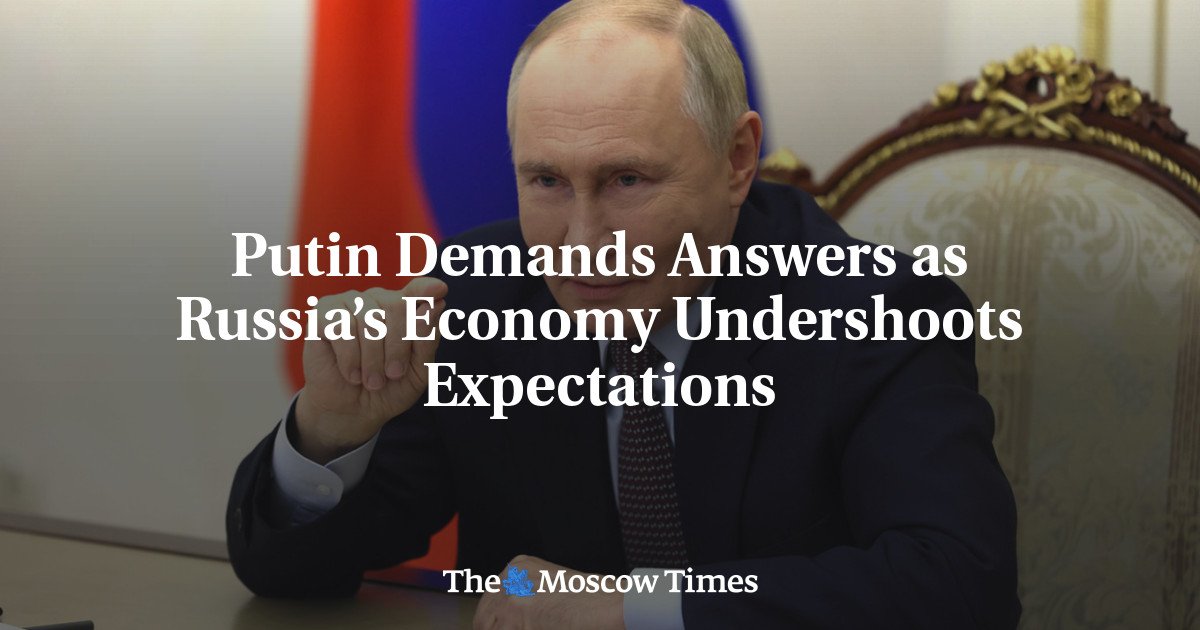
President Vladimir Putin on Wednesday demanded explanations from the government and Central Bank over why Russia’s economy is performing worse than expected this year, calling for urgent measures to revive growth in his second public complaint about economic weakness in a month.
According to the Economic Development Ministry, GDP in January and February was 1.8% lower than in the same period last year. The Russian Academy of Sciences’ Institute of Economic Forecasting (INP) estimated a 1.5% year-on-year contraction for the first quarter, while the Central Bank had previously forecast GDP growth of 1.6% over the same period.
The ministry attributed part of the decline to calendar effects, noting that January had two fewer working days and February one fewer than a year earlier. Adjusted for this, GDP was flat year-on-year in January and rose 0.3% in February.
Putin dismissed the explanation as insufficient.
“These are objective circumstances, of course, but it is clear they are far from the only factors determining business and investment activity in the country,” he said, pointing to declines in manufacturing, overall industrial output and construction.
Construction, a key sector, contracted sharply, falling 16% year-on-year in January and 14% in February, according to official statistics.
Russia’s economic slowdown, driven by falling investment, weak business activity and declining oil and gas revenues, is raising concerns about budget stability and the sustainability of growth as high interest rates and war-related distortions weigh on the outlook.
The Central Bank’s business climate indicator stood at 0.2 points in January before slipping to -0.1 in February, with zero marking the line between expansion and contraction.
Separate monitoring of financial flows showed a sharp and deepening drop in incoming payments across most sectors during the first quarter.
The slowdown is also straining public finances, as oil and gas revenues in the first quarter were down 45% compared with a year earlier, while non-oil revenues rose just 7% despite increases in VAT and excise duties. Government spending, meanwhile, jumped 17%.
As a result, the budget deficit reached 4.58 trillion rubles ($60.5 billion), already exceeding the full-year target.
Economists warn that weaker growth, falling demand and higher debt servicing costs will squeeze corporate profits and investment.
The Gaidar Institute has cautioned that tax revenues may fall short of government expectations this year.
The World Bank said declining oil and gas revenues are not being offset by other sources of income. It views a recent spike in oil prices linked to the war in Iran as temporary, offering only limited relief without altering the broader trend of slowing growth.
The Kremlin-linked macroeconomic research center CMAKP raised its forecast for Russia’s Urals crude export price to $81.6 per barrel this year, but said this would lift growth by no more than 0.5 percentage points, keeping overall expansion below 1.3%.
Prospects for a significant rebound remain limited. Interest rates are high and the Central Bank has signaled it will maintain tight monetary policy for an extended period. Investment fell by 2.3% last year and is expected by the Economy Ministry to decline further in 2026.
Companies’ own funds, the main source of investment, are under pressure as profits fall. Analysts at the INP have flagged declining corporate earnings, budget constraints and weakening consumer demand as key risks to the outlook.
Much of the remaining growth is concentrated in the defense sector, which economists say is diverting resources away from civilian industries.
Output in defense-related manufacturing has risen while production of consumer goods has slowed or declined, according to Gazprombank’s economic research unit.
Civilian industrial sectors accelerated their downturn at the start of the year, CMAKP said.
Most forecasts now point to modest growth of around 1% this year. Promsvyazbank has cut its GDP growth forecast to 1% from 1.5%, while the Central Bank’s consensus forecast remains at 1%.
The World Bank recently lowered its projection to 0.8%, while the International Monetary Fund raised its estimate slightly to 1.1%.
Analysts say an end to the war in Ukraine would provide the biggest boost to the economy, but would not resolve deeper structural problems.
“It would not bring back all those who left, restore business trust in the state, rebuild degraded institutions or shift the economy from military-driven rents to productive growth,” said Andrei Yakovlev, a research associate at Harvard University’s Davis Center, and Vasily Burov, head of consultancy Estonto Lab.
Read this article in Russian at The Moscow Times’ Russian service.
