



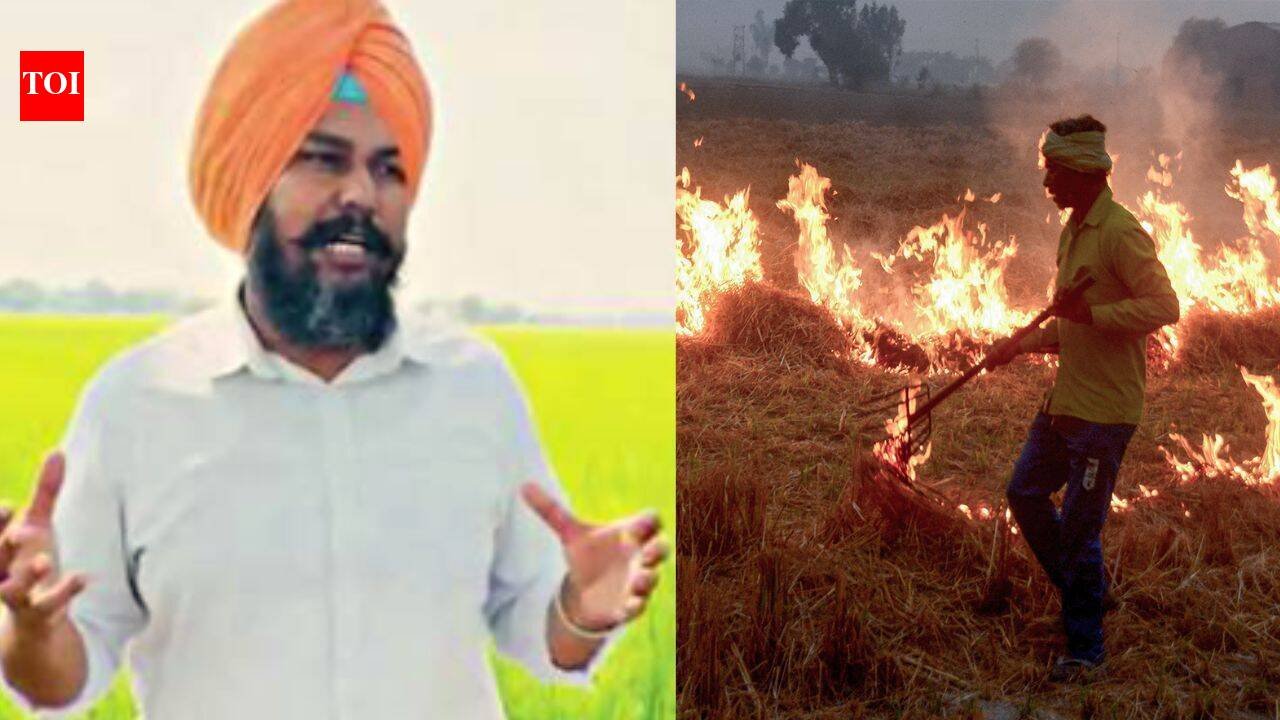
CHANDIGARH: It is still early in the stubble-burning season, but Punjab is showing signs of a significant shift in a practice that has long been blamed for worsening Delhi-NCR’s winter air.Farm fires in the state have dropped sharply over the past five years — from more than 83,000 in 2020 to around 5,100 in 2025. Early indications this season suggest the decline could continue, with only around two dozen stubble-burning cases recorded so far, compared with more than 80 during the corresponding period last year.For years, the arrival of autumn in Delhi-NCR has coincided with a rise in farm fires across Punjab and Haryana, with smoke from burning paddy residue contributing to the region’s pre-winter haze.
Farmers begin to turn away from burning
While government support for crop-residue management machinery has played a role, farmers themselves say attitudes towards stubble burning are changing.In Ransih Kalan village, around 35km from Moga, farmers have pledged not to burn paddy residue.“We are not only keeping our word but also persuading nearby villages to follow suit,” said village sarpanch Preetinder Pal Singh.Ground-level observations also indicate that the reduction in farm fires is not merely a result of farmers shifting burning to night-time hours to avoid satellite detection. Smoke that once routinely covered roads, highways and villages across Punjab during September and October has reduced noticeably in recent years.
Stubble finds a market
Punjab agriculture department director Gurjit Singh Brar said the fall in farm fires was the result of several factors, including a growing market for crop residue.“Farmers can make money from selling the residue to pellet and briquette units,” he said. Such units convert agricultural residue into biomass that can be used as industrial fuel.The state has also stepped up support for crop-residue management. Agriculture minister Gurmeet Singh Khudian said farmers have procured 16,227 crop-residue management machines for the current season.The government has also released a subsidy of around ₹183 crore for the purchase of 10,000 CRM machines.
But machinery alone may not solve the problem
Despite the progress, farmers’ organisations say access to machinery remains a major challenge.Only around 1% of Punjab’s farmers have access to equipment through custom hiring centres, while fewer than 20% have access to cooperatives, according to the concerns raised by farmers.For many farmers, burning remains the quickest and cheapest way to clear fields before the rabi sowing season.“Many farmers have no option but to burn stubble as they have no resources to manage it. Even if machinery is provided, they have to arrange for tractors and pay for diesel,” said Hajinder Singh, a farmer from Baggi village in Bathinda.Farmers such as Gora Singh from Bhainibagha in Mansa said adoption of newer methods to manage crop residue was increasing, but they want financial compensation to make the practice sustainable.
The crop cycle leaves little time
Punjab’s cropping pattern is one of the structural reasons behind the recurring stubble problem.Many farmers grow three crops a year. After harvesting wheat, they grow maize, which matures in around 70 days and is largely used as an alternative to green fodder. Paddy is then transplanted in mid-July and harvested in late October, leaving farmers with a narrow window to prepare their fields for wheat.The cycle leaves little time for farmers to manage paddy residue without delaying the next crop.
Long-duration paddy adds to residue
Some farmers have shifted to shorter-duration paddy varieties after the government mandated that transplantation begin only from June 15. However, many continue to grow longer-duration varieties, particularly Pusa 44, because of their higher yields.These varieties also generate more stubble.Efforts to diversify Punjab’s cropping pattern and reduce dependence on the wheat-paddy cycle have so far made limited progress.Cotton, once a major alternative crop, has also seen its acreage shrink sharply due to pest attacks, including whitefly and pink bollworm. Cotton cultivation, which covered more than 3 lakh hectares around a decade ago, has fallen to less than 1 lakh hectares.
Paddy covers 80% of cultivable area
This year, paddy is being cultivated on around 32 lakh hectares in Punjab, accounting for nearly 80% of the state’s total cultivable area.The crop is estimated to generate around 19 million tonnes of straw.That means the underlying challenge remains large even as the number of farm fires declines.As long as the paddy-heavy cropping cycle continues, the state will have to find ways to manage millions of tonnes of residue every year.
Govt pushes industry partnership
Chief Minister Bhagwant Mann has called for greater collaboration between the government, industry and other stakeholders to develop sustainable crop-residue management solutions.During a recent meeting with a Confederation of Indian Industry delegation, Mann said farmers needed “practical, affordable and effective solutions” to manage crop residue.The state government has also prepared an action plan to increase awareness among farmers against stubble burning. Around 151 blocks across Punjab’s 23 districts have been identified under the plan.For now, the sharp decline in farm fires offers some relief ahead of the winter pollution season. But with paddy continuing to dominate Punjab’s farmland and millions of tonnes of straw generated every year, the long-term challenge remains finding an affordable way for farmers to manage the residue without burning it.
