



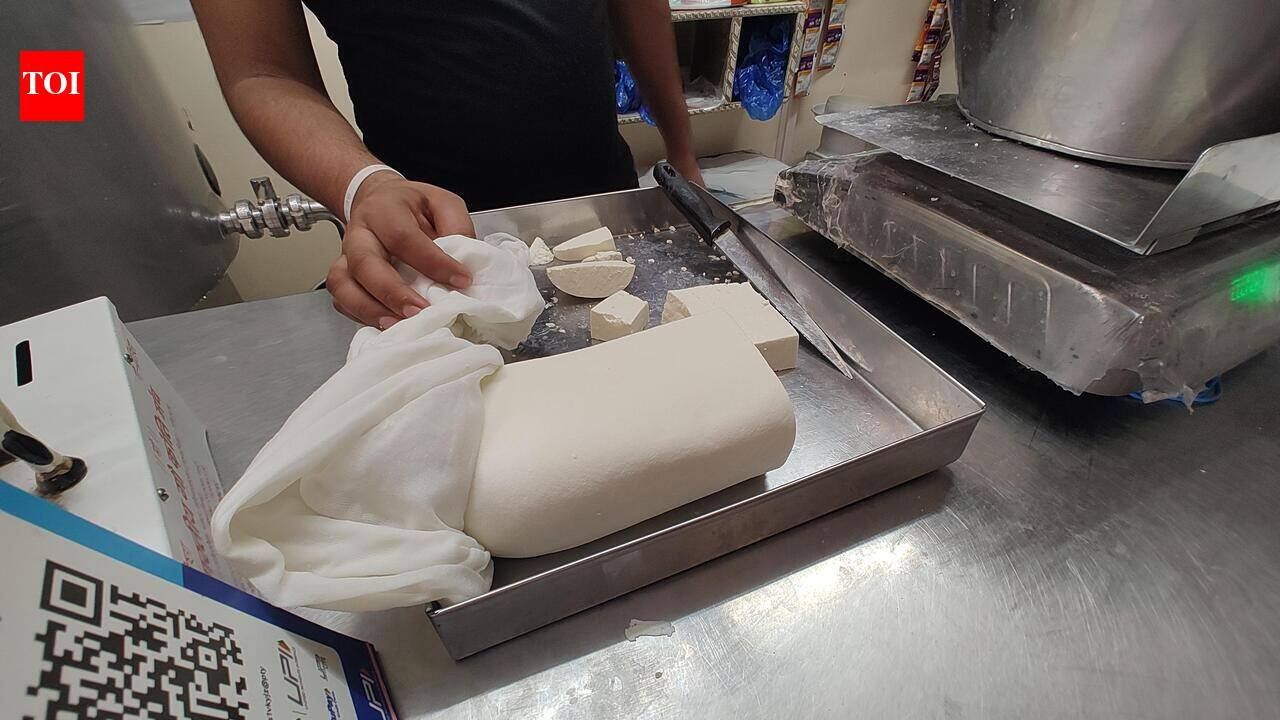
Chandigarh: The Punjab govt has imposed a one-year ban on the manufacture, processing, preparation, packing, storage, transportation, distribution and sale of analogue (non-dairy) paneer across the state. The order issued by Kanwal Preet Brar, Commissioner, Food and Drugs Administration, Punjab, comes into immediate effect and will remain in force for one year from the date of its issuance, unless earlier rescinded, modified or extended in accordance with law.The order, issued under Section 30(2)(a), read with Sections 18 and 29 of the Food Safety and Standards Act, 2006, said products described as “Analogue Paneer”, “Non-Dairy Paneer”, “Vegan Paneer”, “Synthetic Paneer” and “Plant-based Paneer”, among other similar descriptions, were being manufactured, stored, transported, distributed and sold while being represented, displayed or marketed as “Paneer”. As per the order, “analogue/non-dairy paneer” is defined as: “any product resembling paneer in which milk fat or milk solids are replaced wholly or partly by vegetable oil, vegetable fat or other non-milk-derived constituents.”Between April 1, 2025, and March 31, 2026, samples of paneer/dairy analogue drawn from across Punjab were sent for analysis to a notified Food Laboratory. Of these, 512 samples stood analysed as on date, and 215 samples (42%) of the analysed samples were reported to be non-conforming. These comprised 156 substandard and 59 unsafe samples.Despite sustained enforcement, surveillance and sampling over a period of one year, along with awareness and labelling measures, the incidence of non-conforming paneer and substitution of genuine paneer by vegetable-fat analogue had shown no appreciable improvement, with non-conforming samples remaining at 42% of those analysed.The order stated that a significant proportion of the analysed samples showed a Butyro-refractometer (BR) reading outside the limits prescribed for milk fat, indicating the addition or substitution of vegetable (foreign) fat not naturally present in milk, rendering the article of food unsafe and misbranded under the provisions of the Act.The order stated: “Paneer is a standardised food under Regulation 2.1.16 of the Food Safety and Standards (Food Products Standards and Food Additives) Regulations, 2011, defined as the product obtained from milk (of any variant), with or without added milk solids, by precipitation with permitted acidulants (lactic acid, citric acid, malic acid, vinegar, glucono delta lactone or sour whey) and heating; milk fat is an essential constituent of paneer, and the substitution or addition of vegetable oil, vegetable fat or any non-milk fat is not permitted.”It further stated that a product resembling paneer in which milk fat or milk solids were replaced wholly or partly by non-milk constituents was, in law, an “analogue in dairy context” and “is not paneer and cannot be named, sold or served as ‘Paneer’”.The order also requires every Food Business Operator manufacturing, packing, storing, distributing or selling paneer/chhana to ensure that every package carries the declarations prescribed under the Food Safety and Standards (Labelling and Display) Regulations, 2020.


