


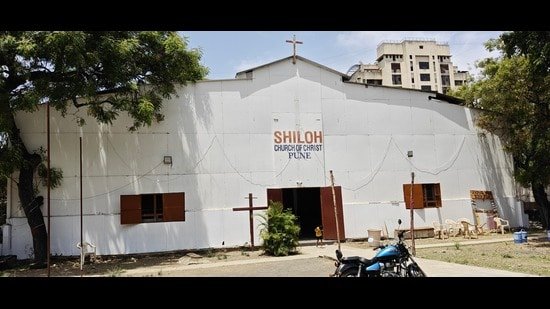
The Pune Cantonment Board (PCB) on Monday asked the management of Shiloh Marathi Church of Christ, located within the Poona Christian Cemetery premises at Dhobi Ghat, to initiate the process of regularising its prayer hall structure, allegedly built without prior approval nearly three decades ago. The move comes days after a proposed demolition drive triggered large-scale protests by members of the Christian community.

A delegation led by Pastor Robin Mahadkar, along with Azad Samaj Party Pune president, advocate Tosif Shaikh, met the PCB chief executive officer, Vidyadhar Pawaron, on Monday and submitted an application seeking regularisation.
In the petition, dated April 20, Mahadkar stated that the church has been in “peaceful, bonafide and lawful possession” of the premises for nearly three decades. He said the facility is used not only for religious purposes but also for social welfare activities, including de-addiction awareness, counselling, youth guidance, rehabilitation efforts and community support programmes.
He urged the board to keep the demolition in abeyance and allow time to complete legal formalities, also requesting a joint survey and a hearing. “The proposed demolition will adversely affect ongoing social and humanitarian activities. We assure full cooperation and undertake to comply with all legal requirements,” the petition stated, adding that the church is willing to remove any excess construction if required.
Advocate Shaikh said they expect the PCB to take a fair decision. “We hope the board will act judiciously without yielding to any pressure. Otherwise, we will be compelled to approach the court,” Shaikh said.
PCB officials said the application for regularisation will be examined as per rules before any further action is taken. CEO Vidyadhar Pawar said the structure, spread over 10,000 sq ft, stands on Class B-1 land, where the General Land Register (GLR) records the holder of occupancy rights (HOR) as the United Kingdom’s High Commissioner. “The land belongs to the central government but falls within the administrative jurisdiction of the cantonment board. We are authorised to act as per rules,” he said.
According to Pawar, the prayer hall was constructed without submitting building plans or obtaining mandatory permissions. “The construction took place without our approval. However, it is not classified as an encroachment per se, and there is a provision for regularisation. We have asked the church authorities to apply and follow the statutory procedure,” he said.
He added that the PCB had first issued a notice regarding the unauthorised construction in 2006, and an appeal filed by the church was dismissed in 2014. “Action has been initiated based on persistent complaints,” Pawar said, rejecting allegations of selective targeting.
Referring to claims about other alleged illegal constructions, including a PCB fire brigade structure near Dhobi Ghat, he said, “These allegations are baseless.”
The issue escalated last week after the PCB issued a demolition notice dated March 23, 2026, for what it termed as unauthorised construction within survey numbers 545, 546 and 547 in the cemetery campus.
Community leaders said the demolition notice, though dated March 23, was served only on April 13, leaving little time to respond. They also questioned the timing of the action, alleging it created fear among the community.
The notice triggered widespread protests, forcing authorities to temporarily halt the drive. On April 17, nearly 1,000 members of the Marathi-speaking Christian community gathered at the cemetery’s main gate near the PCB fire brigade office to oppose the action.
Tensions flared when a JCB machine was deployed for demolition, but protesters assembled quickly and blocked the operation, forcing officials to withdraw. Following discussions with community representatives and local leaders, the demolition was stayed until Monday to allow the church to present its case.
The protest saw participation from Congress corporators, Arvind Shinde and Rafique Shaikh, Azad Samaj Party Pune president, and members of the Bhim Army. Protesters alleged that the PCB’s action violated principles of natural justice and infringed upon religious rights.
The Shiloh Marathi Church of Christ, built nearly 30 years ago within the 19-acre cemetery premises, can accommodate over 1,000 worshippers and serves a significant section of the Marathi-speaking Christian population.
