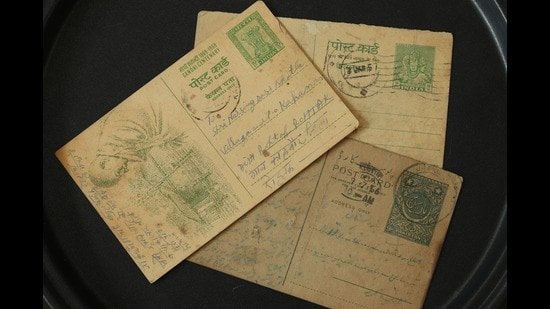
An unexpected postcard from a long-lost friend peered out of a heap of dusty mail at the apartment entrance. A heart-tugging one-liner on its verso, it felt like a 14 x 9 centimetre-time capsule from our school days. The cramped busy afternoon suddenly felt breezy with portable memories. The simplest form of open communication and the most heartfelt messaging system, these cream yellow postcards and their variations were once all over the place.
Postcards from colonial India (Shutterstock)
The first one printed in mocha brown was issued by the British administration. It had the Royal Coat of Arms bang at the centre and a head shot of Queen Victoria at top right. It read ‘East India Postcard’ and was priced at three paise. Lakhs of them were sold in the early years. After independence, the National Postal Service introduced four distinct categories of postcards: the Regular, the Meghdoot, the Printed and the Competition. But none of them had the main-character energy of the picture postcard.
India entered its most colourful phase in the postcard journey 18 years after the first East India Postcard was issued. On October 21,1897 an Austrian man sent out the first picture postcard of Indian origin to Europe. William Rössler, the sender was a photographer who worked as an assistant with Johnston & Hoffmann and later with Bourne and Shepherd, colonial India’s foremost photo studios.
Printed in Vienna and marked “Greetings from Calcutta”, Rössler’s picture postcards had three visuals: goddess Kali holding a beheaded demon in her fist, a burning ghat, and a nautch girl. In his essay, Building Postcards: Rössler’s Calcutta 1896, Omar Khan, author of Paper Jewels: Postcards from the Raj, says the postcard concept was invented by an Austrian in 1869. “It is no accident that Rössler had his Calcutta series printed most likely in Vienna’s 6th district. There, lithographic presses weighing hundreds of kilos were fit into the basement rooms of five storied Hapsburg apartment buildings with large courtyards… Vienna was the cutting-edge of European postcard manufacture around 1895,” he writes.
Picture postcards became popular in Europe in the decades between the late nineteenth century and the First World War. In India, these lovely pieces of visual ephemera were produced by home-grown companies like HA Mirza (Delhi), Gobindram Oodeyram (Jaipur), and Raphael Tuck & Sons (Lahore, Calcutta), with Clifton & Co. (Bombay) taking the lead. These cities swiftly became postcard hubs, with a voluminous postal traffic.
Interestingly, leading photographers like Mirza of Mirza and Sons shot extensively within the country but sent their materials to Germany for processing and printing. Once that was done, the postcards returned to India, only to head to Europe once again as part of the memorabilia taken home by returning colonials – a fascinating almost-circular supply chain of that period.
The themes varied. Sunrise and sunset scenes were widespread as were Christmas themed pictures. The hill station landscape also formed a distinct category. “This was the dominant aesthetic used in the colonies to not only portray the landscape, but to also change it. Hill station picture postcards show how this aesthetic was used to make “mountains” into “hills.” They show us the aesthetic shifts that took place in order to create a “home away from home”, writes Shaswati Talukder in Picturing Mountains As Hills – Hill Station Postcards and the Tales They Tell.
Unsurprisingly, ‘native’ images were much sought after. Military personnel stationed in cantonments across South Asia were especially keen on picture postcards. While exotic and visually pleasing, the Indian scenes on the card also bathed the sender in the glamour of the upwardly mobile. Yousef Saeed, a collector and co-founder of Tasveer Ghar, a South Asian archive, notes how, “Most early postcards with India-specific images depict what can be called the “native views” of India for a primarily European consumer, with very few postcards being found usable by Indians themselves.”
Of course, Indians too were interested in picture postcards. Ghalib sent several to members of his social circle, even to those of his friends who lived within Delhi. Festive picture postcards flooded the market especially around Eid, Diwali and Christmas. For those in faraway lands, they were much-awaited messages from home.
“Postcards gave the sense of communicating through the action of hand-writing and posting (and receiving) them. That has now been lost,” laments Saeed. He notes that for Indians, these cards were more an “expression of greetings or sentiments on special occasions” than an illustration of a place visited.
There has been an uptick in interest in these bits of ephemera that are also a part of lived material culture and the number of collectors is burgeoning. Curators and designers are also working hard to revive the postcard.
Daak Vaak, which works with hidden artworks and ideas from the unsung heroes who’ve shaped India’s cultural landscape, believes postcards are more than a “medium of communication”. A refreshing break from digital noise, Millennials and Gen Z are drawn to them as a novel way to connect with each other and with earlier generations.
“Now that we have begun a shop, we absolutely love the idea of greeting cards. We’ve started designing postcards for occasions. And seems everyone is loving it too. So much more personal than a WhatsApp forward!” says Insha Fatima of Daak Vaak.
DV’s postcards are meant to spread good vibes. The top selling ones are love themed and sell all year round. Others with funny captions are meant to be sent on birthdays and special occasions. It’s a quasi-return to an analog world in the best possible way – by reclaiming all that’s ‘lost’ and ‘tactile’.
Postcards are still niche but perhaps, they will return to this world plagued by the virtual. Because even the most avid sender of Whatsapp messages still yearns to actually “keep in touch”.
Nilosree Biswas is an author, filmmaker, columnist who writes about history, culture, food and cinema of South Asia, Asia and its diaspora.