


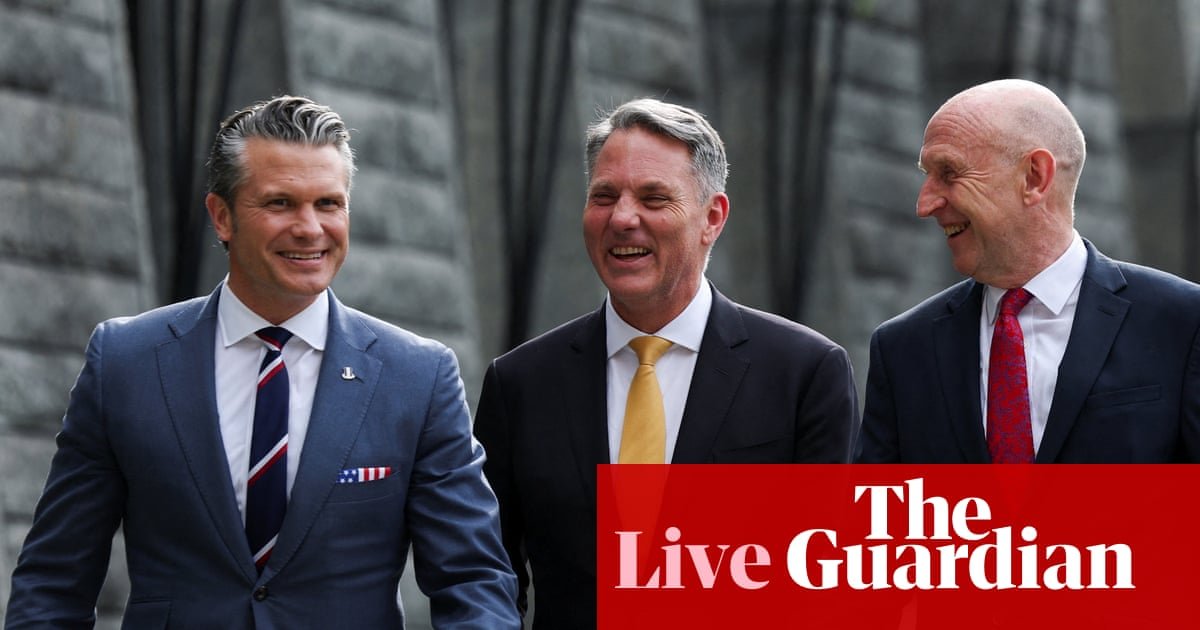
Australia always preferred used submarines, defence secretary claims
Dan Jervis-Bardy
Australia’s preference was always to receive secondhand nuclear powered submarines under the Aukus deal, defence officials have revealed, prompting the Coalition to question if the original arrangement was “imposed” on the Albanese government.
The defence secretary, Meghan Quinn, was grilled at Senate estimates on Tuesday night about the announcement that Australia would buy three used Virginia-class submarines from the US rather than a combination of new and old vessels.
Under questioning from the shadow defence minister, James Paterson, Quinn said it was a “joint idea” from Australia and the US to rework the deal.
Pressed on which country proposed the alternative plan first, Quinn said:
Australia’s position is that we would have always … had a preference for three in-service (submarines).
A surprised Paterson asked why the Albanese government accepted the original deal if that wasn’t its preference.
They imposed a new submarine on us and said you must take a new submarine even if you want three in-service?
Quinn replied:
This is a joint exercise over many decades, working collaboratively with an alliance partner to deliver a capability which is significant and is very important for Australia’s national defence. So there are many reasons why three in-service (submarines) would be simpler, lower-cost through the training of staff, the sustainment arrangements, the maintenance requirements, and all of those considerations.
Key events
Krishani Dhanji
Good morning, Krishani Dhanji here with you for another busy sitting day – thanks to Martin Farrer for getting us started.
Debate on the government’s bill to change capital gains tax and the tax offset will continue today, with the opposition calling for the bill to be split. We’ll also be keeping a close eye on estimates – with Defence and the submarine agency set to front senators this morning.
The Solomon Islands prime minister will attend Parliament today for talks with Anthony Albanese. There are reports this morning from Nine newspapers that Albanese will use the time with the new prime minister to begin discussions on a treaty agreement and revive a policing deal.
There’s plenty happening so let’s get stuck in!
University changed wifi terms to monitor for ‘breaches of policies’, report finds
Caitlin Cassidy
The University of Melbourne (UoM) changed its wifi terms of use allowing the network to be monitored by the university to help detect “suspected unlawful behaviour” or “breaches of university policies”, a new report into campus free speech has found.
The final report, released on Wednesday, was the result of a people’s inquiry into campus free speech on Palestine, initiated in 2025 by students and academics with support of the Greens. It had 150 written submissions and three public hearings.
An investigation found the UoM breached Victoria’s Privacy and Data Protection Act when it used its wifi network to surveil students and staff holding a pro-Palestine protest. It quietly introduced new terms of use in January, despite the state’s deputy information commissioner describing the surveillance as a “breach of trust”.
A spokesperson for the UoM said it was the university’s “responsibility to foster a secure and respectful environment, while upholding compliance with our policies”.
The wireless terms of use were revised after community feedback and reissued in January 2026 and now include more information on how wireless network data may be used.
The report found there had been widespread restrictions on free speech and academic freedom since pro-Palestine encampments were established in 2024, including disciplinary action, protest crackdowns and surveillance.
The Greens deputy leader and patron of the inquiry, senator Mehreen Faruqi, said the findings were “chilling”.
The harsh measures to silence dissent are quite reprehensible when universities should be upholding academic freedom and free speech.
Bart Shteinman, executive officer of the Jewish Council of Australia, which participated in the inquiry, said universities were facing a “rightwing culture war”.
Australian troops will be sent to Poland to train with Ukrainians
Dan Jervis-Bardy
Australian troops will be sent to Poland in coming weeks to train Ukrainian soldiers in the latest effort to support its fight against Russia’s illegal invasion.
Australian Defence Force personnel have since January 2023 been based in the UK helping to train Ukrainian soldiers in basic infantry tactics, leadership and military skills.
But in coming weeks, the ADF personnel will be shifted to Poland as part of a Norwegian-led operation, bringing Australian troops closer to the conflict zone.
Making the announcement last night, the defence minister, Richard Marles, said:
Australia is continuing to adapt our contributions to Ukraine to ensure our support remains practical, relevant, and aligned with their most urgent needs.
ADF personnel trained more than 3,650 Ukrainians in the UK under Operation Kudu.
Since the start of Russia’s full-scale invasion in February 2022, the Australian government has provided more than $1.7bn in support for Ukraine, including $1.5bn in military assistance.
Australia always preferred used submarines, defence secretary claims
Dan Jervis-Bardy
Australia’s preference was always to receive secondhand nuclear powered submarines under the Aukus deal, defence officials have revealed, prompting the Coalition to question if the original arrangement was “imposed” on the Albanese government.
The defence secretary, Meghan Quinn, was grilled at Senate estimates on Tuesday night about the announcement that Australia would buy three used Virginia-class submarines from the US rather than a combination of new and old vessels.
Under questioning from the shadow defence minister, James Paterson, Quinn said it was a “joint idea” from Australia and the US to rework the deal.
Pressed on which country proposed the alternative plan first, Quinn said:
Australia’s position is that we would have always … had a preference for three in-service (submarines).
A surprised Paterson asked why the Albanese government accepted the original deal if that wasn’t its preference.
They imposed a new submarine on us and said you must take a new submarine even if you want three in-service?
Quinn replied:
This is a joint exercise over many decades, working collaboratively with an alliance partner to deliver a capability which is significant and is very important for Australia’s national defence. So there are many reasons why three in-service (submarines) would be simpler, lower-cost through the training of staff, the sustainment arrangements, the maintenance requirements, and all of those considerations.
Welcome
Martin Farrer
Good morning and welcome to our live politics blog. I’m Martin Farrer with the top overnight stories and then Krishani Dhanji will be your guide.
Australia’s preference was always to receive secondhand nuclear powered submarines under the Aukus deal, the defence secretary told Senate estimates last night. More coming up.
And Australia is going to send ADF troops to Poland to help train Ukrainian fighters. More on that, too, soon.
