


POCO M8 Power Review: POCO has done something for its new sub- ₹25,000 smartphone that most brands are reluctant to replicate for their models. The latest M8 Power comes with a Full-HD+ AMOLED screen, something which is going extinct in its counterparts.
This is a substantial feat because rising memory prices, driven by the rapid adoption of AI, have increasingly compelled smartphone brands to use lower-resolution LCDs. This makes room for a pair of mediocre hardware components and a 7,000 mAh or more battery, helping them keep their inventories within the coveted price bracket.
But strip the M8 Power of its display, and it matches most aspects of its current peers: an underpowered processor, once meant for the sub- ₹12,000 category, an 8,000mAh battery, and a 50MP camera.
So, it raises the question: Has POCO sufficiently optimised the M8 Power’s hardware to give it another edge over the competition beyond the AMOLED display, or is it just a run-of-the-mill offering with a garnish on top? I spent two weeks using this smartphone to find out. Here’s what I realised:
POCO M8 Power Display: Big and vibrant, but not quite as smooth as it should be
When unwrapping the M8 Power, the first thing that caught my attention was how massive its AMOLED display looked, which, by the way, measures 6.9 inches diagonally. It is so large that calling it a tablet doesn’t entirely feel out of place. As expected, watching anime series and YouTube videos felt so immersive on the M8 Power’s display.
While catching up with weekly episodes of my favourite series, including Daemons of Shadow Realm and One Piece, I noted that the M8 Power’s display kept colours well saturated rather than letting them go overboard. It even handled complex scenes well, allowing each visual element to shine. All these observations were also evident when I doomscrolled through my life on Instagram.
With the FHD+ resolution in place, the AMOLED panel on the M8 Power rendered all the live-action content I watched on YouTube crisp and clear, which I am truly grateful for. That said, POCO’s new smartphone doesn’t support HDR content in any app, so users won’t be able to watch videos with incredible detail in both dark and bright scenes.
Brightness isn’t an issue for the M8 Power’s display, as it peaks at 1800 nits. So, content remains legible even when using the phone in direct sunlight.
Although POCO has incorporated a 120Hz refresh rate into the M8 Power, it never came in handy during my use. I consistently encountered stutters, even when doing something as simple as swiping through the application menu. But this is something for which the choice of processor and its optimisation should be blamed, which I will discuss thoroughly in the performance section.
POCO M8 Power Audio and Haptics: Usable audio, but neither feels particularly refined
Unlike the display, the M8 Power’s speaker is serviceable at best. Given its mono setup, it cannot produce the stereo effect people look for when watching a movie.
In normal ambient noise, with the TV playing at low volume in the background, even when I turned the volume up to the maximum, I still had to bring the M8 Power closer to my face just to hear what I was watching. This is something I never faced on smartphones that also feature a mono speaker, such as the OnePlus Nord CE 5 or the CMF Phone 2 Pro.
While the M8 Power’s speaker handles the mids reasonably well, it makes the highs sound shrill and falters in the low range, struggling to produce fuller audio.
Speaking of haptics on POCO’s new smartphone, there is nothing to rave about. The way it buzzes when typing and when adjusting the volume feels unpolished and unpleasant. So it makes much more sense to turn the vibration off to save power.
POCO M8 Power Battery and Charging: A big reserve, modest mileage and a slow refill
Like several of its recent rivals, the M8 Power also packs an 8,000mAh battery. Honestly, I support this trend because a larger battery means a longer runtime. Right? In the M8 Power’s case, this isn’t exactly true. To understand what I mean, let’s look at how POCO’s new smartphone compares with the Motorola G37 Power in the PCMark Battery test, our benchmark for smartphone batteries:
| POCO M8 Power | Motorola G37 Power | |
|---|---|---|
| Runtime in PCMark Battery test | 16:13:00 | 17:26:00 |
Despite featuring a smaller 7,000mAh battery, the Motorola G37 Power delivers better runtime than the M8 Power. This result is significant because the AMOLED display on POCO’s new smartphone is often considered relatively power-efficient compared to the LCD on the Motorola G37 Power. This indicates that POCO has left some room for improvement in software optimisation, which could otherwise have prevented such a scenario.
The same efficiency shortcoming was also evident in my real-world experience. I often noticed that just scrolling on Instagram guzzled the M8 Power’s battery faster than on other smartphones. Given its 8,000mAh capacity, the phone still managed to deliver five to six hours of screen-on time, with some juice still left for the next day.
Charging the M8 Power is rather a run-of-the-mill experience. In my test, the 45W bundled charger took an hour and 45 minutes to charge the phone from empty to 100%. This slow charging speed won’t align with the schedules of those who always live their life in a hurry.
POCO M8 Power Design and Build Quality: Familiar from afar, sturdy up close
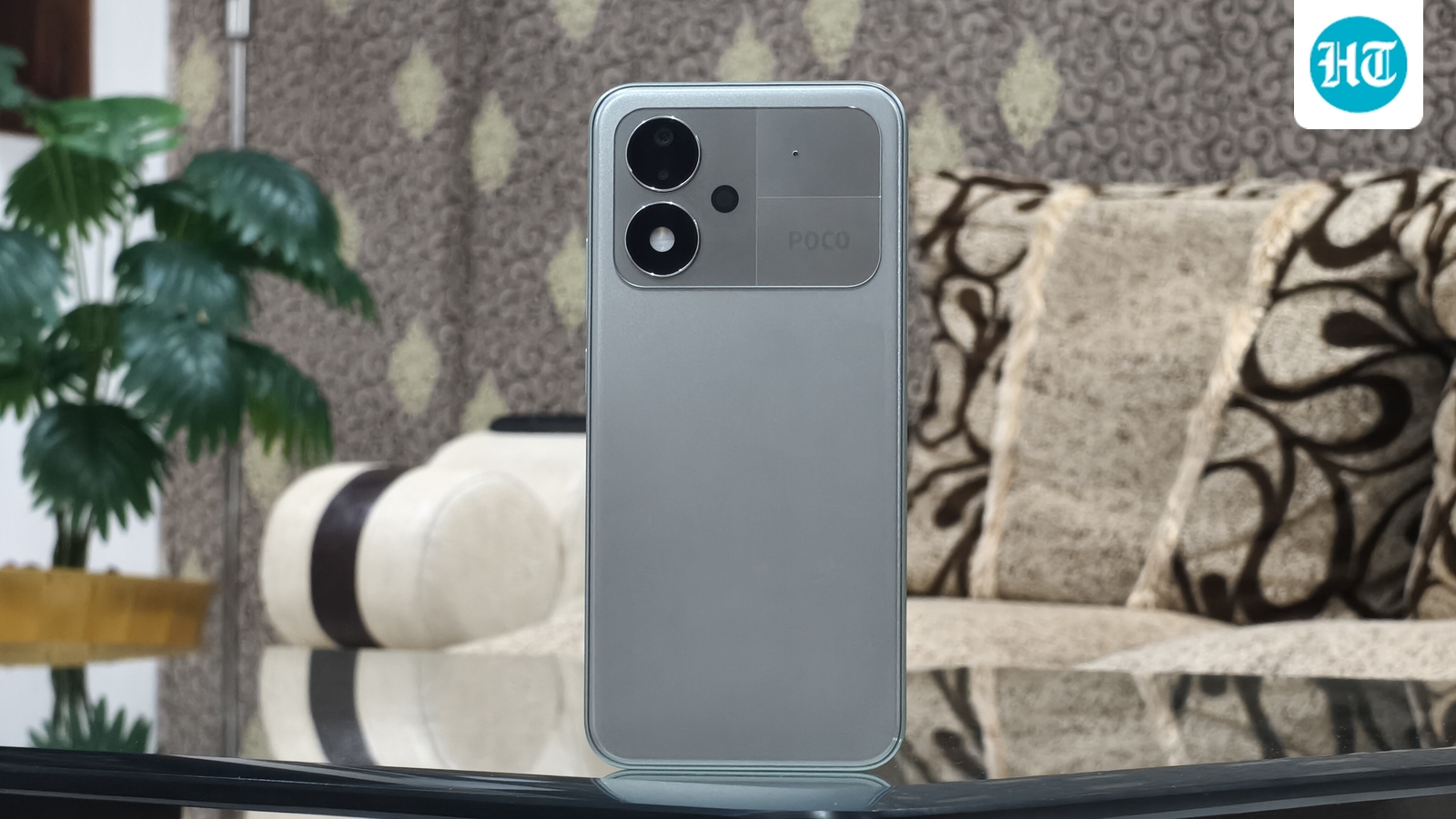
A smartphone’s design is highly subjective, yet I feel the M8 Power won’t win many hearts. Its camera visor is very similar to that of the Redmi Note 13 Pro+, particularly in layout and pattern. While the latter’s overall design aesthetic still feels better executed and even somewhat timeless, the M8 Power’s styling doesn’t evoke any emotion. Its three shades of colour, which, by the way, are Black, Blaze Orange, and Green, don’t improve the case either.
But I do want to give credit to POCO where it is due. The brand has slightly rounded the edges on both the front and rear, making the M8 Power comfortable to hold without causing any sharp pain. That said, holding the phone with one hand for extended periods starts to feel more like weightlifting. Its 225g weight is often classified as heavy for a smartphone.
In hand, the M8 Power gives the impression that the brand has built it to be durable. I believe that accidentally dropping it on the floor won’t really faze the weakest of hearts, as the Corning Gorilla Glass 7i protection on the front is designed to absorb the impact and distribute it evenly.
POCO M8 Power Performance: Simple tasks suit it, multitasking does not
Performance is the aspect in which the effects of cost-cutting are most severe for the M8 Power. The way POCO has handled this cost-saving measure on its new smartphone has consequently restricted its customer base to simple-minded people, particularly toddlers and grandparents, whose usage is limited to a single app.
I say this because simple multitasking, particularly swiping through Instagram Reels while keeping Google Maps in a floating window, is enough to make the M8 Power lag. The phone even stutters when swiping through Instagram Reels alone. In contrast, watching only one video and simple browsing don’t cause any lag.
The main cause of this issue isn’t that POCO used the Snapdragon 4 Gen 4 SoC on the M8 Power, which was originally intended for the sub- ₹12,000 segment, or that it incorporated UFS 2.2 storage. Rather, poor optimisation is the main culprit.
In my experience, I have never encountered such lag in budget smartphones launched in 2025, as other brands have focused more on compensating for underpowered hardware by allocating resources more effectively.
It’s a no-brainer that this performance shortfall doesn’t translate into smooth gaming. The table below shows how the M8 Power performed in BGMI at the lowest graphics settings, which is “Smooth”:
| POCO M8 Power | |
|---|---|
| Avg FPS (Smooth Graphics) in BGMI | 39.3 |
| 5% Low FPS (Smooth Graphics) in BGMI | 32.2 |
First, the phone only supports 40 fps at the lowest graphics settings. While the game doesn’t match the smoothness of 60 fps or higher at this frame rate, players can still enjoy fighting enemies. But in the M8 Power’s case, consistent frame drops and stutters ruined my mood more than I anticipated.
Another thing that took away from the gaming experience was the phone’s delayed response to touch inputs when I moved the character or fired the gun. This suggests that the M8 Power is better suited to people who casually play games that don’t require serious horsepower to load, for instance, Subway Surfers and Ludo King.
POCO M8 Power Software: More frustrating than refined, with some useful AI
Although most smartphone software is configured to mask underpowered hardware with smoother animations and a feature-rich experience, HyperOS 3 on the M8 Power doesn’t check the necessary boxes. For starters, tapping the camera app takes a long time to bring up the viewfinder. Furthermore, immediately checking the photograph after clicking one freezes the phone for a few seconds.
While HyperOS 3 provides animations when bringing down the notification shade and opening the app menu, it lacks animations when opening and closing apps. What makes the situation worse is that apps appear a few seconds after tapping their icons.
Speaking of apps, HyperOS 3 on the M8 Power comes preloaded with sketchy apps and bloatware. I would recommend deleting them before handing the phone to a toddler or grandparent, as an accidental tap might open something unsettling.
The only saving grace of HyperOS 3 on the M8 Power is its useful AI suite in the gallery app, which helps users touch up their photographs. While POCO promises 4 years of software updates for the M8 Power, basing a purchase decision on future software improvements isn’t a wise move.
Considering the performance and software of the M8 Power, I say people should consider last year’s smartphones if they need to purchase one immediately under ₹30,000. iQOO Z11x, Realme P4x, and Motorola Edge 60 Fusion are among the best options left, striking a perfect balance between capable hardware for the price and a more polished software experience.
POCO M8 Power Camera: Good when the light is right, shaky when it is not
Compared to the two aspects above, the camera on the M8 Power is mostly decent. While the phone is said to feature a dual-camera setup, the second camera is just a 2MP bokeh sensor that hardly comes in handy. The 50MP primary camera essentially does the heavy lifting when it comes to capturing photographs.
In daylight, it captures colours more closely to how the subject and setting originally appeared. Because the camera sensor is small, it delivers sharper images when capturing a subject up close and hazier ones when the subject is farther away. Given this and the lack of a dedicated telephoto lens, taking a detailed zoom photograph becomes difficult.
HDR processing is mostly hit-or-miss. Sometimes the photos come out with good detail in both the darker and brighter areas, while in others the highlights are overblown.
Generally, a smaller sensor size limits the camera’s ability to expose its images properly. To compensate for this issue, the primary camera on the M8 Power often slows its shutter speed. As a result, most photos taken in low light come out blurry due to sudden movement.
In contrast, the front camera is serviceable at best, delivering selfies with near-natural colours in daylight. Given its 8MP resolution, it isn’t worth expecting it to retain a detailed rendition of facial features, such as stubble.
POCO M8 Power Connectivity: The kind of reliability that goes unnoticed
Connectivity was largely reliable throughout my time with the M8 Power. I never had any issues making calls, and Google Maps fetched directions smoothly over a 5G network. Streaming videos over mobile data was equally consistent, with no noticeable buffering during playback.
Verdict:
The POCO M8 Power is a phone built around one standout feature: its 6.9-inch FHD+ AMOLED display. It is large, vibrant, and a welcome departure from the lower-resolution LCD panels that are increasingly common in this segment. The 8,000mAh battery also offers decent endurance, although charging is slow. The primary camera is capable in daylight, while connectivity remains reliable. However, underpowered hardware and poor software optimisation affect everyday performance, gaming and the overall experience. With a few compromises too many, the M8 Power struggles to make a compelling case beyond its display.
Specifications
Price
24,999 rupees (6GB + 128GB), 27,999 rupees (8GB + 128GB)
Display
6.9-inch AMOLED, 120Hz
Resolution
2396 × 1080 pixels (Full HD+)
Processor
Snapdragon 4 Gen 4
RAM & Storage
6GB and 8GB RAM, 128GB storage
RAM & Storage Type
LPDDR4X and UFS 2.2
Primary Camera
50MP f/1.8 and OIS; up to 1080p 30fps video recording
Front Camera
8MP; up to 1080 30fps video recording
Connectivity
5G, Wi-Fi 5 and Bluetooth v5.1
Battery
8000mAh, 45W fast charging
Reasons to buy
Vibrant AMOLED display with saturated colours, crisp detail and immersive viewing.
The 8,000mAh battery delivers five to six hours of screen-on time.
The primary camera captures natural colours and sharp close-up shots in daylight.
Reason to avoid
Performance struggles with multitasking and demanding games, with frequent stutters.
HyperOS 3 feels sluggish and cluttered, with delayed app launches and bloatware.
Charging takes around 1 hour and 45 minutes, which feels slow.
At 225g, the M8 Power feels heavy during prolonged one-handed use.
Its familiar design lacks the visual character to stand out.
Disclaimer: At Hindustan Times, we help you stay up-to-date with the latest trends and products. Hindustan Times has an affiliate partnership, so we may get a part of the revenue when you make a purchase. We shall not be liable for any claim under applicable laws, including but not limited to the Consumer Protection Act, 2019, with respect to the products. The products listed in this article are in no particular order of priority.
