



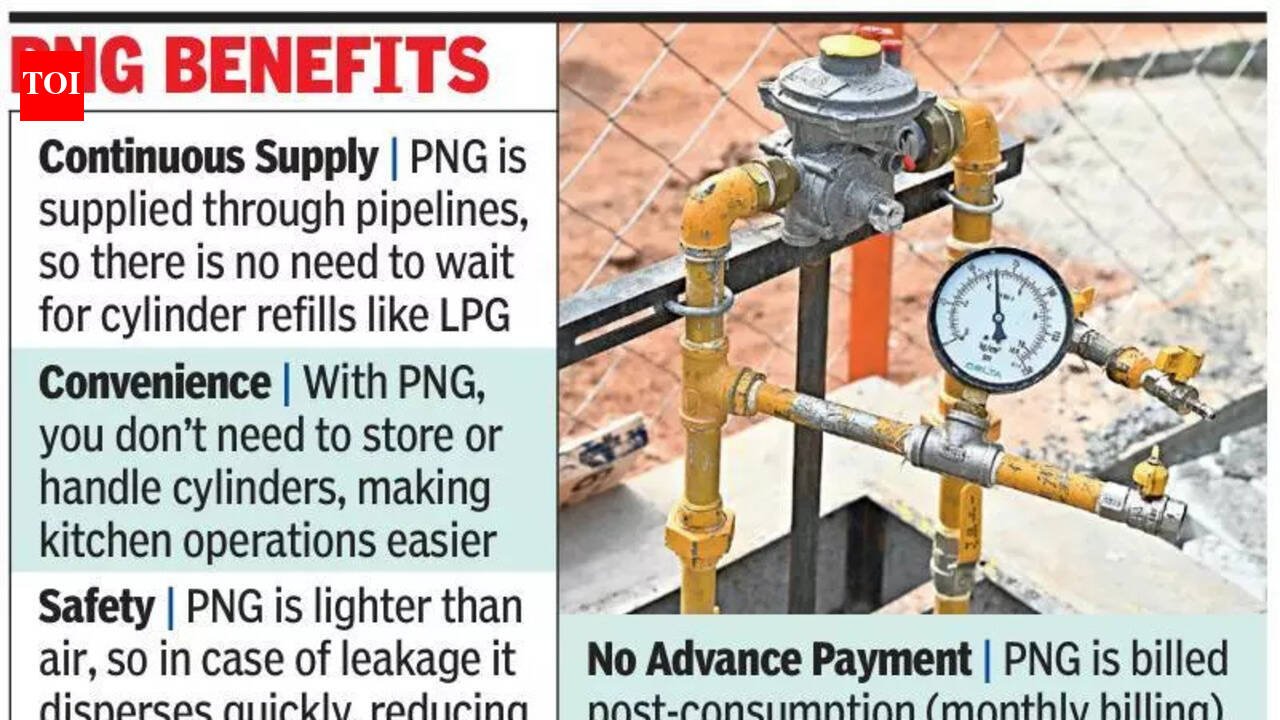
Lucknow: The Centre’s push to encourage households to shift from LPG to Piped Natural Gas (PNG) is seeing slow adoption in Uttar Pradesh, even as the pipeline network expands across almost every district of the state.The ministry of petroleum and natural gas has been urging consumers to adopt PNG to reduce pressure on the LPG supply chain and ensure a more stable and uninterrupted energy supply. However, official data indicates a significant gap between the number of households covered by PNG infrastructure and those actively using the service. According to data from the Petroleum and Natural Gas Regulatory Board (PNGRB), Uttar Pradesh has over 2.39 crore domestic PNG connections. In contrast, figures from the Petroleum Planning and Analysis Cell (PPAC) show that only about 20.94 lakh households are currently using PNG for domestic consumption. Officials from City Gas Distribution (CGD) companies operating in the state clarified that the higher PNGRB figure reflects households that have been connected to the PNG pipeline network, while PPAC data counts only those who have are actively using the service, as indicated by regular billing. “The actual number of consumers is reflected by those paying bills against PNG usage,” said an official from one of the 13 CGD companies operating in Uttar Pradesh. Green Gas Limited (GGL), one of the CGD companies that supplies PNG in cities like Lucknow, Agra, Unnao, Ayodhya and Sultanpur, said consumer response remains limited despite the availability of infrastructure. According to company officials, GGL currently receives only around eight to ten applications per day for new domestic PNG connections. “We have the capacity to provide service to over 3.25 lakh consumers immediately, but still there is a sense of hesitation among people to switch to PNG,” said a senior official of GGL. In GGL’s operational areas, the total number of PNG consumers is around 1.57 lakh, with more than 80,000 users in Lucknow and about 75,000 in Agra. Officials say PNG offers advantages like continuous supply, post-consumption billing and reduced dependence on LPG cylinder deliveries.


