


FRAGRANCE OF IDEAS
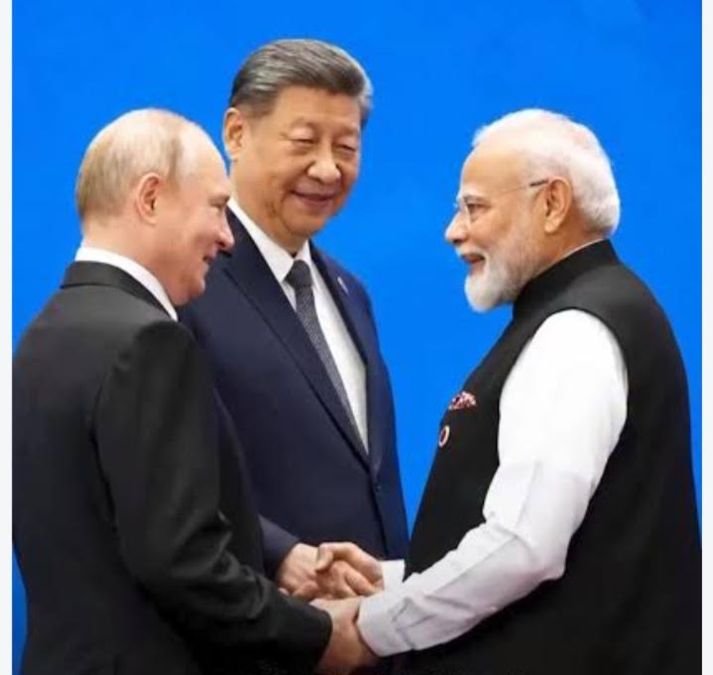
Prime Minister Narendra Modi was recently on a very successful four-day visit to two Central Asian nations, Uzbekistan and Kyrgyzstan. Besides attending the usual official ceremonies, bilateral meetings and other important engagements in the two countries, PM Modi also attended the two-day Shanghai Cooperation Organisation (SCO) Summit in Bishkek, the capital of Kyrgyzstan. The Summit was also attended by the Russian President, Vladimir Putin and the Chinese President, Xi Jinping, besides the other heads of government that were invited to the Summit.
There is no doubt in the fact that the visit of PM Modi and the SCO Summit 2026 attracted the attention of the whole world, and all these developments were duly reported and covered by the global media. The presence of the heads of the governments of China, Russia and India in Bishkek was seen with keen interest by the international media, geopolitical watchers and the Western media and political establishments.
PM Modi made a very impactful presence in Tashkent-Uzbekistan during his visit there before coming to Kyrgyzstan. The talks therein were focussed on bilateral cooperation, energy issues, and regional security. The Indian side also discussed the important issue of a possible uranium supply programme in the near future to India from Uzbekistan.
President Shavkat Mirziyoyev received PM Modi at the Tashkent international airport and accorded him a befitting welcome on behalf of his government. He also conferred Uzbekistan’s prestigious honour ‘Oliy Darajali Do’stlik’ (Order of Friendship) upon PM Modi in recognition of his international stature and huge positive contribution to the global cooperation. This is Modi’s 36th international award, which he has received over the last 12 years globally. PM Modi also held very productive delegation-level strategic talks with the Uzbek’s side during his two-day stay in Tashkent.
Modi also participated in yoga programmes in Tashkent, inter-cultural events, Ramcharitmanas recitation event, interactive programmes with scholars, Indologists, youth and the students at the university and the tree-plantation ceremonies. He also visited the former Prime Minister of India Lal Bahadur Shastri Memorial and paid floral tributes to his memory. It was here in Tashkent that the former PM Shastri breathed his last during the Indo-Pak talks in 1966.
On reaching Bishkek, the capital of Kyrgyzstan, from Tashkent, PM Modi received an impressive ceremonial welcome. He held bilateral talks with the Kyrgyzstan delegation headed by their President, Sadyr Zhaparov, to enhance bilateral economic and commercial relationship between the two nations. He also attended the opening ceremony of the World Nomad Games in Kyrgyzstan alongside visiting global and regional leaders who had come to Bishkek in connection with the SCO Summit on 31st August and 1st September 2026.
At the Summit, PM Modi made a strong plea to the world to dismantle the entire ecosystem of terror financing without double standards. He said that in the previous meeting of the SCO, he had outlined three pillars as India’s vision for the SCO, and these included ‘security, connectivity and opportunity’. He said, “The time has come to move these three pillars beyond vision and translate them into concrete outcomes. The first and foremost requirement for this is peace and security. Terrorism continues to pose a serious challenge to humanity as a whole. In the fight against terrorism, we cannot remain confined to an action-reaction approach.
We must dismantle the entire ecosystem of terrorist financing, recruitment, radicalisation, and safe havens. We must speak with one voice and make it clear that there can be no place for double standards on this serious issue. We must send a strong message to countries that use terrorism as an instrument of policy and provide safe haven and support to terrorists that terrorism can never be a strategic asset for anyone. Our shared aspiration for a peaceful and secure Eurasia is also closely linked to peace and stability in Afghanistan. India has been contributing to the development and provision of humanitarian assistance to the people of Afghanistan and will continue to do so.
In today’s interconnected world, the scope of security has become even broader. The crisis in West Asia has demonstrated that a conflict in one region does not remain confined to that region. Its impact is felt across the world, affecting energy security, maritime trade, and supply chains. The countries of the Global South bear the greatest brunt of such disruptions. Therefore, India has consistently called for all tensions and conflicts to be resolved not on the battlefield, but through dialogue and diplomacy.
Drug trafficking is not merely a crime; it is a serious threat to our younger generation and regional security. The Centres being established under the SCO to address challenges such as security threats, organised crime, information security, and narcotics are a positive step. We must make these Centres an effective instrument for practical coordination and timely action”.
On the sidelines of the Summit, PM Modi met the Russian President Vladimir Putin and urged an immediate and peaceful resolution to the Russia-Ukraine conflict. His quote got a lot of attention and appreciation that suggests; ‘From endless war to the end of war’. He also met the Iranian President Masoud Pezeshkian to expand trade and address West Asian diplomatic stability.
The President of Iran requested Modi to use his extensive resources to bring the Iran and West Asia crisis to a halt. Pezeshkian urged Modi to leverage India’s extensive relationships with various international parties to help stop the cycle of violence and support a peaceful dialogue process. He also thanked India for its support and cooperation during the recent conflict and called Modi a man of peace.
In a bizarre attempt to showcase his presence at the Summit, the Pakistan Prime Minister Shehbaz Sharief, who was also attending the SCO Summit, committed his office to post an edited group-photograph of the leaders of the Summit on their social media handle. He did so immediately after PM Modi’s office posted the original group photograph of the Summit on social media. However, due to the huge international criticism mixed with sarcasm and embarrassment, the Pakistan PMO was compelled to change the ‘edited photograph ‘, which brought humiliation for Pakistan globally and left behind a diplomatic distaste.
Additionally, Sharief, in his address, raked up the issue of the Indus Water Treaty (IWT) at the SCO summit unsuccessfully. However, the External Affairs Ministry of India, under the leadership of Dr. S.Jay Shankar, External Affairs Minister, who was also attending the Summit, issued a befitting reply from Bishkek itself and made its stand known to the world on the IWT issue. The statement said that the Hague-based International Tribunal ruling that ‘India’s decision to suspend the Indus Waters Treaty was not legally permissible and that the 1960 pact remains fully in force’ was not in any way acceptable to India. India rejected the ruling, saying the tribunal had no jurisdiction to pronounce on its sovereign decisions.
India rejected the award and also the interim measures order, reiterating that it does not recognise the Court of Arbitration and has never participated in its proceedings. “This so-called court was constituted by the World Bank in patent breach of the terms of the Treaty; and India categorically rejects its so-called award, just as it has firmly rejected all prior pronouncements by this illegally constituted body,” the Ministry of External Affairs said in a frontal statement issued from Bishkek. The statement is a rejoinder to all the concerned who try to intervene in the internal affairs of a sovereign nation-state.
India walked the talk very emphatically during the whole diplomatic process, pursuing its established policy doctrines, i.e. “Terror & Talks won’t go together” and “Water & Blood can’t flow together”. India’s consistent policy in this regard has stood the test, particularly when it elaborated that as long as Pakistan abets, sponsors and supports terrorism, there can be no real and normal relationship with it.
This time, even The New York Times, that keeps on criticising India’s policies and PM Modi’s leadership, was forced to change the line. It highlighted Prime Minister Narendra Modi’s diplomatic strategy as a “hedge” against shifting U.S. trade policies under President Trump during the Shanghai Cooperation Organisation (SCO) summit in Bishkek.
The New York Times reported that India is actively building new global partnerships and securing concrete economic and strategic deals to reduce its exposure to unpredictable U.S. trade pressures. The coverage in the paper noted that PM Modi has travelled extensively, visiting around 20 nations since August 2025, to hammer out independent economic ties, such as submarine technology cooperation with Germany and trade adjustments with European and Asian partners. The MOU signed with the European Union sometime back is a big example in this context.
PM Modi’s presence alongside Vladimir Putin and Xi Jinping at the Bishkek summit was framed as part of India’s multi-aligned foreign policy, balancing non-Western cooperation while navigating wider global and economic tensions. Energy security, new strategic deals, long term investments, historic engagements, forging cultural ties and opening new vistas for the establishment of peace in the highly volatile conflict regions globally are the most important takeaways of PM Modi’s Central Asian tour this time.
The whole world now awaits the BRICS summit that is going to take place on September 12 & 13 in New Delhi under India’s BRICS 2026 chairship.
(The author is a senior BJP & KP leader, Human Rights Defender and columnist and can be reached at: [email protected])
