



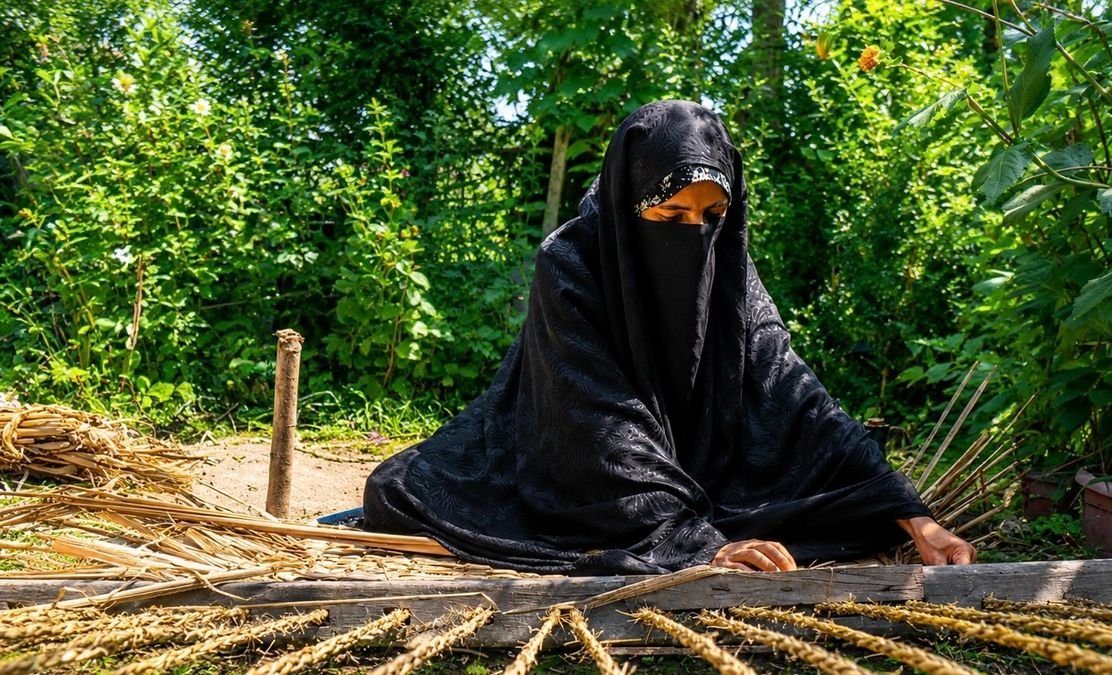
Srinagar: What began as a small family effort to keep a fading Kashmiri tradition alive has now found recognition on one of the country’s biggest public platforms. In the latest edition of Mann Ki Baat, Prime Minister Narendra Modi praised the revival of Kashmir’s traditional reed mat, locally known as Waguv, highlighting the work of Srinagar-based artisan Ghulam Hussain and his daughter Tanzeela.
Addressing the nation, Prime Minister Modi said, “Earlier, it was seen in every household in Kashmir, but over the last few years, its usage had started to decline. In such a situation, Ghulam Hussain ji of Srinagar and his daughter Tanzeela ji took a resolve. Both got involved in giving new life to the tradition of ‘Waguv’ craft.”
Calling the craft eco-friendly and deeply rooted in Kashmir’s heritage, the Prime Minister noted that Waguv is handcrafted from reeds and rice straw collected from Kashmir’s wetlands. He said the mats remain naturally cool in summer and warm in winter, making them a sustainable alternative to modern flooring.
“Today, Waguv is rapidly gaining popularity and reaching other parts of the country. I am very proud of everyone associated with this initiative,” Modi said, urging people to support local products under the ‘Vocal for Local’ campaign and consider bringing Kashmir’s traditional mats into their homes.
For Tanzeela, a resident of Roni Mohallah in Mir Behri, the mention was more than a moment of recognition, it was the reward for years of perseverance.
“First of all, I want to express my heartfelt gratitude to Prime Minister Modi because he mentioned our names and our craft in ‘Mann Ki Baat’. I thank him from the bottom of my heart,” she said.
A postgraduate student pursuing a Master’s degree in Persian at the University of Kashmir, Tanzeela balances academics with preserving the centuries-old craft she inherited from her father and grandfather. Over the past few years, she has transformed the family’s small-scale work into a source of livelihood for around 20 women in her locality, enabling them to weave mats from their homes while managing household responsibilities.
She also acknowledged the role of media in bringing visibility to the craft.
“I am thankful to all the departments and especially the media. Through media coverage, our work reached people across the country. The videos reached Modi Ji, and today he spoke about us in his programme. Earlier, very few people came here because they thought this was a far-flung area. But after the media highlighted our work, our craft reached people across India and even internationally,” she said.
Recalling the motivation behind reviving Waguv, Tanzeela said the traditional mat had almost disappeared from Kashmiri homes after synthetic mats and carpets became popular.
“This is our own heritage. We realised that if we do not preserve it, it may disappear. We have been working on it for the last few years with the hope that one day people would recognise its value. Today, we are seeing that hard work bear fruit,” she said.
She appealed to the people of Kashmir to embrace the craft once again.
“I want to tell the people of Kashmir that this is our own heritage. If we don’t promote it, then who will? We should keep our culture alive and support our traditional crafts,” she added.
The recognition comes as a significant boost for the traditional Waguv craft, whose history dates back several centuries and is believed to have flourished during the 16th century. Once a common feature in Kashmiri homes, shikaras and houseboats, the handcrafted reed mats had gradually fallen out of use with changing lifestyles.
For the artisans of Mir Behri, however, the Prime Minister’s acknowledgement is not the end of the journey but a new beginning. With growing demand, increased public awareness and national recognition, the family hopes the revival of Waguv will encourage more young people to preserve Kashmir’s traditional crafts while creating sustainable livelihoods for local communities.
Notably, Rising Kashmir was first to feature Tanzeela, a postgraduate student who continues the family legacy alongside her Master’s studies.


