


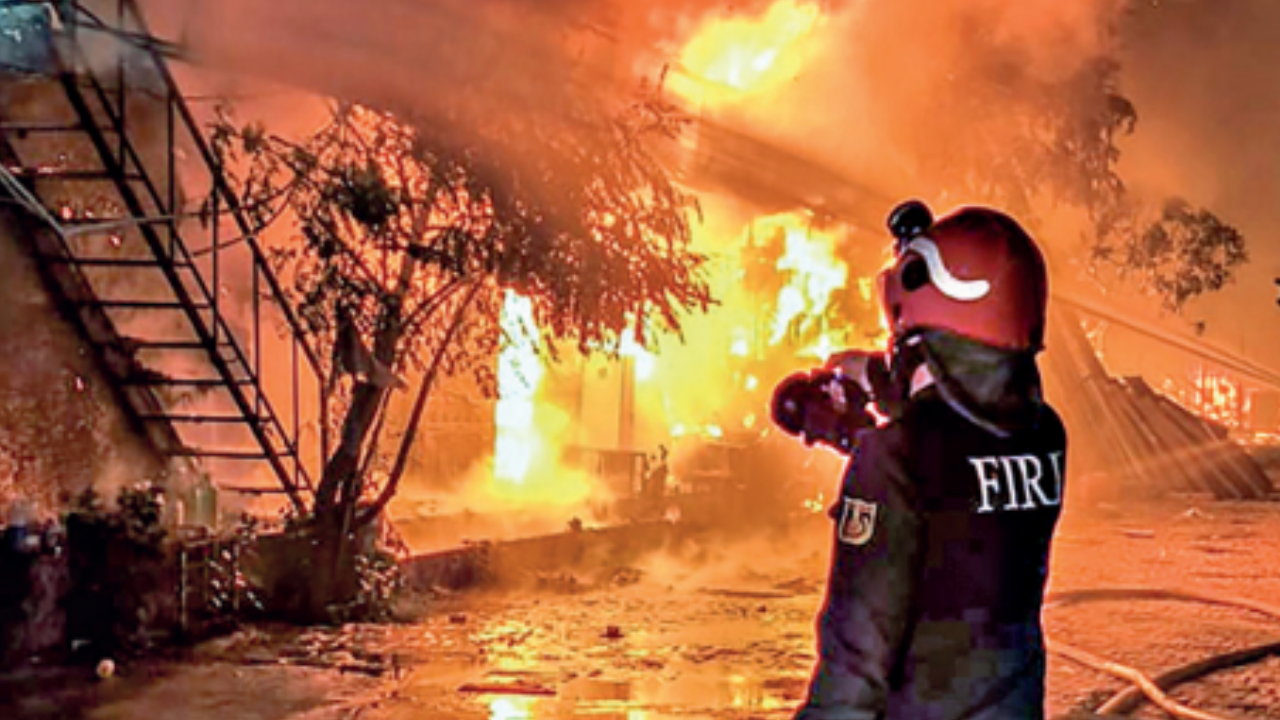
Days after 15 students died in a Lucknow bldg fire, the incident has sparked a debate on safety norms. TOI looks at the situation in Odisha as many residences double up as business units It was just like any other day for Sujata Sharma when she took a break from work and was scrolling on her phone in the afternoon on June 22 when she came across a horrifying reel – visuals of mothers wailing for their children as a devastating fire swept through a commercial building in Lucknow, killing 15 students. What was happening thousands of kilometres away had repercussions for Sujata in Bhubaneswar as she immediately thought of her 20-year-old son who is currently enrolled in a private coaching centre at Nayapalli. “I was afraid of sending my son to his coaching center for days after the tragedy. The incident exposed a serious safety lapse in buildings operating without fire clearances,” she said.While the UP police have arrested the commercial building owner, among others, for negligence, the incident has reignited the debate of residential neighbourhoods being quietly transformed into business hubs at the cost of safety, planning norms and public welfare.During April-May this year, the Supreme Court, in a series of orders, observed that using a building for a purpose different from its sanctioned use amounts to a “fraud on the system”, a position that could have major implications for cities like Bhubaneswar and Cuttack. According to a preliminary survey conducted by BMC following SC’s intervention, 153 commercial units are functioning from residential properties in Bhubaneswar currently. “The issue is not simply whether a shop or coaching centre is operating from a residential building. The concern is whether fire safety norms, evacuation routes, parking rules and structural loads are being followed,” urban safety expert Dipu Nanda said.In May this year, a fire at an apartment in Laxmi Sagar claimed three lives. Subsequent investigation revealed that the apartment lacked an occupancy certificate. In recent months, Bhubaneswar has witnessed major fires at Unit-I Market, Priyadarshini Market near CRP Square and Market Building areas, causing extensive property losses and raising questions about fire preparedness in congested urban zones.Following the Lucknow tragedy, Odisha State Disaster Management Authority ordered a statewide fire safety audit of educational institutes and coaching centres, specifically directing inspections of facilities operating from multi-storeyed buildings.A senior fire services official said the state is increasingly concerned about occupancy patterns in city buildings. “The risk increases when a structure approved for residential occupation starts commercial activities,” the official added.Parallelly, a transformation is slowly taking place in busy neighbourhoods such as Patia, Sailashree Vihar, Niladri Vihar, Chandrasekharpur, Nayapalli, Jagamara and Saheed Nagar, mostly having residential and commercial populations at the same place.Independent houses now function as coaching institutes and homestays. Apartment flats host doctors’ chambers, consulting offices and startups. Residential plots have become restaurants, hostels and event spaces.“Traffic congestion, parking disputes and noise have become a routine. In some lanes, commercial activities continue till late at night even though the area was planned as a residential locality,” Debasish Sahoo, a resident of Niladri Vihar, said.A house owner operating a coaching institute in Patia area defended the practice. “The demand is huge and commercial rents are not affordable for many small businesses. Most people are simply trying to earn a livelihood,” he said.The recent apex court order indicated that establishments running businesses from residential properties may face increased scrutiny if authorities begin strict implementation of the directives on land-use violations. Bhubaneswar mayor Sulochana Das said that a city-wide inspection was recently done in compliance with the SC’s directive. “We have found that several houses were turned into commercial zones in Patia and Chandrasekharpur areas,” she said. Das added that the preliminary report has been submitted to the apex court which has now asked the authorities to submit an action taken report. “We are launching a crackdown on such illegalities. Due action will be taken,” Das said.Urban planner Rashmi Ranjan Das said the challenge is balancing economic realities with public safety.“Cities have evolved and land use has also evolved, but changes cannot happen outside a regulatory framework,” she added.
