



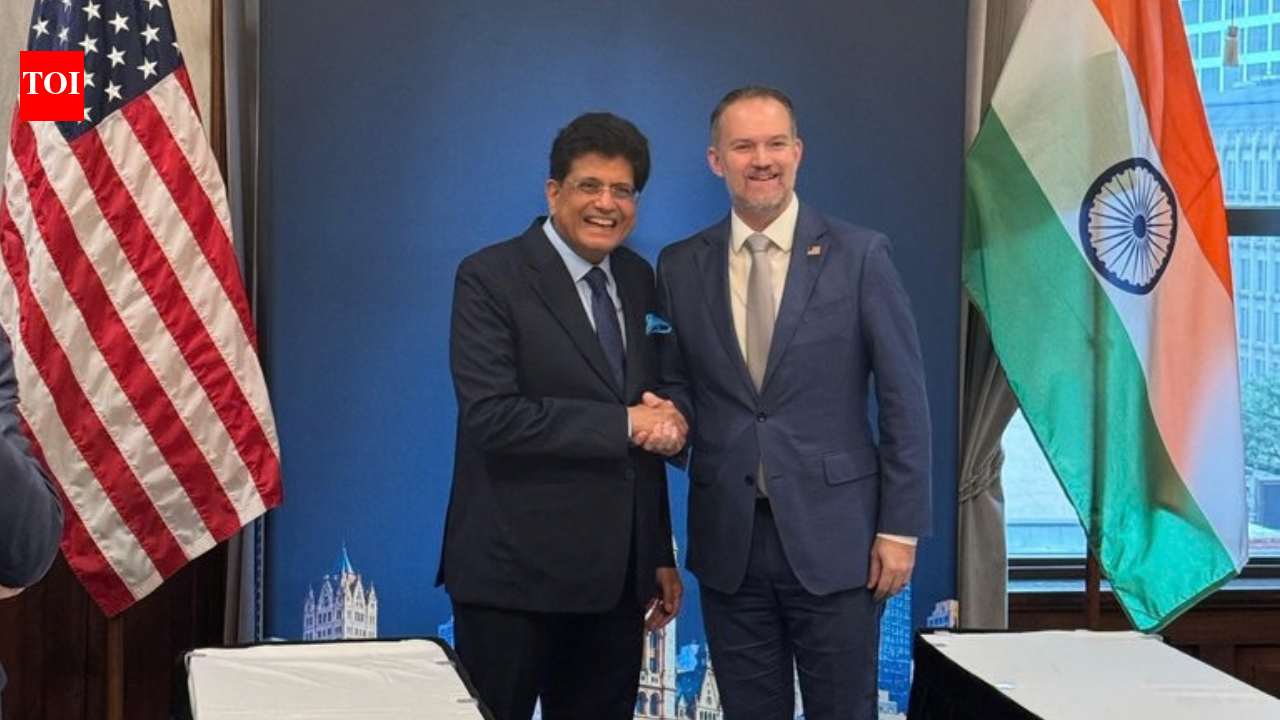
US trade representative Jamieson Greer called Union commerce and industry minister Piyush Goyal a “trade minister for life” as he opened the G20 trade ministers’ meeting in Milwaukee. The light-hearted remark came as the two ministers met on the first day of the two-day gathering.Greer added that the work of building a fairer trading system would continue long after the current ministers had left office, with Goyal being the exception.The US has put four issues at the centre of its G20 presidency: the “weaponisation” of food, structural excess industrial capacity, the Most-Favoured-Nation (MFN) principle and forced labour in supply chains.Goyal, meanwhile, said he had a productive discussion with Greer on bringing an interim agreement under the India-US Bilateral Trade Agreement to an early conclusion. “We also exchanged views on G20 deliberations under US Chairship.”On the issue of food, Goyal added, “Highlighted that our shared objective must be to ensure that food remains a source of security, stability and cooperation. Also, underlined that we must clearly distinguish between the weaponisation of food supply chains and legitimate measures adopted by countries to pursue domestic policy objectives and address food-security needs.”
Steel overcapacity takes centre stage
The first day produced a new framework on steel overcapacity, with countries participating in the Global Forum on Steel Excess Capacity endorsing the “Milwaukee Framework”.Greer said it would seek stronger coordinated action on excess capacity, including trade remedies, steel supply-chain monitoring and greater scrutiny of transhipment.Asked whether countries had agreed to increase tariffs on Chinese steel, Greer said governments would decide their own measures.“Well, every country will do what they think is appropriate,” Greer said. “We want to coordinate those measures. The United States has taken robust measures, and it probably makes sense for other countries to do that too.”Greer said G20 leaders had pledged to address excess capacity in 2016, but that it had become an even greater distortion a decade later. He said the US had used tariffs and bilateral deals over the past year to cut its trade deficit and strengthen supply chains.
MFN rules face US rethink
Greer also called for the MFN principle to be re-examined. The rule requires countries to offer the same trade terms to all partners. While describing it as a cornerstone of the trading system, he said its unconditional application could limit countries’ ability to respond to distortive policies and changing market conditions.India, meanwhile, has maintained that it will work towards “a rules-based, open, inclusive, transparent, equitable and non-discriminatory multilateral trading system, with the World Trade Organization at its core, while ensuring adequate policy space for developing countries.”The US agenda also includes eliminating forced labour from global supply chains and opposing the weaponisation of trade in food.
Goyal pursues India-US trade deal
The two ministers are also engaged in bilateral discussions in Milwaukee, working towards an India-US Bilateral Trade Agreement and an interim deal.The commerce ministry said that Goyal would engage his US counterpart “as part of ongoing efforts to advance a balanced and mutually beneficial India-US Bilateral Trade Agreement (BTA) and finalise an interim deal in line with the Joint Statement of 7 February 2026”.The discussions follow a Wednesday telephone conversation between Prime Minister Narendra Modi and US President Donald Trump, during which they reviewed bilateral cooperation on trade, defence, energy and emerging technologies.Before the ministerial talks, Goyal met CEOs and senior executives of American manufacturing and technology firms at a roundtable hosted by the National Association of Manufacturers.He also urged US manufacturers to deepen their presence in India, collaborate with small and medium enterprises and explore co-investments in advanced manufacturing and resilient supply chains.The G20 meeting comes ahead of the leaders’ summit scheduled to be hosted by the United States later this year.
