



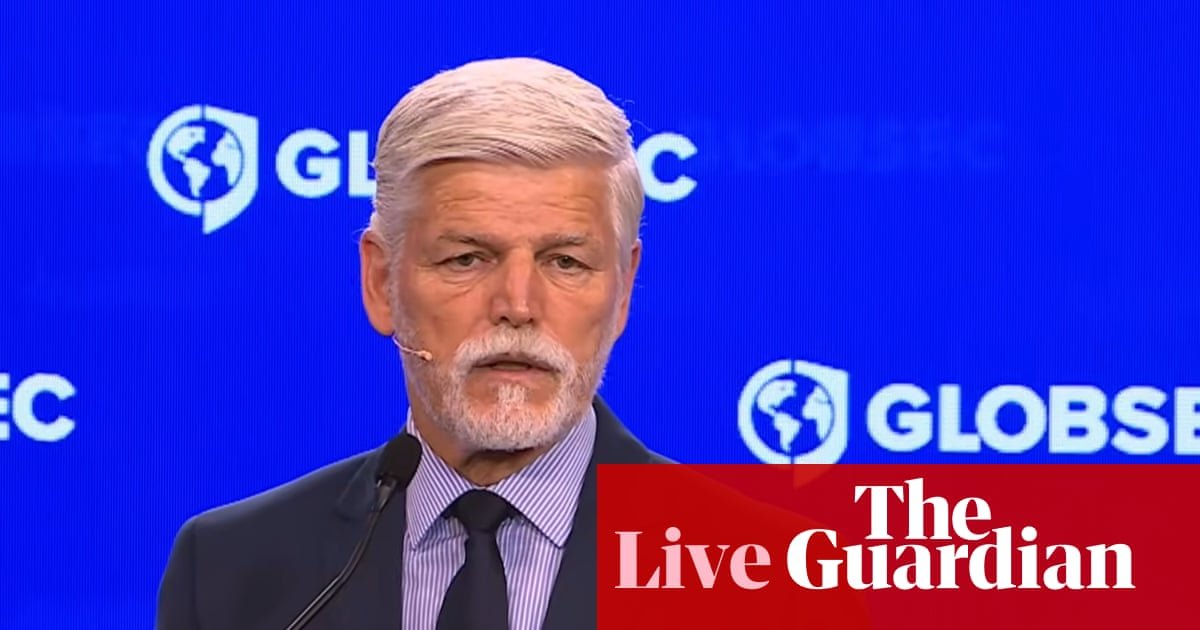
‘Peace in Europe no longer default,’ Czechia’s Pavel says
In a stark warning, Pavel – a retired Nato general – warns that “peace in Europe can no longer be treated as the default state of affairs.”
“It must once again be actively protected, defended and maintained. The lesson of this moment is not that Europe is alone it is that Europe needs to be strong enough to stand on its own when needed.”
He warns that Europe needs to pull all the levers to get itself into the best position, as “history will simply not wait for Europe to become ready.”
“We must act swiftly,” he says.
Key events
-
Russia claims Ukraine is seeking escalation after Zelenskyy warns of possible expansion of war by Russia
-
Europe needs to learn from Ukraine, move ‘much faster’ to respond to challenges, Pavel says
-
‘Peace in Europe no longer default,’ Czechia’s Pavel says
-
‘If Ukraine is forced into bad peace, we will all live with consequences for decades,’ Pavel warns
-
EU and Nato should align priorities to help Europe step up its defence, Pavel says
-
‘No time to lose’ as capabilities, not spending, are key for Europe’s ability to defend itself, Pavel says
-
‘Many assumptions for old security architecture are no longer valid,’ Czech president warns
-
Morning opening: Dobré ráno from Prague
Russia claims Ukraine is seeking escalation after Zelenskyy warns of possible expansion of war by Russia
Just as Pavel was speaking in Prague, Russian foreign ministry spokesperson Maria Zakharova told reporters that Ukrainian president Volodymyr Zelenskyy was pursuing escalation of the conflict between the two countries.
It’s quite a claim given (checks notes) Russia’s continued and relentless invasion of Ukraine for years.
But it fits a pattern of Russia’s increasingly assertive or outright aggressive language towards others in the region – first the Baltics, and Latvia in particular, and now Ukraine.
In fact, Zelenskyy specifically warned last night about the prospect of Russia expanding its aggression, particularly from the direction of Belarus.
““Ukraine will certainly defend itself, and right now our task is to strengthen our state so that none of Russia’s five scenarios for expanding the war through northern Ukraine succeeds,” he said.
Europe needs to learn from Ukraine, move ‘much faster’ to respond to challenges, Pavel says
Pavel also warns against Europe losing out through “bureaucratic obstacles.”
He points to Ukraine’s ability to innovate and live test new solutions, such as drones, within days, going through procurement and production to an accelerated timeline.
“Ukraine has demonstrated not only determination and heroism, but also unbelievable capacity to adjust, to innovate, to change.
It is something that we in Europe have lost through many regulatory measures that are necessary in peacetime, but of course in conflict you have to be … flexible and achieve the results in shortest possible time. …
I visited Ukraine a number of times, and also companies producing drones. They are producing them in a vast variety of versions, sending them straight to the frontline, testing in days, and having feedback in companies again in days. So the pace goes well beyond what we can achieve in peacetime. …
If we want to succeed in any potential future conflict, we have to have the procedures that will be much faster than that we have today, because otherwise we will be losing the conflict on bureaucratic obstacles.”
He compares it to Europe “having all the ingredients for a great meal, but we still don’t have a recipe.”
And that ends his session.
In a short Q&A, Pavel gets asked about the role of AI and technology more broadly.
He says it is “beyond any doubt that technology will be the weapon of the future,” as he points out to Russia’s Putin and China’s Xi focusing on this issue during their talks in China this week.
“I think we have to take it seriously, because mainly China is our is doing tremendous progress in this, and experience from both Ukraine and the Middle East shows that technological superiority can be a true game changer.”
‘Peace in Europe no longer default,’ Czechia’s Pavel says
In a stark warning, Pavel – a retired Nato general – warns that “peace in Europe can no longer be treated as the default state of affairs.”
“It must once again be actively protected, defended and maintained. The lesson of this moment is not that Europe is alone it is that Europe needs to be strong enough to stand on its own when needed.”
He warns that Europe needs to pull all the levers to get itself into the best position, as “history will simply not wait for Europe to become ready.”
“We must act swiftly,” he says.
‘If Ukraine is forced into bad peace, we will all live with consequences for decades,’ Pavel warns
Pavel turns to Ukraine, stressing that “supporting Ukraine is not a charity,” but “a direct investment in Europe’s own security.”
“If Ukraine is forced into a bad peace, we all will live with the consequences for decades,” he warns.
EU and Nato should align priorities to help Europe step up its defence, Pavel says
Pavel also stresses the need to bring the EU and Nato closer, as Brussels “has instruments that Nato does not have: funding, infrastructure, and industrial policies” that can work as policy tools to help with defence preparations.
“I am convinced that these two sets of instruments should be connected. Nato and European Union are not competitors in European security. They should function as complementary pillars.”
He gives a specific example of Nato working with the EU to modernise “routes, ports, bridges and airfields” that are critical for moving forces across Europe.
“The task is to make sure that the two plans overlap; that Nato’s military requirements guide EU investments, and the EU investments strengthen Nato deterrence.”
He pointedly says that such plans should include Canada, Norway, and the UK, as “indispensable European security actors.”
‘No time to lose’ as capabilities, not spending, are key for Europe’s ability to defend itself, Pavel says
Pavel says that Europe “has already made significant progress in defence spending,” but warns that “credible defence is not built on spending levels alone.”
“We need to work hard to strengthen our strategic enablers and close critical gaps in areas such as strategic airlift, air and missile defence, intelligence, logistics, or military mobility. There is no time to lose.”
‘Many assumptions for old security architecture are no longer valid,’ Czech president warns
Pavel begins by saying that his repeated warnings that Europe needs to focus on its political will, industrial capacity and technological capacity “remain fully valid; if anything, it has become even more urgent today.”
He says it is clear that Europe “must assume greater responsibility for our own defence, not because we are told so by Washington, but because it is in our own strategic and vital interest.”
He says that as “debates about the future scale of America’s conventional military presence in Europe are becoming more pronounced, Europe must be prepared for this reality.”
“This doesn’t mean that Europe should turn away from the United States – just the opposite. Nato remains the foundation of our collective defence, and the transatlantic bond remains essential for our own security – but we must be honest [that] many assumptions supporting the old security architecture are no longer valid.”
The Globsec Forum in Prague is now under way.
Czechia’s Pavel is on stage for his opening address.
I will bring you the key lines.
Morning opening: Dobré ráno from Prague
Jakub Krupa
in Prague
Dobré ráno, or good morning from Prague.
Over 2,000 state officials, foreign policy and security experts from Europe and beyond are meeting in the Czech capital for the GLOBSEC Forum 2026. And there is no shortage of issues to cover.
From the latest drone incidents in the Baltics to broader security situation in Ukraine and Europe – and this part of Europe in particular – to broader global questions on energy, geopolitics, AI, and the state of the transatlantic alliance, there will be plenty of things to cover.
We will hear from the Czech president, Petr Pavel, the European Commission’s vice-president, Henna Virkunen, and the former Nato secretary general, Anders Fogh Rasmussen, among others just as Nato’s foreign ministers gather in Sweden for their ministerial meeting today and tomorrow.
Last night, Pavel warned that Russia will continue to be Europe’s main security threat for decades, as the continent wakes up from being overreliant on US protection and needs to radically bolster its own defence as a new global order of competing superpowers takes shape.
I will bring you all the key lines here.
Elsewhere, I will bring you the latest on Ukraine, the said drone incidents in the Baltics, and all other relevant news from across the continent.
It’s Thursday, 21 May 2026, it’s Jakub Krupa here, and this is Europe Live.
Good morning.


