



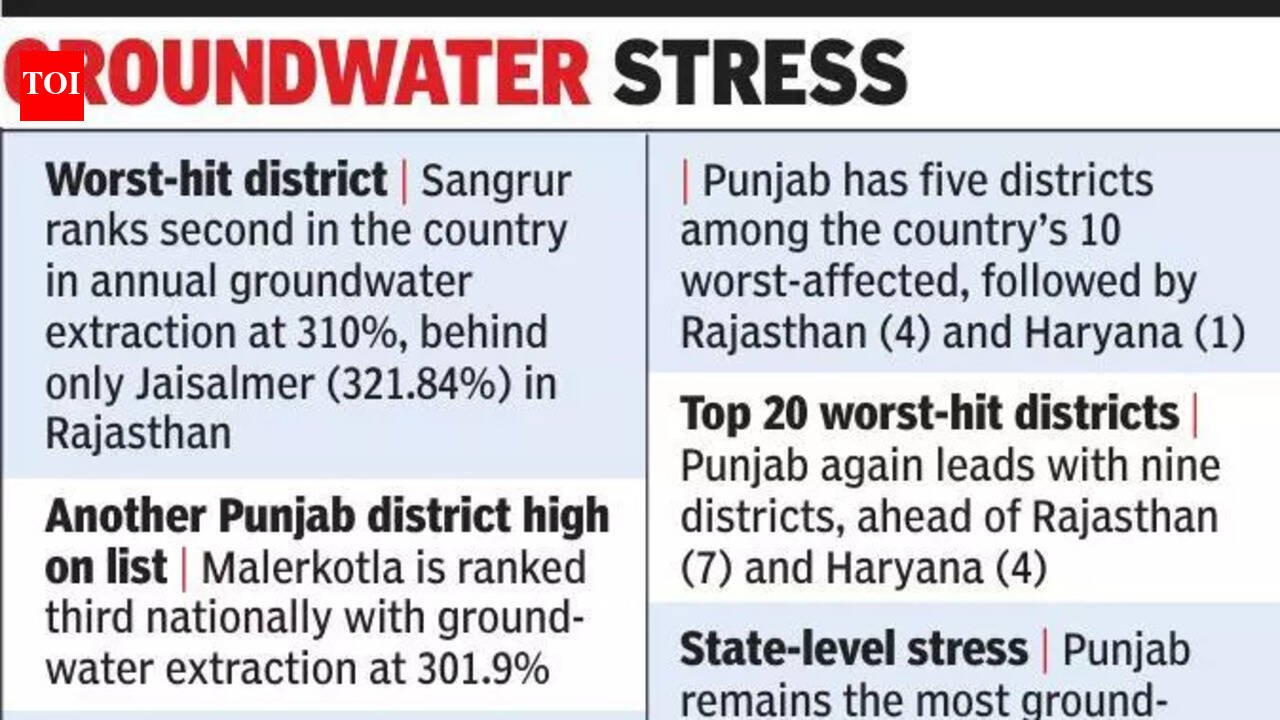
Bathinda: Punjab chief minister Bhagwant Mann’s native district Sangrur ranks second in the country in annual groundwater extraction exceeding extractable groundwater resources, according to the Dynamic Groundwater Resource Assessment, 2025, conducted by Central Ground Water Board in coordination with states.Sangrur recorded a groundwater extraction stage of 309.99%, second only to Jaisalmer in Rajasthan, which tops the list at 321.84%. Adjoining Malerkotla stands third at 301.93%. It was part of Sangrur district until June 2021, when it became Punjab’s 23rd district. Excessive reliance on paddy transplantation is cited as the primary driver of Sangrur’s high extraction levels. Nationally, 94 districts across nine states fall in the overexploited category, where groundwater extraction exceeds 100% of extractable resources. Of these, Rajasthan accounts for 27 districts, followed by Punjab with 20, Haryana with 15, Tamil Nadu with 10, Madhya Pradesh with five, and Uttar Pradesh, Gujarat and Delhi with four each. This was revealed by Union minister of state for Jal Shakti Raj Bhushan Choudhary in a written reply in Rajya Sabha on Monday. Among the 10 worst-affected districts, Punjab leads with five, followed by Rajasthan with four and Haryana with one. In the top 20 worst-affected districts, Punjab again tops with nine districts, ahead of Rajasthan with seven and Haryana with four. Of the 21 critical districts — where extraction stands between 90% and 100% of extractable resources — Uttar Pradesh has the most at seven, followed by two each from Madhya Pradesh, Karnataka, Tamil Nadu, Delhi and Rajasthan, and one each from Telangana, Chhattisgarh, Haryana and Punjab. At the state level, Punjab, Rajasthan and Haryana are the only three with groundwater extraction over 100% of the extractable resources. Punjab is at the top with 156.36%, followed by Rajasthan at 147.11% and Haryana at 136.75% against the national annual average of 60.63%. The Central Ground Water Board has around 27,000 manual and 22,000 automated monitoring stations for groundwater level and around 20,000 monitoring stations for groundwater quality spread across the country. MSID:: 129897664 413 |


