



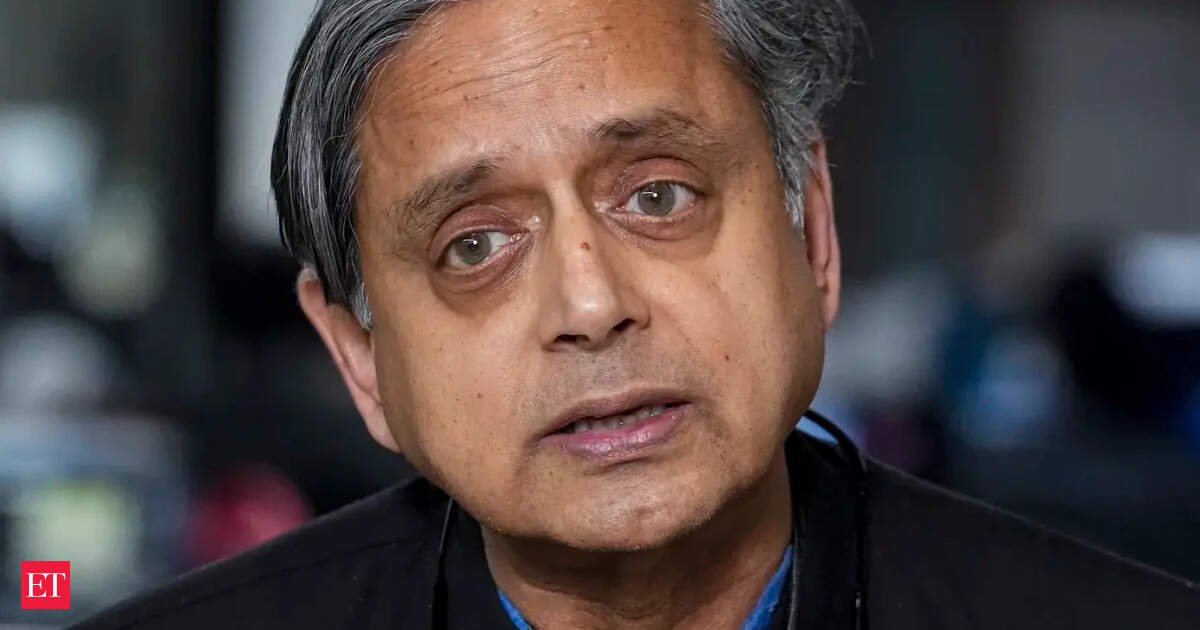
Tharoor emphasised that if Pakistan emerges as a peacemaker in a specific context, it does not erase the evidence of its past misdeeds.
Also Read: Lebanon ceasefire integral to pact, says Iran FM spokesperson amid US talks
Speaking with reporters after attending the National History Conference here, Tharoor said Pakistan has “skin in the game” as it shares a 900 km-long border with Iran and also has a significant Shia population.
The Congress leader noted that if the conflict escalates, all the refugees will come to Pakistan, and therefore, its stake is different in this game from that of India. “I don’t see any competition with Pakistan when it comes to this,” he said.
Tharoor expressed his belief that India’s primary interest lies in achieving peace. “I think we should monitor what is going on very carefully. Our government, our prime minister, our foreign minister, our petroleum minister, everyone is in touch with leaders of that region because that is in our interest. We cannot afford to be disengaged; we have to be very much actively involved, and I will say that we should absolutely hope that peace comes as a result of these efforts.
“I don’t think there is any need to worry about who brings about the peace. Who brings about the peace won’t matter if peace comes. If peace fails, on the other hand, then we should analyse very carefully the reasons for that failure and see if there is any way that we can contribute to a different outcome,” the former minister of state for external affairs said.Also Read: Donald Trump says US initiating move to ‘clear out’ Strait of Hormuz, cites global shipping security
Tharoor underscored that India has a fundamental interest in both peace and maintaining regional stability.
“A vacuum is dangerous; it hurts us in other ways also. As a leading voice of the Global South, India is a responsible stakeholder in the process of constructing a viable regional and global order and for that we cannot afford to be passive, we cannot just observe when fires are blazing in the neighbourhood, we would have to play an active role but it would have to be carefully considered role, one where we examine for ourselves what is the most useful contribution we can make,” Tharoor said.
“Sometimes, that useful contribution may truly be in silence. I have written that earlier. But today we are understandably more active in the region, three ministers are flying around, and the prime minister is on the phone. All of this is very good. We need to see much more of this because that engagement is what keeps us viable and potentially able to play a larger role that today we are not in a position to play,” Tharoor said.
Tharoor also took a swipe at Pakistan over a social media post by Prime Minister Shehbaz Sharif, where he appealed for a two-week extension to allow diplomacy in the West Asia conflict. Shortly after it was published, users circulated screenshots of the post’s edit history showing it initially carrying the line: “Draft — Pakistan’s PM Message on X.”
“I do feel that Washington gave the message to Pakistan’s PM to post it on X, or why would someone write ‘Draft — Pakistan’s PM message’? The language and some phrases used in that message also pointed to the US involvement. The role that it is playing with the US, only Pakistan can play that,” he said.
Furthermore, Tharoor reiterated that even if Pakistan emerges as a peacemaker, it does not negate its previous misdeeds.
“If it wishes to be recognised as a peacemaker, then it must dismantle the terrorist infrastructure and the terrorist training camps located in their country, freeze their bank accounts, and arrest those leaders who roam about delivering hate speeches. Only then will we truly believe that a genuine change has taken place within you,” Tharoor said.
His remarks come amid the high-stakes meeting scheduled between the US and Iran in Islamabad. US Vice President J D Vance and Iranian Parliament Speaker Mohammad Bagher Ghalibaf arrived in Pakistan on Saturday to hold peace talks, as the international community awaited a breakthrough to end the escalating conflict in West Asia that has triggered widespread economic disruptions.
While Vance is accompanied by Special Envoy Steve Witkoff and Jared Kushner, President Donald Trump’s son-in-law, the Ghalibaf-led Iranian delegation comprises Foreign Minister Abbas Araghchi, Supreme National Defence Council Secretary Ali Akbar Ahmadian and Central Bank Governor Abdolnaser Hemmati.
The two sides are in Islamabad to attend the Pakistan-mediated peace talks, four days after Iran and the US announced a two-week ceasefire. However, a massive wave of Israeli strikes on Lebanon, killing more than 300 people, has left the truce in tatters.
While Tehran claimed the assault violated the terms of the ceasefire understanding, the US and Israel said Lebanon was not part of the deal.
Earlier, at the National History Conference, Tharoor said the question of who writes our past is not confined to historians alone, as it lies with institutions, politicians, educators, and those who shape public discourse.
“More broadly, it lies with all of us, for the way a society remembers its past is inseparable from how it understands itself in the present. History is not simply inherited; it is interpreted, debated, and often contested,” he said.


