



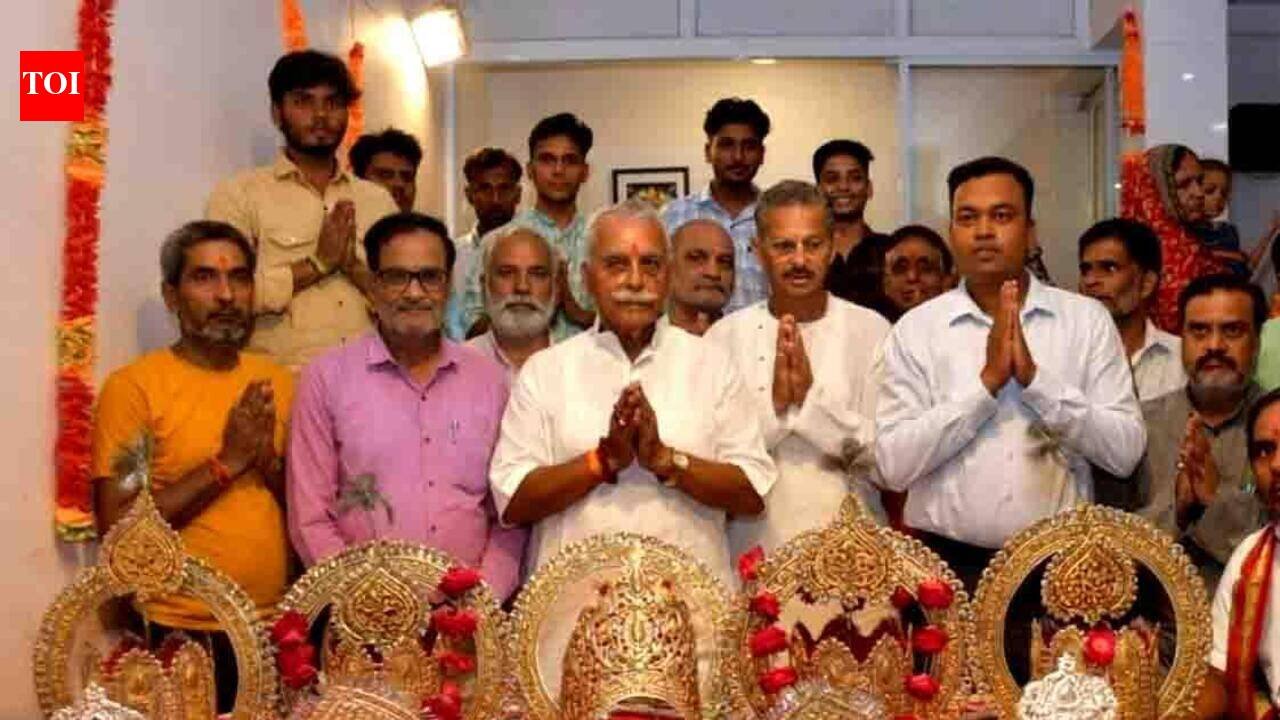
Prayagraj: The ‘Mukut Pujan’ (coronation crown worship) ceremony of the Pajawa Ramlila Committee was held with great grandeur, upholding a unique, centuries-old tradition at Shahganj Ram Mandir with chants hailing Lord Ram on Tuesday.As many as 11 Brahmins and Vedic scholars performed the worship of the golden crowns of Lord Ram, Lakshman, Goddess Sita, Bharat and Shatrughna. The event, featuring the worship of Lord Ram’s crown and the Aarti, was also conducted.Ramlila authorities claimed that the history of the Shri Mahant Baba Hathiram Pajava Ramlila Committee spans approximately 200 years. Prayagraj’s famous Pajawa Ramlila started over 200 years ago. Earlier, Ramlila was performed inside the Ram temple at Shahganj as Hindus were not allowed to hold public processions during Mughal rule. After the British took control of Prayagraj in 1802, the temple Mahant Baba Hathiram, who was also a wrestler, started public Ramlila at a place called Pajawa in Atarsuiya. He used to carry the artists playing Ram and Lakshman on his shoulders and Sita in his arms to the venue. Pajawa is a type of clay used by potters and since potters lived there, the area got its name. The committee later came to be known as Shri Mahant Baba Hathiram Pajawa Ramlila Committee. After the show, the Mahant would rest at the Sati Anusuya Temple and then stop in front of Chowk’s Jama Masjid so that people could see the artists. Later, he also started Vanar Sena processions on the days of Kumbhakarna and Ravana vadh, which became famous as Ram Dal of Navami and Dashami. Ravana vadh was enacted at Kakra Ghat on Yamuna. In 1820, due to a communal dispute, the Ram Dal was stopped for 2-3 years. Then Lala Mahadev Prasad asked the Mahant to restart it and took responsibility for security. Even today, the Ramlila is run by his family members Suresh Chandra Tandon and Amitabh Tandon. Inspired by Baba Hathiram, many other Ramlila committees were formed in the city, but Pajawa Ramlila became the most famous. Over time, it became bigger with modern tableaux. In 2006, director Sachin Kumar Gupta introduced sound and light effects, which continue till now.
