



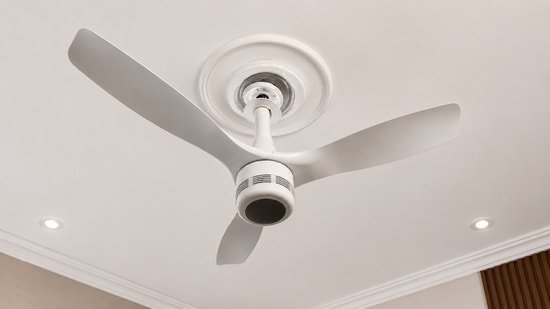
For as long as I can remember, buying a ceiling fan has been the most boring decision in setting up a home. You look at the blade size, maybe the star rating if you’re feeling responsible, and you move on. Nobody debates fans the way they debate phones or TVs. Orient Electric is betting that this is about to change, and the Aero O2 is its opening argument.
On paper, this is India’s first “oxygen-enriching” ceiling fan. That’s a big claim to lead with, so I spent time with the fan running in a closed bedroom in Delhi, the kind of city where checking the AQI before opening a window has become second nature, to see how much of it holds up in daily life and how much is packaging.
Orient Aero O2 review: Design and First Impressions
The Aero O2 doesn’t try to hide what it is. The motor housing is noticeably bulkier than that of a regular ceiling fan because that’s where the Bio-Oxy Plasma ION+ module sits. Orient has gone with a clean white finish, and 1200mm aerodynamic blades, and the whole thing looks premium enough not to feel out of place in a newer apartment. It’s also, quite honestly, a fan people will ask you about the first time they see it running, mostly because of the subtle light ring under the motor that changes colour depending on whether the purification mode is active.
The remote is RF-based rather than infrared, so you don’t need to point it at the fan for it to respond, which sounds like a small thing until you’ve spent years fumbling with an old IR remote across a dark room. It handles speed, timer settings, reverse rotation, and toggling the ion mode on or off.
Orient Electric Aero O2 BLDC Fan Review: What’s Actually Powering It
Strip away the marketing language, and the Orient Aero O2 is a BLDC ceiling fan first. Orient lists the motor at 250 CMM air delivery with a 290 RPM speed, and the fan is built around a low-wattage BLDC motor, somewhere in the high 30s in terms of watts, which is standard territory for this class of premium fan and a meaningful step down from the 75-90W a regular induction motor fan pulls. Over a full day of use, that difference shows up on the electricity bill, even if it’s not dramatic month to month.
Noise is another strong point. Even at higher speeds, the motor remains quiet enough that it never becomes distracting while working or sleeping.
The included remote is easy to use and offers multiple speed controls, timer functions, reverse rotation for winter, and independent control of the plasma ion system. The reverse mode is particularly useful if you use air conditioning during winter or simply want better air circulation without a direct breeze.
The Big Feature: Does the Oxygen-Enriching Technology Matter?
This is where the Aero O2 separates itself from every other ceiling fan. Orient says the fan uses Bio-Oxy Plasma Ion technology that releases plasma ions into the room. According to the company, these ions break down certain pollutants, neutralise microbes, reduce some harmful gases, and release oxygen bound within those compounds. The company also cites NABL-accredited lab testing, which claims that it can raise oxygen levels by up to 90 percent over eight hours, cut down gases like NO2, SO2 and CO2 by up to 75 percent, and neutralise close to all airborne microbes it’s tested against. There’s also a headline number about improving the indoor air quality index by up to 60 percent.
I want to be upfront about how I read numbers like these. Lab conditions are lab conditions, and a bedroom with a door that opens and closes, people walking in and out, and a window that isn’t sealed is a very different environment. What I can tell you from actually living with the fan is this: I didn’t feel some dramatic burst of freshness the moment I switched on the ion mode. Nobody should expect that. What I did notice, especially in a shut room over a couple of hours, is that the air felt a little less heavy than it does under a plain fan, particularly at night with the AC running and the room fully sealed. It’s a subtle shift, not a transformation, and I’d stop well short of calling this a replacement for an air purifier. It works alongside one, not instead of one.
Living with It Day to Day
Where the Orient Aero O2 earns its keep without needing any asterisk is as a fan. The airflow is strong and even across the room, the speed steps feel well-calibrated rather than jumping in awkward increments, and the noise level is genuinely low even at the top speed. For a bedroom, that quiet operation probably matters more day-to-day than the oxygen claims.
The reverse rotation winter mode is a feature most Indian households never touch, but if you’ve used central heating or an AC in reverse-cycle mode abroad, you’ll know what it does: it pushes warm air that collects near the ceiling back down into the room during colder months. It’s a nice inclusion for a fan you’re expected to run all year.
The timer is set in blocks of two, four, six, and eight hours, which is practical for anyone who likes falling asleep without worrying about getting up to switch the fan off later.
Orient Electric Aero O2 BLDC Fan Review: Energy Efficiency
The BLDC motor is one of the Aero O2’s biggest strengths. If you’re upgrading from an older induction-motor ceiling fan, electricity savings over several years could be meaningful, especially if the fan runs for long hours every day. It also receives a 5-star energy rating, which adds to its long-term appeal.
Orient Electric Aero O2 BLDC Fan Review: What Could Have Been Better
The biggest hurdle is pricing. At around Rs. 15,000, the Orient Aero O2 costs several times more than premium BLDC ceiling fans from brands like Atomberg, Havells, Crompton, or even Orient’s own lineup.
The oxygen-enrichment claims also require a degree of trust. While Orient references laboratory testing, most buyers won’t have a practical way to verify those benefits at home. Independent long-term studies would make the value proposition even stronger.
Lastly, buyers looking specifically for air purification may still need a dedicated HEPA air purifier in cities with consistently poor AQI.
Should You Buy the Orient Electric Aero O2?
The Orient Aero O2 succeeds first as a premium BLDC ceiling fan. It delivers strong airflow, runs quietly, consumes little power, and includes useful features like remote control, timer modes, and reverse rotation.
Its air-treatment technology makes it different, but I wouldn’t recommend buying it solely because of the oxygen-enrichment claims. Treat those as an added benefit rather than a guaranteed replacement for an air purifier.
If you’re already planning to buy a premium ceiling fan and are willing to pay extra for a product that also attempts to improve indoor air quality, the Orient Aero O2 offers something genuinely different. But if your priority is simply cooling or maximum value, there are several BLDC fans available at a much lower price that deliver similar airflow and energy efficiency.


