



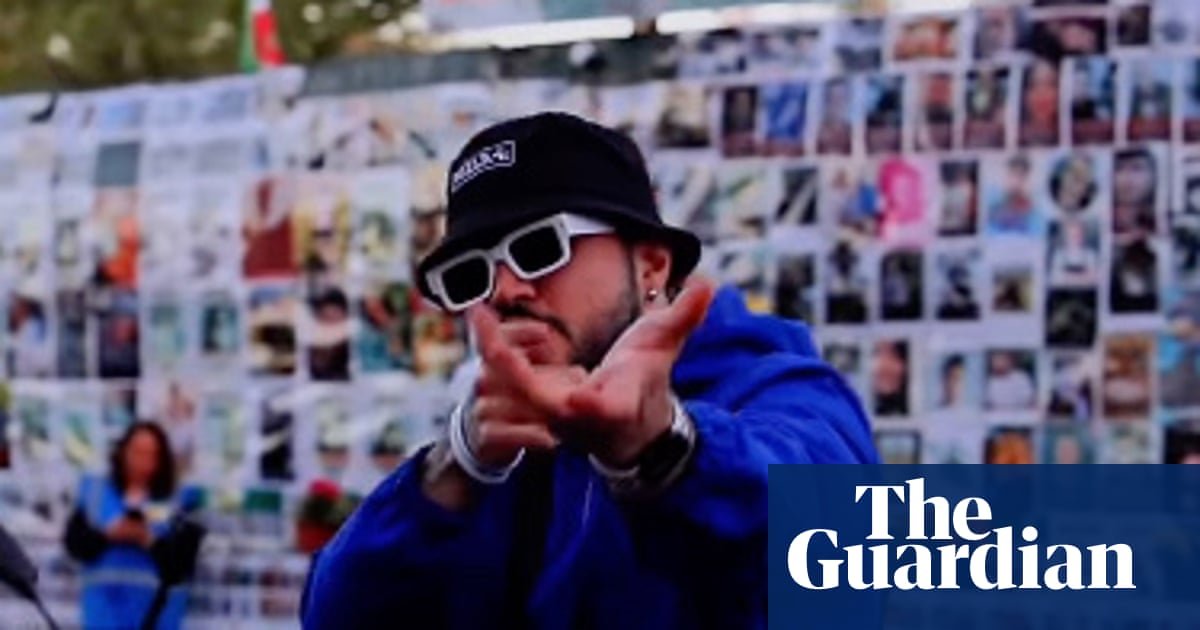
Wearing a bucket hat, a blue Adidas hoodie and khaki shorts, Tony Mohraz, also known as 021kid, chest-bumps a friend in front of a memorial wall in Golders Green, in north London.
Photographs can be seen behind him of those who were killed protesting against the Iranian regime. As a large lion and sun flag used in Iran before the Islamic revolution is waved overhead, Mohraz starts to rap.
“Basij, one, two, shoot. IRGC, one, two, shoot. Mojahedin, one, two, shoot,” he drills for the benefit of a camera while imitating firing a weapon.
The rap from Mohraz – an advocate for the return to the Iranian throne of the Pahlavi dynasty, specifically Reza Pahlavi, the exiled son of the late shah – is a remix of a hip-hop war anthem popular in Israel, called Harbu Darbu (slang borrowed from Syrian Arabic which, in Hebrew, means to rain hell on an opponent).
The Basij he is pretending to shoot is a paramilitary organisation that is known as the “iron fist” of Iran.
The IRGC referenced is the Islamic Revolutionary Guard Corps, the regime’s most powerful political and military institution. And then there is the mention of the Mojahedin.
The People’s Mojahedin Organization of Iran (PMOI), more commonly known as the Mojahedin-e-Khalq (MEK), was part of the revolution against the western-backed shah in 1979 but became an exiled armed opposition group fighting the new regime from Iraq.
The MEK today publicly distances itself from its Shia Islam and Marxist background and claims to speak, both at home and abroad, for those who want a democratic secular Iran rather than the return of a monarchy that ended with the exile of Shah Mohammad Reza Pahlavi 47 years ago.
The aggressive drill music made by Mohraz, 28, whose 021kid moniker derives from the phone code in his home city of Tehran, is only the most public evidence of a battle being played out on the streets of London that is not between supporters and opponents of the Iranian regime but instead within the opposition.
It is a clash that has been electrified by the hopes raised by the US and Israeli military action over the past three months, but is now posing a headache for British police, as well as being a source of anxiety for the Iranian diaspora touched by it.
Scuffles at protests against Tehran’s regime, often requiring police intervention, have been attributed to tensions between the sparring sides, raising the concerns that matters could escalate.
Laila Jazayeri, the director of the Association of Anglo-Iranian Women in the UK and a prominent supporter of the MEK in London, has referred Mohraz’s video to the police, describing it as a “terrifying and direct incitement to murder members and supporters” of her dissident group.
“Death to mullah, MEK and leftists,” rapped Mohraz in a second music video posted on his Facebook page earlier this month. He also filmed himself marching at the recent Unite the Kingdom rally, organised by the far-right activist Tommy Robinson, whose real name is Stephen Yaxley-Lennon.
The Metropolitan police have told Jazayeri, who has been given two death sentences in Iran for her activism, that the complaint is being taken seriously.
“Thank you for bringing this to my attention,” wrote an inspector from the Barnet community policing team. “I appreciate that the content you’ve shared is concerning, particularly for you and others within the MEK community, and I want to reassure you that this is being taken seriously.”
A Met spokesperson said: “The Met police are assessing a report of threatening behaviour in relation to a song released online. Enquiries are ongoing.”
The video is part of a campaign of intimidation, claimed Jazayeri, who said she had been further “disturbed” by the “sight of some of Reza Pahlavi’s supporters parading in black jackets and T-shirts bearing the insignia of Savak,” the shah’s feared secret police.
She said: “This is not harmless nostalgia. It poses a direct threat to democratic discourse and to those struggling for a free and pluralistic Iran. No one can credibly claim to stand for freedom while glorifying the symbols of authoritarian rule.”
Around Finchley road, in north London, an area known as Little Tehran because of its large Iranian community, restaurant and cafe owners claim they have faced pressure from self-declared pro-Pahlavi supporters to put up the flag associated with the monarchy.
A reception organised in March by the Conservative MP Bob Blackman in the Jubilee room in Westminster Hall for the Persian new year, or Nowruz, was the subject of a noisy intrusion by three self-identified pro-Pahlavi supporters before they were ejected by security.
“Bob made a complaint to the authorities, so the services are aware of them now,” said one of the MP’s aides.
One of those who sought to crash the event, Niyak Ghorbani, an IT technician, explained his motivation in a TikTok post made before they entered the parliamentary estate. “Today we came to an MEK Nowruz event which they held here,” he said with a smile. “We came to turn their Eid into mourning.”
Elahe Jamali, a second intruder, said: “It’s interesting – the MEK are Islamists and Marxists, neither of which respect the Nowruz holiday.”
She added: “However, when they need to, they hijack it for their own benefit. We’ve come here to say happy Nowruz to the guests and then to enlighten them about who they choose to side with.”
Asked this week about their presence at the event, Jamali told the Guardian that they had been polite and had merely been “letting people know that there is a terrorist cult team in place called the MEK… We see them as an extension of the regime. Not only did they bring in the Islamic Republic, they also held arms against Iranian civilians during the Iran-Iraq War.”
MEK was proscribed in the UK as a terrorist organisation between 2001 and 2008, with ministers citing its assassination of senior Iranian officials and mortar attacks against government buildings in Tehran.
Similar scenes played out a week later outside the Iran Freedom Congress in London, attended by anti-regime activists and academics, where a handful of self-identified pro-Pahlavi supporters challenged those leaving the Westminster venue. In a statement that was unlikely to calm tensions, the MEK described it as “vile, despicable harassment and threats by shah-worshipping lumpen thugs”.
Ray Torabi, 44, who lives in Cologne, was once a member of the MEK but today regards Pahlavi as a potential transitional leader in Iran. He said he recognised that there were extremists among the supporters of the shah’s son but that it was not the full story.
He said: “One thing you can differentiate between the Pahlavi crowd and the MEK crowd is because the MEK is a cult, they have complete control over their supporters, their members, and you know they’re very well organised.
“That’s why you really don’t see the feeling falling out of line and then doing things, but on the other hand, the Pahlavi crowd, they’re not organised the same way; they’re not a cult, they’re individuals, they’re people who, a lot of them, they see Pahlavi as the only hope for Iran. There’s a group that are really extremists, and then they really worship Pahlavi. Sometimes they take it too far.”
Haleh Blake, 39, an anti-regime protest organiser in the UK who believes Pahlavi has support in Iran as a pro-democracy leader, said she condemned the lyrics of Mohraz but that the abuse on social media went two ways. “I also think there are infiltrations into our crowd,” she said of the view, shared among MEK supporters, that the regime has sought to stir up bad blood.
Sanam Vakil, director of the Middle East and north Africa programme at Chatham House, said it was difficult to gauge the level of support of either MEK or the Pahlavi movement in Iran but that the intimidation and harassment seen in London only helped to feed the Islamic regime’s narrative of a divided opposition.
“There is just deep competition between these groups and they are perhaps seeing this as a moment of opportunity to gain some more credibility in a moment of war and weakness – perceived weakness – of the Islamic republic,” she said. “I know there has been a level of violence and intimidation by the pro-Pahlavi [supporters]… which I think rebounds quite badly against them.”
Representatives of MEK deny their organisation is a cult. Mohraz, who has lived in the UK for eight years, declined to comment. When recently asked by CNN about the claims of harassment, Pahlavi dissociated himself. “I’ve always spoken against any kind of political violence or intimidation,” he said.


