



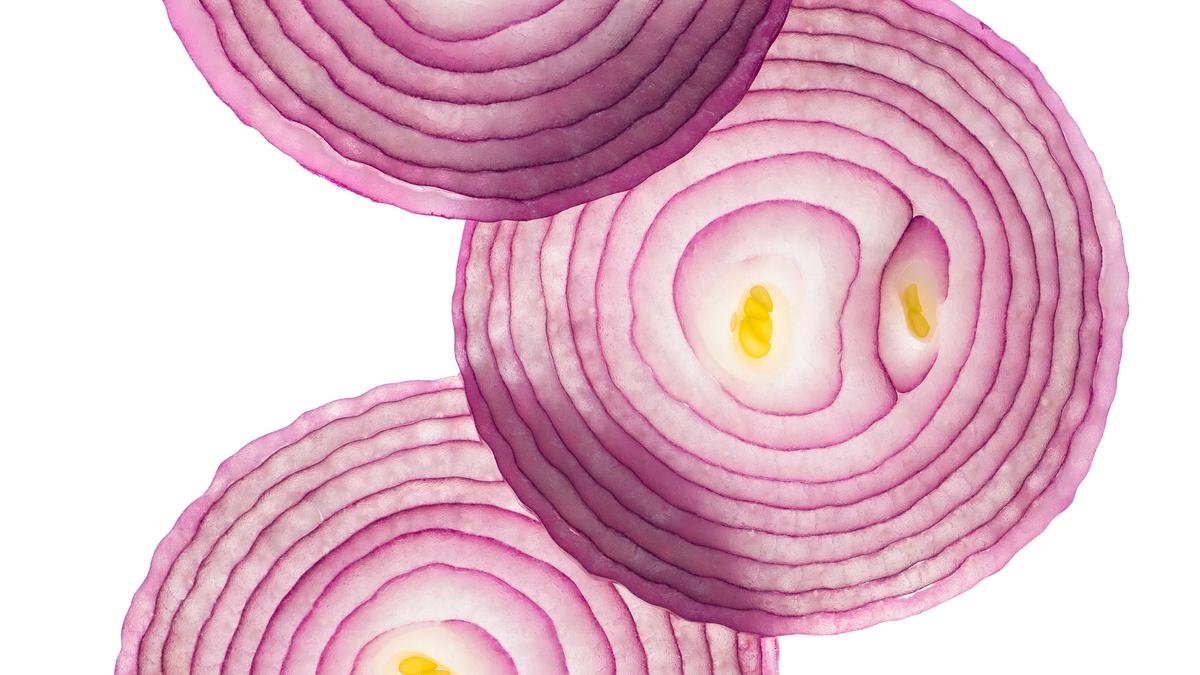
Cry to an onion.
| Photo Credit: Getty Images
It is an ordinary day. Somehow tears pool at the bottom of your eyes, threatening to spill out the canthus any moment. How did it turn out to be like this? Your eyes sting. The more you move your hands at the chopping board, the sting worsens. Alas, there comes the tears, full and uncontrollable.
Who am I mourning? Perhaps the red bulb onion in my hands?
Lacrimosa
The stinging tears just won’t stop! You could step away for a while but that’s only giving you temporary relief. Come back and it’s lacrimosa all over! If you think chopping shallots (smaller onion brothers) will be different, you’re mistaken. Some members of the Allium family just can’t be messed with.
Some members of the Allium family just can’t be messed with.
| Photo Credit:
Unsplash Images
Key members of the Allium family
Bulb onions, Shallots, Garlic, Scallions, Leeks, Chives
Culinary favourites, bulb onions also called common onions (scientific name: Allium cepa), are plants in the genus Allium and are immensely valued for their flavour. In fact, they are one of the world’s oldest cultivated plants. This funnily means that almost everyone, even the coldest and nonchalant of humans, has cried to an onion at least once in their life.
The stinging tears just won’t stop!
| Photo Credit:
Getty Images/iStockphoto
Lacrimosa is the Latin word for ‘weeping or tearful’.
Well, you can cry me a river
Onion bulbs grow underground by absorbing minerals, especially sulphur, from the soil. Many of you may realise from biology class that soil is home to a wide variety of microorganisms, insects, fungi, worms, etc. The onion, hence, exhibits prudence and develops a defence mechanism, a chemical warfare to keep these organisms away from itself. It is this defence mechanism that we experience while chopping onions. It is an onion’s attempt to keep away everyone who hurts it.
The syn
Let’s break this down further. Onion cells are filled with enzymes called allinase. Once the onions absorb sulphur from the soil, they use it with amino acids, turning them to sulphur-rich amino acids. When we cut onions, we break the onion cells open and the enzyme and all the contents spill out. These react with the sulphur-rich amino acids and eventually give rise to a volatile chemical known as syn-propanethial-S-oxide. This chemical is also called lacrymatory factor (LF).
Culprit:
syn-propanethial-S-oxide
The root of our burning eyes is precisely this LF. Once formed, the molecules of syn-propanethial-S-oxide spread into air and eventually reach the nerves of the cornea of the unfortunate person chopping the onion. Not to mention, there’s collateral damage too. If somebody was patiently minding their job in the kitchen while you were chopping onions, that person will cry too. Their eyes will similarly sting, though the degree might vary.
The root of our burning eyes is precisely this LF.
| Photo Credit:
Unsplash Images
Resisting the syn
Can you prevent these tears? The answer is yes, strategically. If you can shield yourself from the molecules of syn-propanethial-S-oxide, you can stop crying. Here’s what you can do:
-
keeping a fan on while chopping (have lot of air come into the kitchen),
-
Wearing goggles (acts like a literal shield),
-
Using sharp knives: Sharp knives cleanly cut the onion, reduces cell damage. Less mist reduces eye irritation.
-
Cut it gently: When you gently cut onions, the chances of onion juices spreading a large surface area is less.
Myth: Another common theory is chilling the onion. But this was debunked by researchers from the Cornell University last year.
“Indeed the tears live in an onion that should water this sorrow”Enobarbus to Antonyin Antony and Cleopatra by William Shakespeare
Published – April 06, 2026 08:00 am IST


