



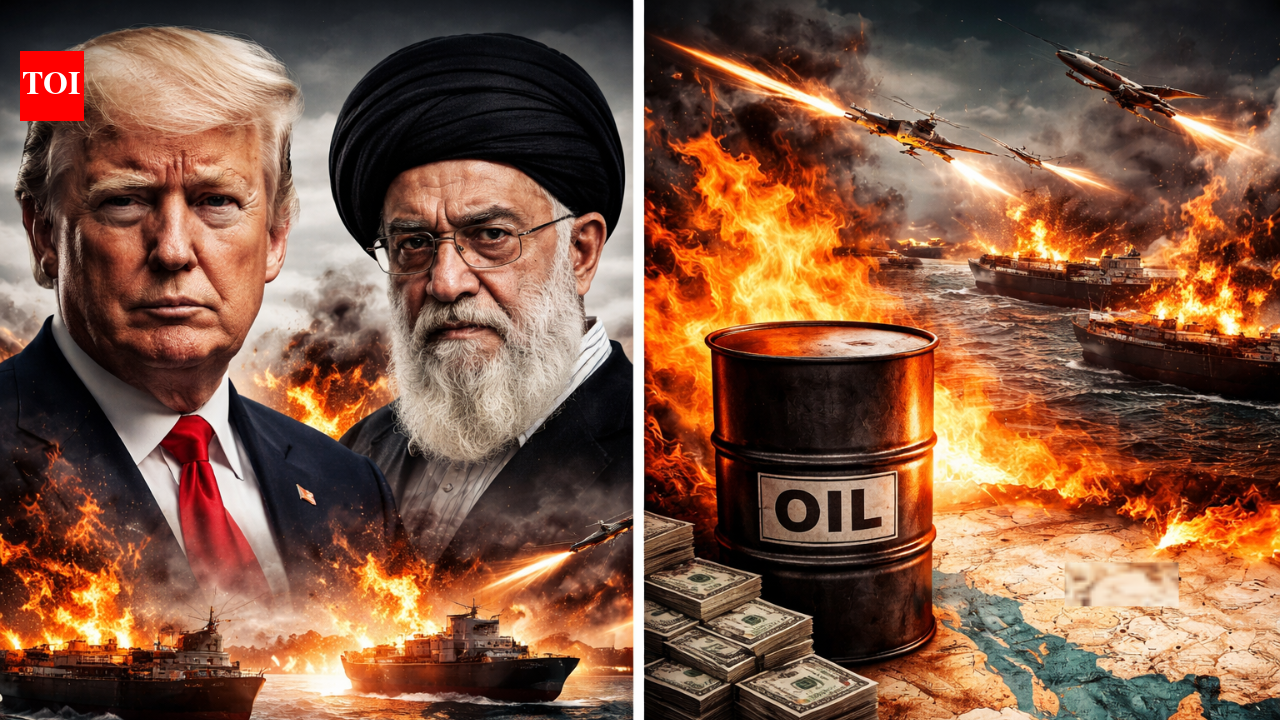
On February 28, what began as Donald Trump’s “dream” project to topple Iran’s regime under Ali Khamenei now appears to have shifted into a pressing push for a “deal”, a term the US president frequently invokes, aimed at reopening the vital oil chokepoint, the Strait of Hormuz.The narrow waterway in Gulf had been effectively choked off by raging Tehran after American-Israeli strikes that also eliminated Khamenei, the country’s longest-serving Supreme Leader on day 1.Not long ago, in February only, Trump said regime change in Iran is “the best thing that could happen”, marking one of his clearest endorsements of replacing the clerical establishment.“For 47 years, they’ve been talking and talking and talking. In the meantime, we’ve lost a lot of lives,” he said.Uncle Sam’s Operation Epic Fury has, in the end, left Donald Trump increasingly frustrated and furious. Despite a grand showcase of American military power and close coordination with Benjamin Netanyahu’s Israel, the campaign has struggled to deliver decisive results.
Facing pushback from Ali Khamenei’s son and successor Mojtaba-ruled Islamic Republic, MAGA supremo also sought support from Nato allies to counter Iran’s chokehold over the Strait of Hormuz. However, with little appetite for deeper involvement, allies largely stayed on the sidelines, leaving Washington to confront the crisis largely on its own.
Operation Epic Fury: Trump and Netanyahu strike Iran
A month ago, Donald Trump orchestrated a bold and highly ambitious military campaign, known as Operation Epic Fury, in close coordination with his longtime ally, Israeli Prime Minister Benjamin Netanyahu. Israel joined the offensive with its own Operation Roaring Lion, launching the first joint strikes on February 28.The campaign’s high-value objectives were achieved, as Iran’s supreme leader and Shia icon, Ayatollah Ali Khamenei, who had ruled the country’s for more than three decades, was killed.The conflict began with a massive strike on Iran, which the Pentagon described as wielding twice the firepower of the 2003 “shock and awe” campaign that marked the invasion of Iraq.
According to a Financial Times report, Israel had been tracking Khamenei’s movements for years, keeping him under constant surveillance. In its effort to monitor the Iranian leader, Israeli intelligence reportedly employed even unconventional methods, including using traffic lights to follow his movements.Another report suggested that Israel played a decisive role in pushing the Trump administration toward a military strike on Iran. These claims were echoed by Donald Trump’s former aide, Joe Kent, who resigned as director of the US National Counterterrorism Center.Kent strongly claimed that Israel had effectively drawn the United States into the conflict, while also dismissing reports that Iran was expanding its nuclear ambitions or plotting “9/11-style” attacks on American soil.
Tehran strikes back before smoke clears
A leaderless Iran retaliated with full force. Its arsenal lit up the skies as strikes targeted key American bases in the Gulf, while missiles and other attacks rained down on Israeli cities.The back-and-forth exchanges soon turned the region into a tense theatre of constant threat and unrest. Among Iran’s losses were top leaders, including the supreme leader’s wife.Soon, the Tehran regime escalated its campaign, launching aggressive missile and drone strikes on American bases across Qatar, Saudi Arabia, and Iraq. But its assault did not stop there.The attacks spread across the Gulf, targeting Bahrain, the UAE, Oman, and Yemen, as Iran sought to assert its reach and retaliate against its adversaries. Lebanon-based Hezbollah, grieving the loss of the Shia leader Khamenei—joined the fray, striking at Israel in a bid for revenge.The region was rapidly engulfed in a new wave of conflict, with skies streaked by missiles and tensions spiralling across multiple fronts.
Gulf states on high alert
Gulf countries have raised concerns over the prospect of attacks by Iran-backed militias and proxy armed groups in the region, fearing they could destabilise regimes and escalate the war further. In a joint statement this week, Qatar, Kuwait, the United Arab Emirates, Bahrain, Saudi Arabia, and Jordan condemned Iranian attacks on their soil, both as strikes carried out directly from Iran and “through their proxies and armed factions they support in the region.”Earlier, Kuwait said it had foiled a plot to kill state leaders, arresting six suspects believed to be associated with Iran’s most powerful proxy group,Hezbollah. For decades, Iran has used proxy militias as a pillar of its foreign and security policy, employing them to export its revolution, expand regional influence, and destabilise enemy countries. The most prominent examples include Hezbollah in Lebanon and the Houthis in Yemen, but other brutal and influential Iran-backed militias also operate in Iraq and Syria.
‘Safe haven’ of Dubai under fire
The safe haven of Dubai, long regarded as a symbol of prosperity and stability, has not escaped the conflict. The sail-shaped Burj Al Arab hotel, perched on Dubai’s Gulf coast, has long embodied the city’s opulence and ambition.Residents were aghast as hundreds of drones and missiles targeted the UAE, including the capital Abu Dhabi, as well as US Gulf allies Oman, Kuwait, Qatar, and Bahrain—countries long considered refuges from regional conflict—on the first weekend after the war began.Explosions rattled windows of Dubai apartment towers, and the city’s bustling international airport was damaged, leaving four people injured.Over the course of the conflict, Iran has repeatedly struck Dubai, the so-called “Pearl of the Gulf,” a city known for its skyscrapers, luxury cars, bustling malls, and thriving business world. The attacks have raised stark questions about security and vulnerability, even as the UAE government continues to insist that the city’s skyline and infrastructure remain resilient.Millions of tourists visit Dubai each year, but in recent weeks, the city has stood on high alert, battered by missile and drone strikes from a vengeful Tehran.
Kharg Island and the oil lifeline
The conflict intensified further when the United States struck Kharg Island, Iran’s economic lifeline and a strategic defence point in the Persian Gulf. US forces conducted heavy airstrikes on military installations, including missile storage areas and other defence sites, while largely sparing the oil export infrastructure itself.
In an interview with NBC News, Trump said previous US strikes had “totally demolished” most of the island’s oil infrastructure. He added, “We may hit it a few more times just for fun.” US Senator Lindsey Graham posted on X, “He who controls Kharg Island controls the destiny of this war.”Kharg’s strategic importance lies in its proximity to the Strait of Hormuz, a narrow maritime passage that connects the Persian Gulf to the Gulf of Oman and the wider Indian Ocean. Roughly 20% of the world’s oil supply passes through this chokepoint every day, making the island and strait a critical factor in global energy security.
The Strait of Hormuz: A high-stakes chokepoint
The Strait of Hormuz has become more than a shipping route—it is a strategic pressure point in a widening Middle East conflict. Narrow and shallow, the waterway forces ships within striking distance of Iran’s rugged Musandam Peninsula coastline, a terrain tailor-made for asymmetric warfare.
Tankers carrying crude from Saudi Arabia, Iraq, Kuwait, Qatar, and the UAE transit the strait en route to global markets. While Iran itself accounts for only 3–4% of global oil supply, its geographic position allows it to threaten far larger shares of worldwide energy flows.Despite Trump proposing joint control of the strait with Iran’s leadership, most viable solutions rely on military force. Mines, drones, and missile threats make the waters dangerous, while mine-clearing operations could take weeks, exposing crews to constant risk and keeping global supply chains on edge.Days ago, Trump issued a stern warning, giving Iran a 48-hour ultimatum: “If Iran doesn’t fully open, without threat, the Strait of Hormuz, within 48 hours from this exact point in time, the United States of America will hit and obliterate their various power plants, starting with the biggest one first!”
Paused strikes?
Now, however, Trump has adopted a more measured approach. While continuing to post in all caps, his tone appears softened. He has paused military strikes on Iran’s energy infrastructure for five days, describing ongoing talks with Tehran as “productive.”In a Truth Social post, he wrote in all caps:“I am pleased to report that the United States of America, and the country of Iran, have had, over the last two days, very good and productive conversations regarding a complete and total resolution of our hostilities in the Middle East. Based on the tenor and tone of these in-depth, detailed, and constructive conversations, which will continue throughout the week, I have instructed the Department of War to postpone any and all military strikes against Iranian power plants and energy infrastructure for a five-day period, subject to the success of the ongoing meetings and discussions.”However, the strikes show no sign of letting up. Jets, missiles, and drones continue to crisscross the region’s skies, targeting airports, embassies and critical infrastructure, while the airspace above much of the Middle East — especially over Iran and Iraq — remains tense and highly volatile. The persistent threat of missile activity and ongoing military operations has disrupted civil aviation, forcing airspace closures and rerouted flights as authorities work to keep commercial aircraft clear of conflict zones.
Major oil facilities hit leading crisis worldwide
Iran expanded the conflict by directly targeting oil infrastructure across the Gulf, aiming to disrupt supplies and raise economic costs for its adversaries. Instead of limiting its response to military sites, Tehran focused on critical oil production, storage and export facilities.Among the key targets were installations linked to Saudi Aramco in Saudi Arabia, underscoring Iran’s ability to strike at the core of one of the world’s largest oil producers. These attacks heightened fears over the security of global oil supplies.The campaign also hit the UAE’s vital oil hub at Port of Fujairah, one of the region’s largest oil storage and export facilities. Drone strikes on oil tanks and infrastructure triggered fires and temporarily halted loading operations, exposing the vulnerability of a key alternative export route.Iran further broadened its energy offensive by striking major facilities such as the Ras Laffan liquefied natural gas plant in Qatar and an oil refinery in Israel, demonstrating its capacity to target oil and energy assets across multiple fronts.By focusing on oil infrastructure, Iran has sought to tighten pressure on global markets, disrupt supply chains and drive up prices — turning energy into a central lever in the conflict while amplifying its economic impact far beyond the region.
Trump called for help, allies said ‘not our war’
Strait 15-days into the war, Trump invited several countries to send warships to reclaim Hormuz. Much to his disappointment, none did.“This is not our war. We have not started it,” Germany said.Trump had hoped for China, France, Japan, South Korea and the UK among others to reclaim Hormuz. “Hopefully China, France, Japan, South Korea, the UK, and others, that are affected by this artificial constraint, will send Ships,” Trump said in a March 14 post.“Nobody is ready to put their people in harm’s way in the Strait of Hormuz,” European Union foreign policy chief Kaja Kallas said.Roughly one-fifth of global oil supply passes through this route. Oil prices have climbed worldwide, prompting several Asian nations to introduce fuel-saving measures, but participating in a US-Israel initiated war is not on the cards.Trump did not shy away from expressing his dissatisfaction with Nato. “They just weren’t there. We spend hundreds of billions of dollars a year on Nato, hundreds, protecting them, and we would have always been there for them, but now, based on their actions, I guess we don’t have to be, do we?” he said.
Why allies stayed away
Many US partners were wary of joining what they see as a war initiated by Washington and Israel, with little prior consultation. Officials and analysts noted that several countries felt sidelined in the run-up to the conflict, leaving little appetite to step in once it escalated.There is also lingering resentment over Trump’s treatment of allies since returning to power. From trade disputes to sharp rhetoric, relations with key partners have been strained, weakening the trust needed to quickly build a coalition in a crisis.Beyond politics, the risks on the ground are significant. Sending naval forces into the Strait of Hormuz would make those countries direct targets for Iran, a step many are unwilling to take. As security experts point out, there is little incentive for nations to expose their personnel to missile and drone attacks in a volatile war zone.Military strategy is another factor. Former officials argue the US has not yet established sufficient control over the strait to reassure allies. Without a clear security umbrella led by Washington, countries are hesitant to deploy their own ships into contested waters.
While many nations — including those heavily dependent on Gulf oil — are feeling the economic fallout, they appear to prefer absorbing higher energy costs over entering a direct confrontation. For them, the risks of escalation outweigh the benefits of intervention.In short, strained alliances, lack of prior coordination, and the high danger of becoming a combatant have combined to keep US allies on the sidelines — despite mounting global pressure to reopen one of the world’s most critical oil routes.
Mediation efforts falter amid deep divides
As the war drags on, tentative diplomatic efforts are beginning to take shape, but with little clarity on whether they can succeed. Donald Trump has put forward a sweeping 15-point ceasefire framework, reportedly delivered to Tehran through intermediaries like Pakistan, which has offered to host talks. While Washington insists “productive conversations” are underway, Iran has flatly denied any negotiations, dismissing the claims as the US “negotiating with itself.”The proposed plan outlines an ambitious roadmap: a temporary ceasefire followed by far-reaching demands on Iran’s nuclear programme, missile capabilities and regional activities, in exchange for sanctions relief and limited civilian nuclear support. It also calls for reopening the Strait of Hormuz — a key global chokepoint — underscoring how central the waterway has become to both military and economic calculations.But the gap between the two sides remains stark. For Washington and its allies, the priority is long-term security guarantees – curbing Iran’s nuclear ambitions, limiting its missile arsenal and ending its support for regional proxies. Tehran, however, is focused on sovereignty and survival. Its leadership has demanded recognition of its rights, reparations for war damage, binding guarantees against future attacks and the lifting of all sanctions.There are also more contentious demands from Iran, including the closure of US military bases in the region and formal control over traffic through the Strait of Hormuz — conditions that are likely to be unacceptable to Washington.Even within Iran, signals are mixed. While political leaders have hinted at openness to talks under the right conditions, hardline elements such as the Islamic Revolutionary Guard Corps appear determined to continue the fight, viewing the conflict as existential.With both sides holding firm and trust in short supply, mediation efforts remain fragile. Analysts say that while backchannel contacts may be underway, any meaningful breakthrough will require significant compromises — something neither side has yet shown willingness to make.
Who is winning the cost war
The financial toll of the conflict is rapidly becoming a critical battleground, and it is one where Trump’s United States appears to be at a disadvantage.Washington is estimated to be spending up to $1 billion a day on the war, with total costs already soaring into the tens of billions, DW reported. Pentagon assessments indicated more than $11 billion was spent within the first six days alone, and analysts now believe the overall bill has likely exceeded $18 billion — with no signs of slowing.A major driver of this imbalance is the stark difference in military costs. Iran is deploying low-cost drones priced at around $20,000, while the US is countering them with interceptor missiles costing between $1.3 million and $4 million each — often using multiple missiles per target. This mismatch is steadily increasing the cost burden on Washington.Meanwhile, Iran is managing to offset some of the economic strain. By effectively controlling the Strait of Hormuz, it remains the only country able to move oil through the vital passage, benefiting from rising global prices. Its oil revenues have climbed to roughly $139 million per day in March, while exports have stayed close to prewar levels of about 1.6 million barrels per day.Tankers continue to load at Kharg Island and transit the strait, even as Tehran blocks ships linked to rival nations — tightening its grip on a key global energy route.The contrast is striking – while the US is incurring massive costs to sustain its military campaign, Iran is pursuing a far cheaper, asymmetric strategy while still generating steady oil income. In economic terms, the balance of the war may be tilting in Tehran’s favour.


