



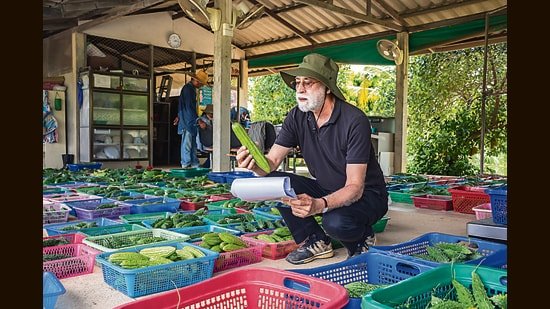
How does a person dedicate 48 years of their life to… gourds – is a question Narinder Pal Singh Dhillon doesn’t believe you should be asking.
A plant breeder, commercial farmer and former professor at Punjab Agricultural University, Ludhiana, Dhillon laughs gamely as he points out that these vegetables “are nutritionally and economically important, especially for small-holdings farmers”.
He himself has been nicknamed the “prince of pumpkin” and “baron of bitter gourd”, he adds; nicknames that were first awarded to him by Maureen Mecozzi, former director of communications at the research organisation World Vegetable Center (WVC; previously the Asian Vegetable Research and Development Center).
Over 20 years, Dhillon has worked with the Thailand-based WVC to develop hardier breeds of these vegetables, including variants that are more resistant to pests and disease.
His journey has been long, he says, but all roads led him to his main goal: cucurbits (the group of vegetables that includes cucumbers, melons, watermelons, pumpkins, squashes, gherkins and his beloved gourds).
Dhillon, 70, grew up in the village of Sur Singh in Amritsar, close to the border with Pakistan. Every day after school, he helped his family care for their cattle, work in the fields or thresh grain. They grew mainly paddy and wheat. “This was a time when the big machines and tractors hadn’t arrived yet,” he says. “Working with our hands was the single greatest joy of living.”
Newspapers at the time were full of talk of the Green Revolution. Punjab was at its heart, and Dhillon was fascinated. Was it true, he asked his father, that people in laboratories could make plants that grew better, and fed more people?
Some of the new breeds would soon reach his village, and he would see the vast difference they made: to yields, profits and livelihoods. His father, he says, chuckling, would tell him tales of the government’s plans for crop improvement as if they were bedtime stories.
Money wasn’t a big part of their lives but when he looks back, yes, they were technically poor, he says, speaking from his office at WVC, where he has headed the Cucurbit Breeding Programme since 2010.
“The choice of plant breeding as a career was obvious in this kind of environment.” He decided early on that he would learn all he could, and help the world grow better vegetables.
He earned a PhD from Punjab Agricultural University, undertook research work at international institutes such as University of California, Davis; Plant Breeding International, Cambridge; the Japan International Research Center for Agricultural Sciences; and France’s National Research Institute for Agriculture, Food and Environment.
He eventually settled in at WVC and, over 20 years, has led a team that has developed beta-carotene-rich, virus-resistant pumpkins, and bitter gourds with inbuilt resistance to a range of bacteria, fungi, parasites and insects. These have made their way to the global seed industry. (Thailand-based East-West Seed is among those who serve as commercial seed partners for the trials.)
Some of the new breeds are being sold in Asia, including in India and Pakistan.
THE GREATER GOURD
To return to what he considers the unnecessary question: Why cucurbits, rather than, say, cereals, which are easier to hybridise?
“They are an important source of vital nutrients that consumers aren’t consuming enough of. Genetic improvement in these can help fill this dietary gap and contribute to global nutritional security,” Dhillon says. Vegetable production can also help reduce rural poverty in developing countries, since these crops can be profitable for small-holdings farmers; and they are considered a key component of crop diversification and adaptation amid the climate crisis, he adds.
Towards this end, Dhillon and his team are working to breed varieties that can grow in varying terrains and climates. They do this by identifying genes from wild relatives that exhibit natural resistance to pests and diseases, and a natural hardiness in extreme climates, and transferring these genes into high-yielding varieties, using the marker-assisted selection (MAS) method.
Using the same methods, they are now working to improve the shelf life of gourds and squashes, pumpkins and melons, and extend disease- and drought-resistance. “Some viruses in cucurbits seem harder to tackle,” Dhillon says.
Growing these vegetables on dwarf vines will be a key focus area too.
In the years to come, more people will turn to greenhouse production, to protect crops from insects, pests and diseases, and from shifting climate patterns, Dhillon says. Breeding hardy varieties that grow on dwarf vines will thus be a priority.
BREED WINNER
What would make his work easier?
If he could make one wish, he says, it would be for easier access to new germplasm (seeds, tissues, DNA). Different countries’ seed banks and plant DNA banks are controlled by international treaties designed to protect sovereignty over genetic resources. This means breeders and researchers must jump through numerous hoops to get their hands on new genetic material. “And new germplasm is needed for continuous crop improvement and its sustainability.”
If he had two wishes, Dhillon adds, he would use the second to turn back the clock. He wishes everyone knew in the 1960s what we now know about the Green Revolution.
Small farmers have paid the price in the long term, he says. The water table has fallen and soil health has deteriorated considerably as crops popularised in those decades continue to be grown in regions that cannot support them, and that did not traditionally grow such water-intensive plants.
His great big hope is that the middle-income group, which is expanding around the world, will create demand for more diversified, healthier diets. “This will lead to an expansion of vegetable production and eventually create economic opportunities for all farmers,” he says.
So don’t ask why gourds, he adds, laughing. Even the least-loved of these, the karela or bitter gourd, is a hero vegetable, effectively controlling blood-sugar levels and keeping us healthy. And what society today, as he puts it, doesn’t need more of that?


