


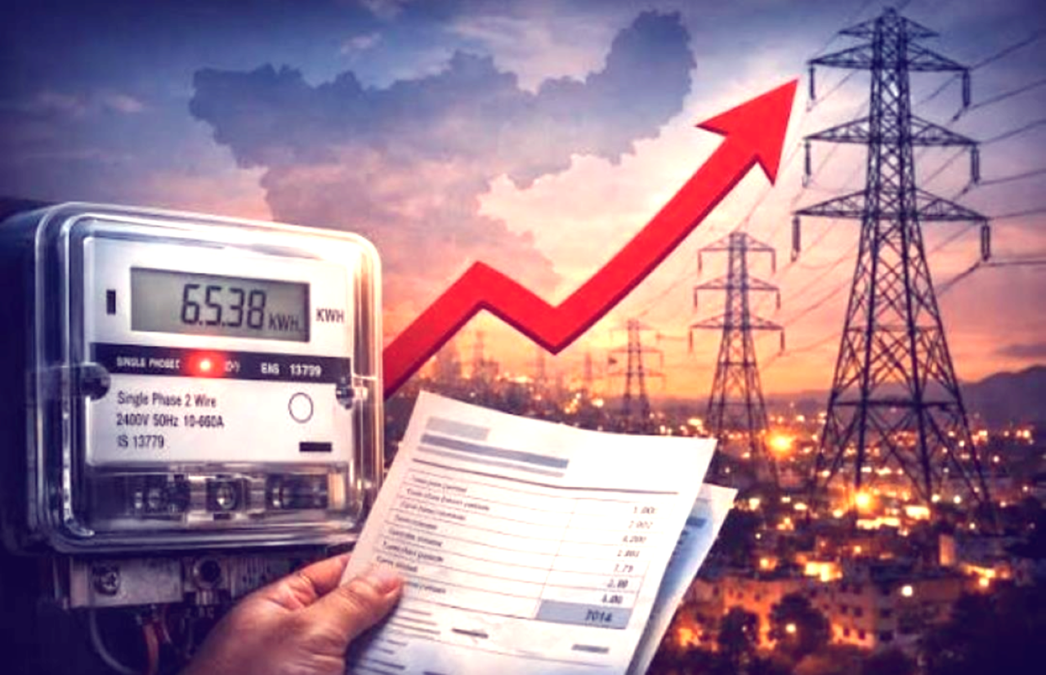
The decision to increase electricity tariffs in Jammu & Kashmir at a time when ordinary families are already struggling with the rising cost of living is deeply disappointing. More importantly, it raises a fundamental question of political accountability: what happened to the promises made to the people before the Assembly elections?
The Joint Electricity Regulatory Commission has approved an average tariff increase of 6.83 per cent, applicable from September 1, 2026. For metered domestic consumers, the rate for consumption up to 200 units has increased from ₹2.30 to ₹2.45 per unit; for 201–400 units, from ₹4.00 to ₹4.20; and above 400 units, from ₹4.35 to ₹4.60 per unit.
These figures may appear small when viewed from the comfort of government offices. For an ordinary household, however, every additional financial burden matters.
From Promise of Relief to Reality of Higher Bills
The National Conference went before the electorate promising 200 units of free electricity. That promise naturally created expectations among families that desperately needed relief.
Today, instead of experiencing the promised relief, consumers are confronting increased tariffs.
The government may argue that its promise of free electricity and the general electricity tariff are technically separate matters. But politics cannot be reduced to technical explanations. The real question is what an ordinary voter understood when promises of cheaper or free electricity were made.
People vote on the basis of promises and the reasonable expectations created by those promises.
If financial constraints, distribution losses and the cost of purchasing electricity were realities after the election, they were realities before the election as well. Governments cannot discover economic realities only after obtaining the mandate of the people.
Kashmir’s Winter Cannot Be Viewed Through Ordinary Consumption Calculations
The impact of electricity prices assumes an even greater significance in the Kashmir Valley.
For people sitting outside Kashmir, electricity may be regarded primarily as a source of lighting and running household appliances. During Kashmir’s severe winter, electricity is intimately connected with survival, warmth and basic human comfort.
Temperatures fall below freezing in many areas. Water pipes freeze. Snowfall disrupts normal life. Families depend increasingly upon electric heaters, boilers, geysers, heating blankets and other appliances.
The elderly, children and economically weaker families suffer the most.
This means that electricity consumption during the harsh winter months cannot simply be treated as discretionary consumption. A Kashmiri family using additional electricity to keep its children or elderly parents warm is not indulging in luxury.
It is responding to climatic necessity.
And the timing is particularly unfortunate. The revised tariff becomes applicable from September 1 and will remain applicable through the approaching winter until March 31, 2027.
The government should therefore ask itself a simple question: Is the period immediately preceding the harsh Kashmir winter the appropriate time to make electricity more expensive for households?
Don’t Make Consumers Pay for Inefficiency
There is undoubtedly a financial problem in the electricity sector. Power has a cost. Distribution companies require revenue, and transmission and distribution losses have historically presented a serious challenge.
But the solution cannot perpetually be to transfer the consequences of inefficiency onto honest consumers.
The first responsibility of government should be to reduce losses, improve billing and collection, prevent electricity theft, modernise infrastructure and improve the efficiency of distribution companies.
A family that pays its electricity bill regularly should not become the easiest source for balancing the books.
Before asking consumers to pay more, the government must demonstrate what measurable reduction it has achieved in distribution losses and what administrative reforms it has undertaken to bring down costs.
Efficiency must come before additional burden.
The Government’s Defence Does Not Answer the Political Question
Chief Minister Omar Abdullah has defended the increase by arguing that the government never promised that electricity tariffs would remain static and that power continues to be substantially subsidised.
That may constitute an administrative defence. It does not answer the political question.
The issue is not whether electricity continues to receive subsidy. The issue is whether the government is moving towards the relief that was promised to the electorate or away from it.
The people were promised 200 units of free electricity. They are entitled to ask when that promise will translate into meaningful relief in their monthly household budgets.
A government cannot seek political credit for promises and subsequently seek refuge behind regulatory calculations when people demand their implementation.
BJP Must Stand With the Consumer
The Bharatiya Janata Party should unequivocally stand with the ordinary electricity consumer of Jammu & Kashmir.
This is not an issue concerning Jammu or Kashmir alone. A shopkeeper in Jammu, a middle-class employee in Kathua, a farmer in the countryside, a pensioner in Srinagar and a family facing the freezing winter in north or south Kashmir all ultimately confront the same question:
How much more can the household budget absorb?
The BJP should demand that the Omar Abdullah government reconsider the tariff increase, particularly its impact upon domestic consumers, and immediately place before the people a transparent roadmap for fulfilling its electricity-related electoral commitments.
Special consideration should also be given to the extraordinary electricity requirements of Kashmir during the winter months.
If necessary, the government should explore a targeted winter electricity relief mechanism for vulnerable and middle-income domestic consumers in the Valley rather than allowing climatic necessity to translate into financial punishment.
Promises Carry a Moral Obligation
Democracy does not end when votes are counted. An electoral promise creates a political and moral obligation. Governments must either implement their promises or candidly explain why they cannot do so.
What they cannot reasonably do is promise relief while seeking votes and subsequently impose additional burdens after coming to power.
The people of Jammu & Kashmir have endured decades of difficulties. They deserve governance that reduces their burdens rather than adding to them.
The BJP must therefore raise its voice firmly, both inside and outside the Legislature, and demand:
Withdraw or substantially reconsider the burden of the power tariff hike on domestic consumers. Protect Kashmir’s households during the harsh winter. Reduce distribution losses before passing costs to consumers. And, above all, honour the commitments made to the people.
Electricity in Jammu & Kashmir—particularly during a Kashmir winter—is not merely another commodity.
For many families, it is warmth. It is security. It is a basic necessity of life.
And a government elected on promises of relief should remember that before making that necessity more expensive.
(The Author is the Chief Spokesperson of JK BJP)
