



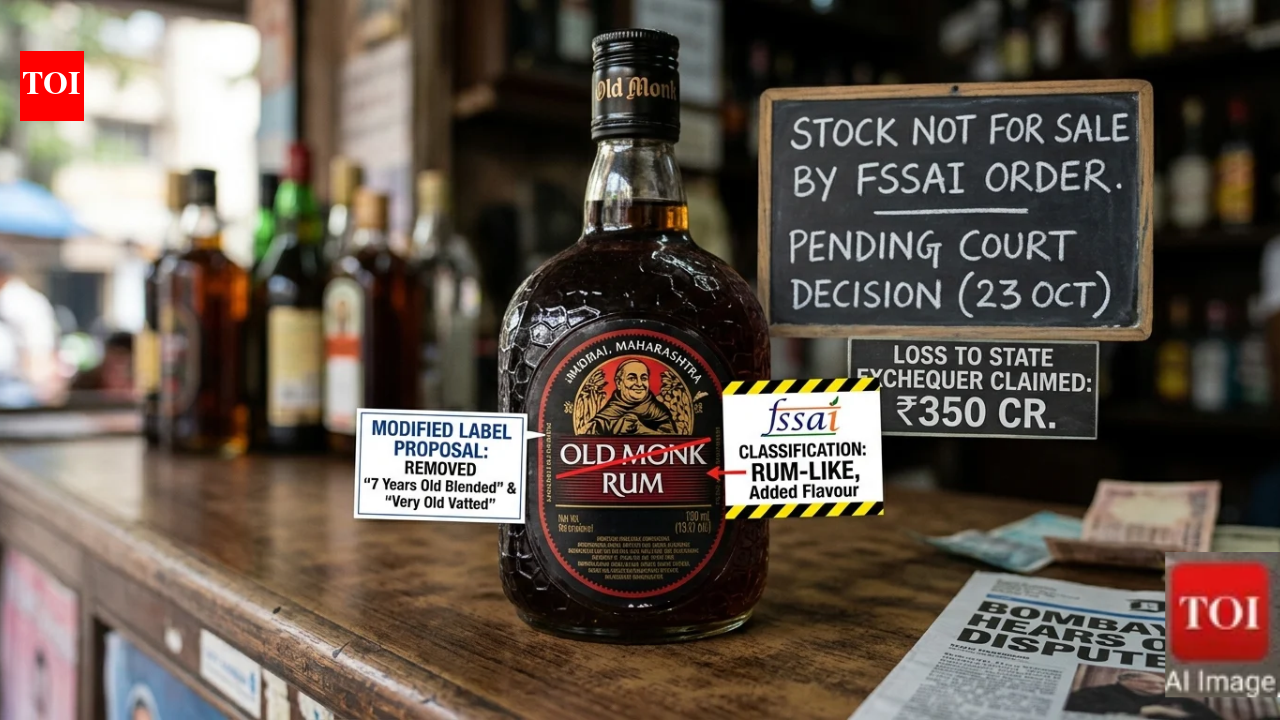
MUMBAI: Maharashtra has reportedly lost around Rs 350 crore in excise revenue following restrictions on the sale of Old Monk rum from its manufacturer’s affected unit, the Bombay high court was told on Monday.Mohan Rocky Springwater Pvt Ltd, which makes the popular spirit, has also claimed business losses exceeding Rs 500 crore as it challenges the Food Safety and Standards Authority of India’s (FSSAI) prohibition order over the product’s formulation and labelling.The company submitted that the sales restrictions had affected its business even as the same formulation continued to be sold through other manufacturing units. It also cited the impact on about 300 workers, according to the submissions reported in connection with the proceedings.Meanwhile sources in the excise department confirmed that ban since May this year had resulted in revenue losses as company’s all rum varients were out of shelves.The financial claims, including the alleged loss to the state exchequer, are the manufacturer’s submissions and have not been independently established as official revenue or employment figures.The dispute pits the manufacturer’s contention that its formulation and use of approved additives are permissible under the applicable regulations against FSSAI’s position that a spirit made with added rum flavouring cannot automatically be marketed under the standard product name “rum”.A division bench of Chief Justice Mahesh Chandra Tripathi and Justice Advait Sethna heard the matter on Monday. The court has listed it for further hearing on October 23.
Revenue claim puts state finances in focus
The excise-revenue claim gives the dispute a direct Maharashtra dimension beyond the commercial interests of the manufacturer. The state’s excise collections are a significant source of revenue, and restrictions affecting sales of a major alcoholic-beverage brand can have implications for manufacturers, distributors, retailers and government receipts.However, the Rs 350 crore figure was cited by the company’s lawyer and should not be read as an independently verified assessment by the Maharashtra State Excise Department. The material available does not establish the period covered by the estimate or provide an official department calculation.The manufacturer has put its own losses at more than ?500 crore. It has also argued that the restrictions have affected employment at the unit concerned.The legal question, however, is not whether the product has a substantial market or whether the restrictions have caused commercial losses. It is whether the product, in its present formulation, meets the applicable standards for sale under the name “rum” and whether its label accurately describes what it contains.
Why FSSAI wants ‘rum-like’ on the label
The action followed an inspection of the company’s Khopoli manufacturing facility in Maharashtra. FSSAI objected to the use of added rum flavouring in spirits sold under a standard product name, arguing that the formulation and its labelling raised concerns about compliance with prescribed standards and the potential to mislead consumers.The regulator’s position is that the product should not be marketed simply as rum if its formulation does not meet the relevant requirements for that category. Additional solicitor general Anil Singh, appearing for the authorities, reiterated before the court that sales could be permitted if the manufacturer changed the product description to “rum-like”.The distinction is important because disclosure of an added flavour does not, by itself, establish that a product qualifies for a particular regulated category. The product must also satisfy the applicable requirements governing its composition and identity.For consumers, the issue is whether the name and information on the bottle accurately communicate the nature of the spirit being sold. The dispute does not, by itself, establish that the product is unsafe to consume; the regulatory challenge concerns its classification, formulation and labelling.
Manufacturer offers label changes, but deadlock persists
Representing Mohan Rocky Springwater, senior advocate Venkatesh Dhond argued that the rules permit approved additives in neutral spirit formulations. The company also questioned why it had faced restrictions when, according to its submissions, the same formulation continued to be sold through other units and competing brands using similar processes had not faced comparable action.The manufacturer had earlier offered to modify its labels after the high court declined to grant an interim stay on the prohibition order. The revised draft labels removed age-related descriptions such as “7 years old blended” and “very old vatted” and prominently disclosed “added flavour”.The company argued that these changes addressed the regulator’s labelling concerns. FSSAI did not approve the revised labels, however, and the disagreement over the product’s classification remained unresolved.The age descriptions are a separate aspect of the dispute. FSSAI objected to wording that could potentially mislead consumers about the product’s ageing or blending. Removing those descriptions did not settle the regulator’s objection to marketing the formulation simply as rum.The manufacturer has maintained that its formulation complies with the rules and that its proposed label changes should be considered. The regulator, meanwhile, has held firm on the need for the “rum-like” description.
Court to consider competing positions
The case has already seen the high court decline immediate interim relief to the manufacturer, leaving the prohibition in place while the dispute proceeds. The company’s willingness to submit revised labels was part of its attempt to find a resolution; it did not amount to a final determination of the regulatory issue.With the parties unable to resolve the disagreement, the court is scheduled to hear the matter again on October 23.The eventual decision could clarify how the applicable food-safety standards govern alcoholic beverages made with added flavours, the use of established product-category names and the disclosures required on labels. It will also determine the legal challenge to the restrictions imposed on the manufacturer’s product.Until then, the company’s financial and employment claims remain submissions before the court, while FSSAI’s objections and the manufacturer’s defence await final adjudication.
