



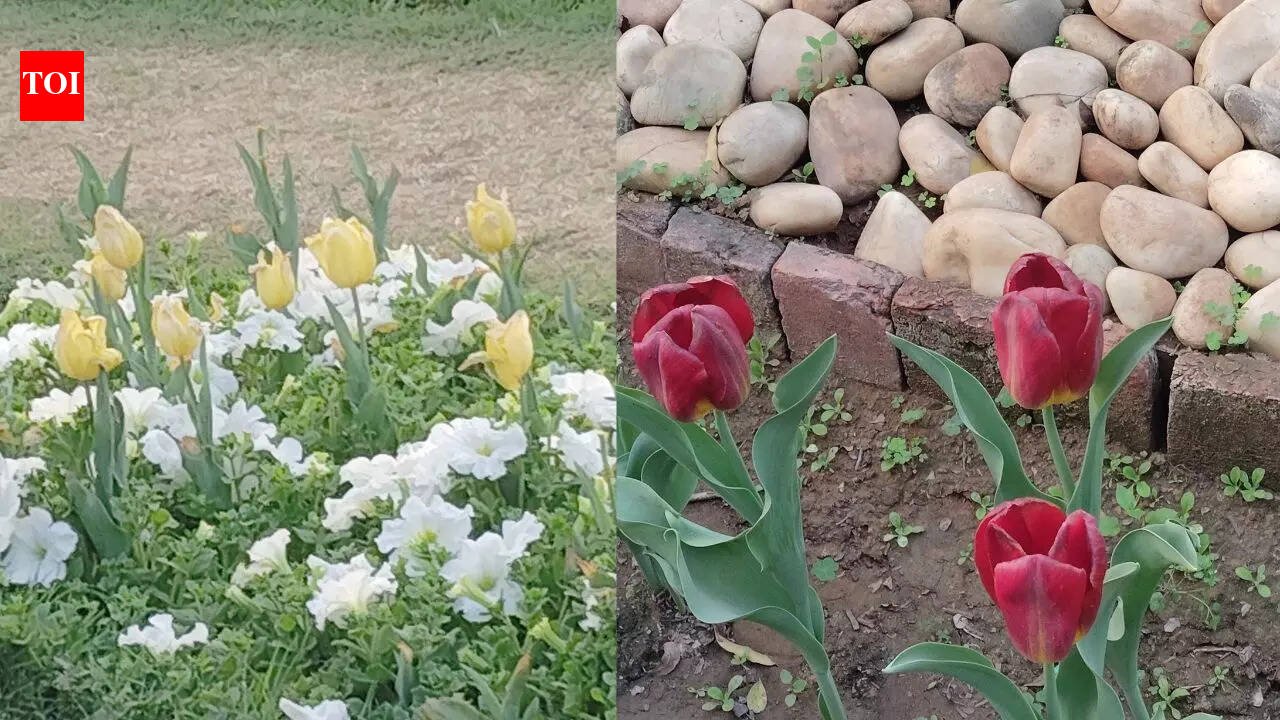
In a city known for its conspicuous consumption patterns, tulip sightings come free of cost and show that experiences and memories that matter need not always be an expensive affair.In Delhi, even a field of tulips cannot remain untouched by politics, memory or the algorithm. What appears to be a simple spring outing slowly reveals itself as a story of seasonal spectacle, intergenerational longing and curated urban beauty blooming in the shadow of the nation’s seat of power.I went with my family to Shanti Path, Delhi, on a breezy March afternoon, enticed by pictures of tulips I had seen everywhere — in newspapers, on social media posts, in endless reels. What I hadn’t expected was a raging war (US-Iran war) that fuelled urgent prime ministerial movement, which would cordon off the stretch just minutes before we arrived.
Image Credit: Pallavi Shankar/TOI
Chasing tulips in the city!The disappointment was palpable. A group of young women, probably in their early to mid-20s, had reached The Tulip Festival at Shanti Path Lawn, Chanakyapuri, clad in crisp cotton and dainty chiffon saris. “I borrowed this sari from my mom just for a picture in the tulip garden,” said one of the young women in the group to another woman who was consoling her by trying to buy her a hawa mithai. Negotiating with the policemen was an elderly couple: “Sir, we have come from very far only to see these tulip fields. Please let us take a quick stroll and a few pictures,” said the man. They got just two minutes and hurriedly took a few pictures with their smartphones.I wasn’t eavesdropping, but I heard the man say to his wife, “See, we couldn’t go to Holland like Amitabh and Rekha (the actors in the 80s movie ‘Silsila’), but I got you here and the tulips are equally beautiful in our own city. What a pity the PM’s visit coincided with our date.” It was the sweetest thing I had heard in a long time.
Image Credit: Pallavi Shankar/TOI
I took this as an opportunity and bargained with the security for a quick walk. I got one minute! All I could manage in that time was a selfie with my son and an effort to use my eyes to soak in as much as possible. This blink-and-you-miss tulip watching wasn’t obviously enough, but we didn’t give up and headed to Lodi Gardens to get our beauty-starved eyes some solace. It was a great idea, I realised, as elegant and robust blooms — in scarlet red, mellow yellow, shades of pink and pristine white — welcomed us into the iconic green space. In that moment, I silently thanked the New Delhi Municipal Corporation (NDMC) for a job well done. For the unversed, NDMC launched a beautification drive at the end of December 2025 by planting around 2.6 lakh tulip bulbs across Lutyens’ Delhi, including 15,000 tulip bulbs at the special conservation centre at the Tulip House in Lodi Gardens (as per media reports). If this hadn’t happened and the tulips were limited to Shanti Path, it would have been a wasted trip for me and others like me who had given up a weekend noon nap for tulip chasing in Delhi.What’s the appeal?Ok, tulips are more than just pretty — the flowers are slender, they look great in symmetrical rows and have an “I am too Instagram-able to resist” vibe. But is it just that? The couple with silver hair at Shanti Path weren’t there to feed their digital accounts elitist spring colours. For the generation that grew up in the 1980s and 1990s, tulips are inseparable from the romance template of Yash Chopra’s Hindi cinema. Back then, foreign travel was aspirational, and today, when tulips bloom like a city native in Delhi, that distance collapses.
Image Credit: Pallavi Shankar/TOI
For Gen Z, though, the vocabulary is different. It is a way to boost image, enjoy the glamour nature provides in scenic settings, practise self-love and focus on mental health. Clicking and getting clicked with tulips becomes a shared digital ritual in a city that feels overwhelming due to its extreme climate and other woes like oppressive summers, bitter winters, long traffic jams and lung-corroding pollution.This intergenerational crossover is perhaps what makes Delhi’s tulip phenomenon so powerful. It allows older generations to revisit memory and helps younger ones create new experiences. The same landscape becomes both archive and aspiration. NDMC, let’s give the same push to Indian blooms If policymakers and tourism planners are attentive, the tulip craze offers a roadmap. The policy push that makes tulips a spring ritual can be extended to India’s home-grown seasonal blooms too. Cities like Delhi have long cultural relationships with flowers like rajanigandha (Indian tuberose), which marks monsoon evenings with its fragrance and is even found in the formulations of desi and luxury perfume makers. And marigold, the charming and much-used flower in summer festivals, weddings and formal events — it can be showcased with sophistication and style in a summer floral festival. The point is not to replace tulips, but to put the spotlight on local blooms with the same passion and funds. The opportunity now is to build on that success — to move from an exotic single-flower seasonal spectacle to a more inclusive floral culture that celebrates the country’s diverse blooms. NDMC, are you listening?Where to spot
- Shanti Path Lawn (Chanakyapuri): Delhi Tulip Festival 2026 began on February 23 and is on till March 10.
- Other places where tulips can be seen:
- Central Park (Connaught Place)
- Lodi Gardens
- Talkatora Garden
- Sardar Patel Marg
- Mandi House
- NDMC Convention Centre Lawn
- Windsor Place
- Sher Shah Suri Marg
- Roundabouts near the Vice President’s House


