



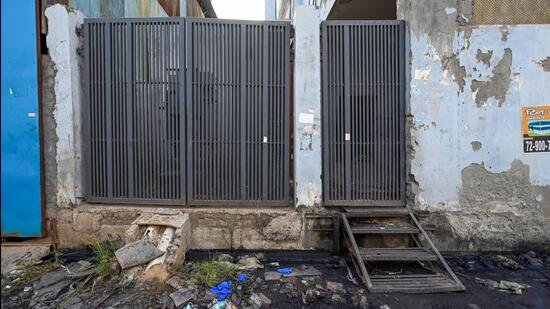
The news of three workers dying after inhaling poisonous gases inside a septic tank at a factory in Mundka Industrial Area is, unfortunately, all too common in Delhi. What is also common in such tragedies is what happened after – officials washed their hands of responsibility and agencies deflected accountability, citing that the activity was conducted in yet another area sitting in the bureaucratic grey zone between “unauthorised” and “industrial”.


While Mundka Industrial Area carries the name of being an “industrial area”, on paper officials stress it is not. Since it came up in an “unplanned manner”, officially it is termed a “non-conforming” industrial area – meaning it has no sewage, drains or even water supply lines. Delhi has 26 such unplanned industrial areas, non-conforming clusters earmarked by the Delhi government for redevelopment. Similarly, of 1,799 unauthorised colonies in Delhi, only 1,235 have sewer lines; the rest depend on septic tanks.
This pattern has played out all too often in recent weeks. On June 3, a fire at an illegally operating hotel in Hauz Rani (an unauthorised area in south Delhi) led to 23 deaths. Just four days before that, another unauthorised construction – in Saidulajab – collapsed, killing six.
Over the decades, Delhi has built a licensing architecture and master plan framework so fragmented that establishments often operate in the gaps between regulators. The result is a system where businesses are one thing on paper and something entirely different on the ground.
Under the Prohibition of Employment as Manual Scavengers and their Rehabilitation Act (PEMSR), 2013, local authorities are legally bound to enforce safety protocols and penalise violators who make workers enter hazardous environments without protective gear. Yet enforcement remains lax, and Delhi continues to witness such deaths.
A senior Delhi Jal Board (DJB) official said the Mundka case involved a site in an industrial area where a private contractor was hired for cleaning the tank. “The contractor is not empanelled with DJB and this area falls under the jurisdiction of the industries department. The tank could have been used for disposal of industrial waste,” the official added.
A senior Delhi State Industrial and Infrastructure Development Corporation (DSIIDC) official said the area falls under a grey zone. “It is a non-conforming area and thus not regulated by us. Agencies like DJB and the corporation are responsible for handling services. Regulations are not clear in this regard,” the official added.
Sunil Chadha, general secretary of the Mundka Industrial Area Welfare Society, said they have been fighting for access to basic sewage and drainage facilities for over a decade. “There are no sewer lines, water or drains. DSIIDC should add these services and DJB should complete its process. Since there are no sewer lines, contractors are hired to clear septic tanks – but it is supposed to be done with suction machines. No one should go inside,” he said.
Despite laws being in place, Delhi has seen case after case where labourers are hired to clear septic tanks instead of investing in mechanical cleaning.
Bezwada Wilson from Safai Karamchari Andolan said agencies like DJB, DSIIDC and the district administration cannot shirk responsibility. “We have documented 12 such deaths in the Delhi in the first six months of 2026 alone. Nationally, 98 deaths have been documented over this period. This is a modern form of untouchability. Article 21 of the Constitution talks about the right to life with dignity. The state has to enforce this,” he said.
As per DJB’s septage management regulations 2018, around 154 private contractors had been authorised for collection and disposal of septage, expected to send it to 86 collection points at sewage pumping stations. Current collection and disposal rates are around 30-40 crore litres of septage per month – vastly lower than the waste generated in unplanned areas.
Last year, the Delhi government announced plans to deploy 300 septage cleaning machines – 150 large and 150 smaller units – which would provide free septic tank cleaning services. DJB was expected to provide these free services until sewage systems were laid in any given area. Like most announced schemes, this remains only on paper.
The water utility had initiated a bidding process, but a senior government official said only a single bid was received. “In case of single bids, re-tendering is carried out to maintain transparency. The plan is still on the government’s agenda,” the official added.


