


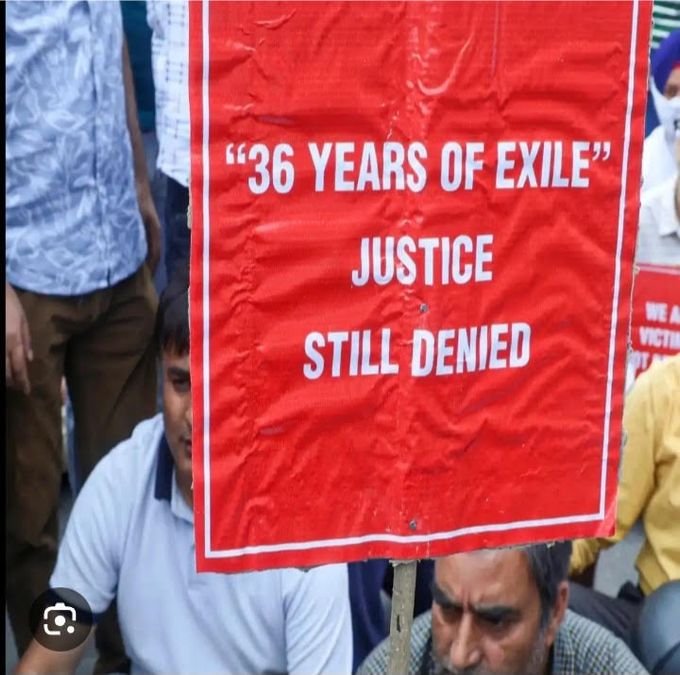
One month ago, the whole world observed the International Refugee Day. In India also, many programmes were held in this regard by various organisations and the advocacy groups championing the cause of refugees. It includes those refugees also who haven’t crossed borders and are called the internally displaced persons. In fact they form a very typical category of refugees and could be called ‘refugees living in their own country’.The horror stories of Kashmir against the indigenous population began with the deceitful change of rule in the 14th century when the reins of power went into the hands of Sultans. They initiated persecution and killings of the Hindu community of Kashmir and forced them to get converted to Islam. The rulers were supported by clerics and other preachers from far-away lands who were hands in glove with the rulers in their agenda of persecution and conversion.For the Hindus of Kashmir, politics would always take a back seat in their life. Yet they were economically squeezed, politically marginalized and socially excluded in their own native land. The forces which made them reach such a situation were none other than those, whom the community trusted, favoured and believed in 1947, when accession and transition of power took place. The community made a conscious effort to erase the past bad memories of persecution and relied more on the promises made to them in 1947.It needs to be emphasized here that in the changed scenario, the Pandits wilfully ignored the fact of historical intent to ethnically cleanse the Kashmiri Pandits from Kashmir. They even sidelined the fact that in 1947, they had faced the worst that could have happened to them. Hundreds of them were left homeless and thousands of them were forced to take recourse to exodus.
The Kashmiri Pandits looked to the future with hope. They were given to believe that the people’s representatives would take care of the governance and the constitution would be the ultimate law; and secularism and democracy would be the guiding principles, and that the minorities would be protected by the government’s instrumentalities and the constitutional provisions. They believed and reposed trust in leaders like Sheikh Abdullah and Pt. J.L.Nehru and the state government supported by the government of India and the overwhelming Muslim majority community, which was believed to be behind the decision of the National Conference in 1947. What happened thereafter is history.The Pandits faced apartheid at the hands of those who had promised them democracy and the rule of law, and to the shocking surprise of the community, the Muslim majority community, instead of providing them protection, showed them the road of exodus to drive them out of Kashmir when there was an upsurge against the Kashmiri Pandit community in 1989-90. Even the governments failed in their constitutional duties to protect them. The Pandits had no choice to make because no organ of the society and the State had the willingness and capacity to protect them in their land of origin.It needs to be put on record that the co-existence in Kashmir was always refused to the minority Hindu community in Kashmir valley despite their past willingness to co-exist. Things have drastically changed in Kashmir and the radicalization is almost complete at a social level. It surely needs rethinking and the Kashmiri Pandits urge the government of India to have a fresh look into the affairs in regard to Jammu and Kashmir and especially the displaced Kashmiri Hindu community. Granting statehood to Jammu and Kashmir at this point of time will surely take the state back to the pre-2019 era and it will be free for all again.The National Conference now having its own government in J&K is again on a warpath to take the Union Territory to a fresh turmoil by organising public outcry in favour of statehood to the UT. Some within its ranks and others outside the party periphery are dreaming for Article 370 and 35A while some others want a separate flag, emblem and constitution again. The party in government has invited all sorts of known and unknown separatists and anti-national elements of J&K in its Jantar-Mantar protest in Delhi on 20 July 2026. When the displaced community of Kashmiri Pandits is waiting for justice for the last 36 years, the government in the UT is completely silent on the issue. It has instead chosen to raise the issue of statehood which made the minority community of Hindus in the valley its worst victim right from 1947.Kashmiri Pandits demand recognition of their genocide in Kashmir, establishment of a Special Crimes Tribunal to go into the excesses committed against the whole community, delivery of justice in a time-frame manner and carving out a separate homeland for them in Kashmir valley with Union Territory status. In context of their being the internally displaced persons, the ‘principle of refoulement’ of the UN applies to them. The so-called reconciliation theories are circulated by the vested interests only to weaken the genocide narrative of the displaced community and that is not going to happen. Besides the existential issues, the issues of survival pertaining to the four-decade old displacement in regard to the Hindu community of Kashmir also matter and are a cause of concern. The enhancement of relief to the relief holders has been pending for the last almost a decade now. The relief holders in Delhi are in struggle for the last two years for streamlining their AMR. The PM Package employees are expected to wait for decades for their transit accommodations in the Kashmir valley. Unemployment among the youth of the displaced community is on rise without any visible solution.In the new context, major organisations of Kashmiri Hindus have resolved to put a new life into their struggle in exile and the younger generations stand to take the resolve ahead. The 20th July 2026, one month after the World Refugee Day in this context, becomes important when the monsoon session of the parliament begins, and lots of questions are raised at Jantar-Mantar, New Delhi in regard to Jammu and Kashmir, including the important issue of the displaced Kashmiri Pandits. The answers have to come from the government of India and the Parliament of India, and the whole community of Kashmiri Pandits awaits their response….!
(The author is a senior BJP & KP leader, Human Rights Defender and a columnist and can be reached at: [email protected])
