



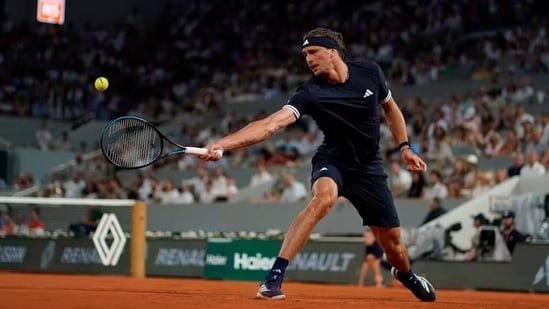
Since the turn of the century, there has been one word that perfectly describes men’s singles tennis: predictability. For almost two decades, it was the Big Three who reigned supreme at the Grand Slams before the baton was passed on to Carlos Alcaraz and Jannik Sinner. But only once in a blue moon does an opportunity emerge where the stars align and offer those lingering on the fringes a chance to bask in the glory. The last 20 years of men’s singles tennis have witnessed just two such instances. Few players have been handed two such opportunities. Alexander Zverev has now found himself at the centre of both. He failed at the 2020 US Open. But Roland Garros 2026 has offered him another. Following a chaotic opening week, his path has been swept clean. And Zverev would be foolish not to walk through.


Alcaraz, the reigning champion, withdrew before the start of the tournament owing to a wrist injury. Sinner, the world No. 1, therefore arrived in Paris as the outright favourite. And why not? The Italian reached the final last year in Paris and arrived with a staggering 29-match winning streak that stretched back to February and included an incredible sweep of five straight ATP Masters 1000 titles, Indian Wells, Miami, Monte Carlo, Madrid and Rome. But he shockingly crumbled in the second round. Despite building a two-set lead against Juan Manuel Cerundolo, Sinner was undone by the Paris heat, which took a visible toll on his body.
Out of nowhere, Novak Djokovic suddenly had hope of finally getting his hands on the 25th major that has eluded him since the 2023 US Open. Despite having returned from injury only weeks earlier, the Serb, a three-time champion at Roland Garros, could not be ruled out as the favourite. But 24 hours after Sinner’s defeat, Paris witnessed the fall of another giant. Djokovic was dumped out in the third round by 19-year-old Joao Fonseca. He too squandered a two-set advantage, his ageing body eventually betraying him in five sets.
The draw lies wide open. And Zverev, whether he likes it or not, is now the man.
For years, the German has borne the uncomfortable weight of not being a Slam winner, of not being able to cross the final hurdle, and thus faced the uncomfortable question of “if”, not “when”. He was billed as the torchbearer of the next generation, the one from that crop of talented players — alongside Dominic Thiem, Daniil Medvedev and Stefanos Tsitsipas — who would bridge the gap between the Big Three era and the new world. But while he flirted with greatness, the title always slipped away. Then Sinner and Alcaraz arrived, and Zverev was quietly pushed to the side.
Yet six years ago, fate worked in mysterious ways to offer him the chance to put an end to all the doubts.
At the 2020 US Open, Djokovic was the overwhelming favourite. Rafael Nadal, despite being the defending champion, opted out due to Covid-related concerns. Roger Federer, then still active, was recovering from knee surgery. But in a dramatic twist, Djokovic was defaulted from the tournament after striking a line judge with a ball in the fourth round.
That opened the door.
Three of the four aforementioned players — Thiem, Medvedev and Zverev — suddenly found themselves in a race for a maiden major title. Medvedev fell in the semi-finals, leaving Zverev and Thiem to contest the final.
For the first time, Zverev found himself in a Slam final, needing only one more win to complete the breakthrough. He led by two sets. He had Thiem on the ropes. And he lost in five.
In the next 21 Slams, he reached only two more finals. His best chance came in Paris. After three consecutive semi-final appearances, he finally broke through to the Roland Garros final in 2024, where he had Alcaraz on the ropes, coming back from a set down to lead 2-1, only to succumb again.
His other opportunity, in the 2025 Australian Open final, ended in a straight-sets defeat to Carlos Alcaraz. Three Grand Slam finals. Three missed opportunities. And each time, when the moment demanded ruthlessness, Zverev blinked.
That has perhaps been the defining flaw in his game — not his serve, not his groundstrokes, which are all of the highest quality. It has been his mental approach in the biggest moments. Against the better-ranked players, Zverev has too often chosen caution over conviction. He becomes watchful and tentative precisely when he needs to be attacking. He has the weapons; he simply hasn’t trusted them enough when the match is on the line.
But 2026 feels different. The stars have never aligned quite like this for Zverev.
Unlike in 2020, where he was seeded behind Thiem, the 28-year-old is now the highest remaining seed in the draw. There is no Alcaraz lurking in the final. No Sinner waiting in the semi-finals. No Djokovic left to conjure magic from nowhere. The draw ahead is not without danger, a potential quarter-final against rising Spanish teenager Rafael Jodar is no walkover, but it has rarely looked more navigable.
At 28, Zverev is at the peak of his physical powers, experienced enough to manage a fortnight and hungry enough to know that opportunities like this do not knock twice. Roland Garros 2026 may well be the greatest chance he ever gets to silence every doubt, erase every painful memory and finally write his name on a Grand Slam trophy. The door is not just open. It is wide open. The only question is whether Alexander Zverev has the courage to walk through it.


