



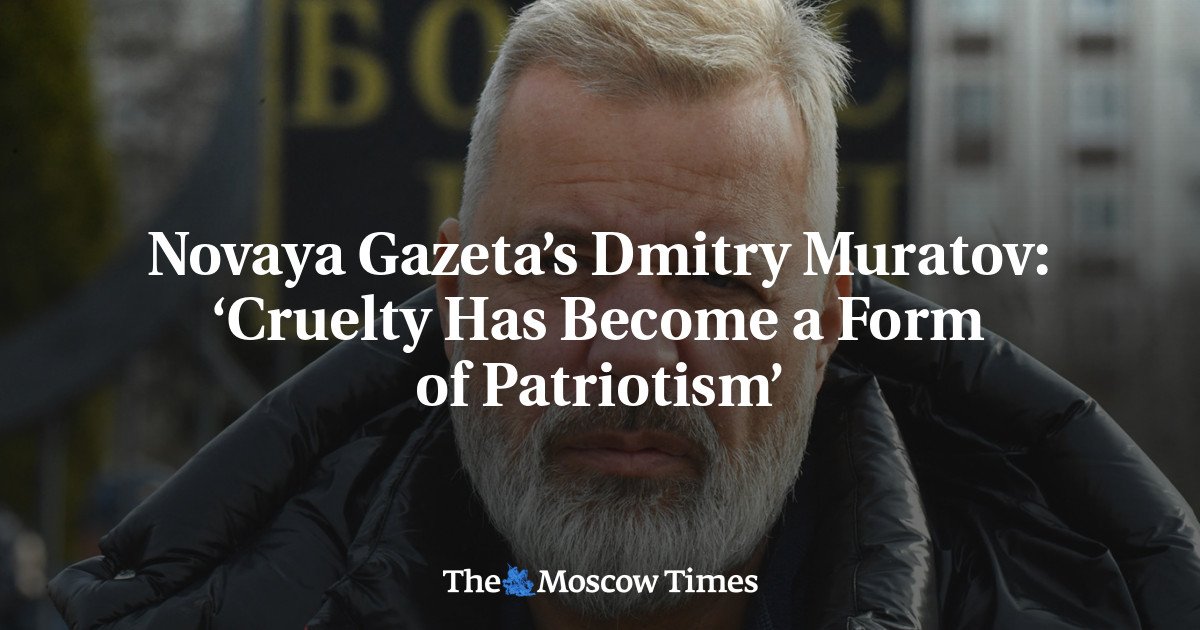
This interview was originally published by the French newspaper Libération on April 11, 2026. It has been translated into English and republished with permission.
On Thursday, April 9, Moscow police carried out a 13-hour search of the renowned Novaya Gazeta newspaper’s offices, where investigative journalist Anna Politkovskaya worked until her murder in 2006.
At the same time, columnist Oleg Roldugin was arrested at his home and placed in pre-trial detention on charges of illegal gathering and use of personal information.
Meanwhile, former Novaya Gazeta editor-in-chief and 2021 Nobel Peace Prize winner Dmitry Muratov — who continues to reside in Moscow despite mounting pressure and attacks on him and his newspaper — was in Paris as part of a campaign in support of political prisoners in Russia.
Libération: On what grounds was your journalist arrested under charges of ‘illegal use and storage of personal data’? What does that mean?
Dmitry Muratov: This is a new law adopted less than a year ago. Actually, this is the first case under this law involving a journalist.
It’s important to understand that in Russia, much of the data that helps uncover fraudulent transactions is considered confidential. Information is obtained through closed systems and various means — sometimes human sources, sometimes databases.
That is how Oleg Roldugin works. For example, he discovered who actually owns the Max messenger, which led to the blocking of all social networks in Russia. It turned out that, officially, the owner of this massive platform is a retired grandmother. (In reality, it is a holding company partly owned by people close to Putin. — Libération)
Another article published a few weeks ago showed that the most expensive building in Moscow, with a direct view of the Kremlin, was purchased by a man who works as a driver for a deputy head of the Chechen government. Not even the prime minister, not Kadyrov, not even his son — but the driver of some deputy.
I think investigations like these may have caused serious irritation toward both the newspaper and Roldugin.
Under [former President] Dmitry Medvedev, officials were required to declare their income. That measure has now been scrapped, because expenditures must be kept secret — after all, we are in a ‘special military operation.’
L: You are currently in Paris, outside Russia. You are no longer editor-in-chief but remain closely tied to Novaya Gazeta. What are your plans?
DM: My plans remain the same. I need to resolve several humanitarian issues concerning our compatriots, particularly those recognized by international organizations as political prisoners. That will take some time.
After that, I will of course return to Russia. I need to assess the damage done to my office during my absence. My safe was broken into, my laptop and hard drive were taken.
I am not upset about that — that is not the most important thing. Since I have not been drinking for three years, I had accumulated a large collection of fine alcohol that people had given me. Now I need to check how much of it was consumed — both by those who carried out the search and by my colleagues in the newsroom. I am rather looking forward to conducting that audit.
L: What position do you hold now that you are no longer editor-in-chief?
DM: First, let us recall why I am no longer editor-in-chief: because Russia passed a law on ‘foreign agents.’ A foreign agent — essentially an enemy of the state — cannot hold a position like editor-in-chief of a newspaper.
I cannot teach, even though I am a university professor. I cannot have a bank account that earns interest. I cannot receive royalties for my work. They are transferred to a special account that I will only be able to access when I am no longer a foreign agent — that is, when I am dead.
This is an absolutely repressive law.
To avoid putting my colleagues at risk, I became a regular editor. I was a shareholder, but I donated my shares to the newsroom. I owned printing presses that had been given to me by the Norwegian company Amedia when it left Russia; I donated those to the editorial board. They were, of course, nationalized by decree of Putin. So I have nothing left.
Novaya Gazeta
L: Did that help the newspaper survive? It is, after all, the last independent outlet with a physical presence in Moscow…
DM: Not exactly. Many leading staff were designated as foreign agents.
In fact, the newspaper’s fate had already been decided. It no longer needs to be anything, because in March — one month after the start of the SVO [special military operation] — and after our well-known covers and reporting, including from Kherson, it was stripped of its license. It is no longer a newspaper.
There is no one left to designate as a foreign agent or an enemy of the people. It no longer exists.
First, the website was blocked. Then the print edition was banned. Then the magazine we launched in its place was also shut down.
Without registration, we cannot submit official requests to state authorities. We cannot obtain accreditation. We have no press credentials. In other words, we do not exist.
L: From the outside, what does the Russian-language media landscape look like today?
DM: Russian media in exile are doing remarkable work. About 1,500 of our colleagues are operating under extremely difficult conditions — penniless, many without housing, some without passports.
They are being hunted. This is a hybrid, subversive war, including against prominent individuals. Criminal cases have been opened against many of them. Dozens have already been sentenced. Some have even been labeled terrorists.
They can no longer return to Russia. Their bank accounts have been frozen. They face potential persecution through international mechanisms like Interpol.
L: What about independent media still operating inside Russia?
DM: Did the state divorce us, or did we divorce the state?
Alexei Venediktov, the former editor-in-chief of the independent radio station Ekho Moskvy, now hosts a YouTube program called Zhyvoy Gvozd, maintaining professional standards and trying to present all points of view.
His offices in central Moscow and the 91.2 FM frequency were confiscated and handed over to Sputnik, a propaganda outlet of RT.
For years, Ekho Moskvy had been the undisputed market leader. They took its offices, its frequency, its corridors, its chairs — even its toilets — and gave them to propaganda radio. And where does it rank now? At the very bottom.
Propaganda can only exist without competition. That is the direct conclusion of what has happened in Russia.
L: After months of disruptions, Telegram was almost fully blocked in Russia on Friday…
DM: Telegram is no longer so much a messenger as it is a media platform.
When Telegram was blocked — even in a test mode — pro-government channels lost about 70% of their audience. Independent channels and media lost only 10-12%.
To continue accessing the information they want, Russians installed VPNs. That is risky — it is visible and easily detected. But 50 million people did it.
L: Have you observed changes in the rhetoric of state propaganda?
DM: Since the start of what I will call the ‘special military operation’ — because I live and work in Russia and must comply with its laws — people like lawmaker Alexei Gorinov have been sentenced for ‘discrediting the army’ after condemning its actions.
Officially, the Russian army never targets civilians. Full stop.
Then this winter, Ukrainian energy infrastructure was bombed. The same television presenters who had insisted, ‘We do not strike critical infrastructure,’ began saying: ‘We will freeze Kyiv, freeze Kharkiv, wipe them off the face of the earth.’
In other words, they openly admit the destruction of civilians.
‘They are Nazis, and we are beautiful Russians with blue eyes and blond hair. We are Vikings. We are Russians, God is with us.’
This is what is new in propaganda: an open embrace of cruelty — an acknowledgment that Russia, my country, is prepared to inflict mass suffering on another people.
What is propaganda? It is the avatar of the state. And that means cruelty has become a form of patriotism.
Patriotism becomes cruelty, and cruelty becomes ideology. Cruelty has always been the ideology of certain regimes — brown regimes.
Cruelty is being inculcated.
When suspects accused of shooting civilians at Crocus City Hall were arrested, television channels broadcast footage of their ears being cut off. They glorify the sledgehammer associated with Wagner leader Yevgeny Prigozhin, used to execute alleged deserters. That same sledgehammer is now displayed in the office of a deputy speaker of parliament.
L: Would you use the term ‘fascism’ to describe this regime, or is it something else? A specific form of Putin-era authoritarianism?
DM: A cult of death, a cult of cruelty, a cult of the leader, a cult of territorial conquest based on historical claims — all these features were described by Umberto Eco as markers of fascism.
L: You are actively advocating for political prisoners in Russia. How many are there today?
DM: Estimates vary among international organizations. Russian lawyers we work with believe a separate list should be maintained for those imprisoned since the start of the war. That number is around 1,400 people. In the final years of the Soviet Union, under [Yury] Andropov, there were about 600.
Most are imprisoned for opposing the SVO. They spoke out for peace. Many are seriously ill.
Igor Baryshnikov from Kaliningrad suffers from asthma and was not allowed to attend his mother’s funeral. A saxophonist from Samara, Andrei Shabanov, suffers from a severe skin condition. Nadezhda Strilets, a Ukrainian-born Russian citizen, is imprisoned in Crimea and was not allowed to visit her one-year-old daughter, who suffers from a severe congenital disease and is on a ventilator. Pediatrician Nadezhda Buyanova, a distinguished Moscow doctor, spent her 70th birthday in prison. For a long time, she was kept in a cell with 70 inmates, where she was the only non-smoker.
L: What can be done?
DM: There are several possible paths.
When a ceasefire is reached and negotiations begin — on agreements, concessions — there must first be pardons or amnesties for women, children and those who have not committed violent crimes. Without that, there can be no deals.
L: So we must wait for a ceasefire? Do you think that could happen soon?
DM: Two years ago, when we mentioned the possibility of a ceasefire in an open letter signed by 51 Nobel laureates — not a pause, but a real ceasefire, to stop the fighting before negotiations — we were sharply criticized.
Now Ukraine’s position, which I share, is: we stand where we stand.
This Friday, Putin and Zelensky announced an Easter ceasefire.
Will it be short-lived? Most likely. But let us not dismiss it outright. Five minutes, even one minute, means 1,000 people will not die.
Yes, it will not bring victory closer. But believers in Ukraine will be able to go to church. In Russia, this also matters.
What path has Russia taken? From the New Testament, with its humanist values, back to the cruelty of the Old Testament. Russian priests are not persecuted — they bless barbarism.
That is why the war must stop for Easter.
I say thank you to Zelensky. I say thank you to Putin.
A Message from The Moscow Times:
Dear readers,
We are facing unprecedented challenges. Russia’s Prosecutor General’s Office has designated The Moscow Times as an “undesirable” organization, criminalizing our work and putting our staff at risk of prosecution. This follows our earlier unjust labeling as a “foreign agent.”
These actions are direct attempts to silence independent journalism in Russia. The authorities claim our work “discredits the decisions of the Russian leadership.” We see things differently: we strive to provide accurate, unbiased reporting on Russia.
We, the journalists of The Moscow Times, refuse to be silenced. But to continue our work, we need your help.
Your support, no matter how small, makes a world of difference. If you can, please support us monthly starting from just $2. It’s quick to set up, and every contribution makes a significant impact.
By supporting The Moscow Times, you’re defending open, independent journalism in the face of repression. Thank you for standing with us.
Continue
Not ready to support today?
Remind me later.
×
Remind me next month
Thank you! Your reminder is set.


