


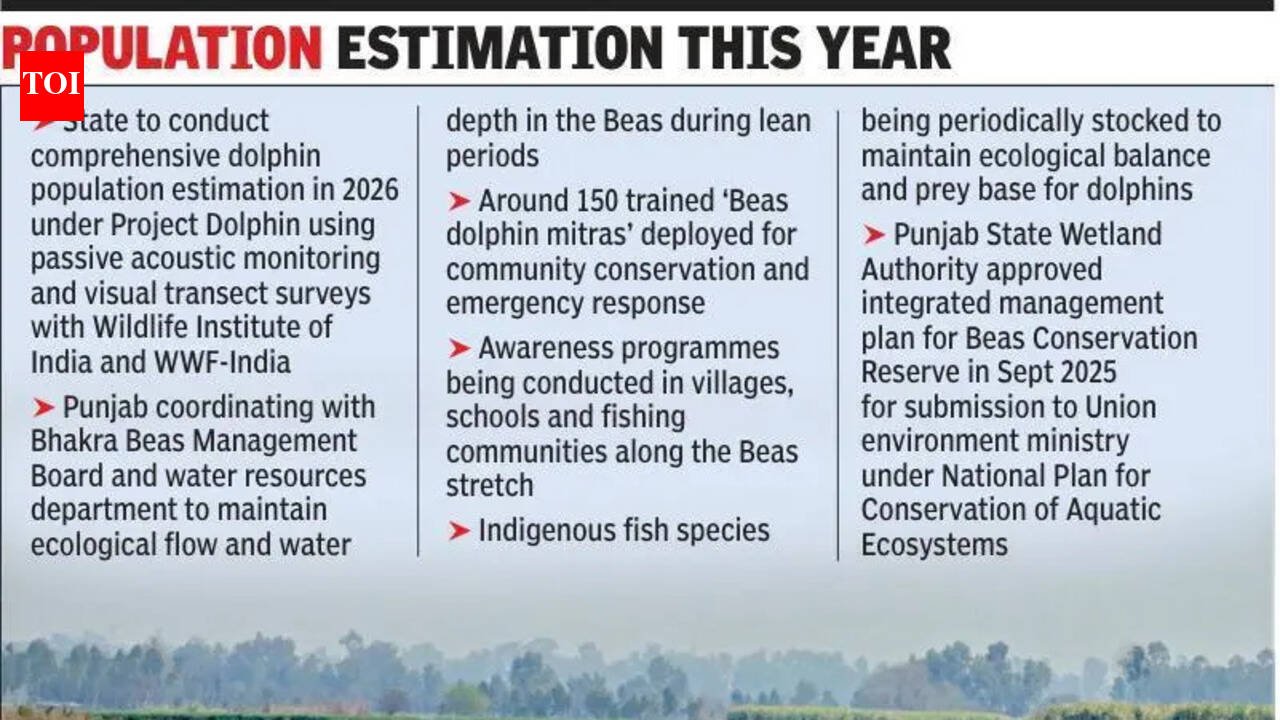
Chandigarh: Facing scrutiny from the National Green Tribunal (NGT) over the condition of the endangered Indus river dolphin, Punjab govt has defended what it described as substantial conservation measures, statutory compliance and continuous monitoring mechanisms undertaken for protection of the species and its habitat.The National Green Tribunal is monitoring the conservation of the endangered Indus river dolphin, which survives in Punjab in an around 185-km stretch of the Beas. In an affidavit filed before the tribunal, Punjab chief wildlife warden Basanta Rajkumar said the state adopted a “proactive, science-based and precautionary approach” towards protection of riverine and aquatic ecosystems. It stated that conservation measures were guided by principles of sustainable development, ecological balance and inter-generational equity, ensuring that conservation objectives were integrated with governance and developmental planning. According to the affidavit, the Indus river dolphin, once believed to have become locally extinct in Indian river systems after the early 20th century, was re-sighted in 2007 in the Harike Wildlife Sanctuary during a field inspection by a forest department official. The presence of a small population in the upstream of the Beas was later scientifically confirmed in collaboration with WWF-India, forming the basis for structured conservation measures by the state, said the affidavit. The govt informed the tribunal that the species had been accorded the highest statutory protection under Schedule-I of the Wildlife (Protection) Act, 1972. It stated that Punjab notified the 185-km stretch of the Beas as Beas Conservation Reserve in Aug 2017 and declared the Indus river dolphin as the state aquatic animal in March 2019, establishing a statutory framework for habitat protection, regulation of activities and conservation management within the said stretch. Besides, the Punjab State Wetland Authority was also established to ensure scientific planning, inter-departmental coordination and implementation of wetland conservation measures. The state claimed that mechanised sand mining is strictly prohibited within the notified conservation stretch and continuous patrolling, monitoring check-posts and joint enforcement drives are being carried out to curb illegal mining, unauthorised fishing and other prohibited activities. The govt said the Punjab State Wildlife Board imposed a complete ban on fishing within the Beas Conservation Reserve in July 2023 and claimed no incidents of dolphin entanglement or injury due to fishing nets had been reported thereafter. The state also informed the tribunal that the Indus river dolphin, being a shy and elusive species, is not frequently sighted. However, the department said, it maintained a systematic and continuous monitoring protocol and stated that only one mortality had been recorded so far, which, upon scientific examination, was confirmed to be due to natural causes and not attributable to any anthropogenic activity. Punjab stated that a comprehensive dolphin population estimation exercise under Project Dolphin was scheduled for 2026 using scientific techniques such as passive acoustic monitoring and visual transect surveys in collaboration with the Wildlife Institute of India and WWF-India. The govt said it had been coordinating with the Bhakra Beas Management Board and the Punjab department of water resources to maintain ecological flow and adequate water depth in the Beas, especially during lean periods, to protect aquatic biodiversity, including the Indus river dolphin. The state also informed the tribunal that around 150 local volunteers designated as ‘Beas dolphin mitras’ were trained and deployed for community-based conservation efforts and emergency response. Awareness programmes were also being conducted in villages, schools and fisher communities along the river stretch. The tribunal was informed about periodic stocking of indigenous fish species being undertaken to maintain ecological balance and ensure a sustainable prey base for dolphins. It stated that the Punjab State Wetland Authority approved an integrated management plan for the Beas Conservation Reserve in Sept 2025 for onward submission to the Union ministry of environment, forest and climate change under the National Plan for Conservation of Aquatic Ecosystems.
