


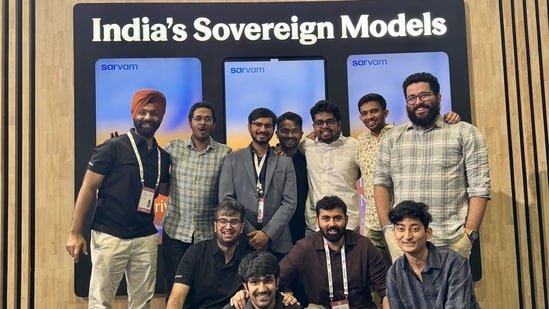
Sarvam AI’s stellar showing at the recently-concluded India AI Impact Summit in Delhi has had at least one unlikely benefit for an employee — Harveen Singh Chadha said that his parents, initially unhappy that he quit Microsoft to join the startup, have now had a change of heart.


What is Sarvam AI?
Sarvam AI is an Indian artificial intelligence company based in Bengaluru that was founded in 2023. The startup builds large language models (LLMs) and multimodal AI systems.
Leveraging the spotlight at the recent AI summit, Sarvam unveiled its own AI model, designed from the ground up for Indian users. The voice-first service supports nearly two dozen Indian languages — a feature the company sees as a key advantage in a country of 1.45 billion people, where most users cannot read, write, or comfortably type in English. (Also read: What is Sarvam, India’s AI model praised by Google CEO Pichai and has an edge against ChatGPT, Claude)
Sarvam employee’s post
Harveen Singh Chadha, an LLM Researcher at Sarvam, said his parents’ attitude towards his job change has undergone a sea change. Chadha quit Microsoft in April 2025 to join Sarvam AI.
“10 months back parents were not happy when I left MS. Today when I reached, they were smiling,” the Sarvam employee said in an X post.
He said that his proud parents have been saving all news mentions of Sarvam and even promoting the company on WhatsApp groups.
“Dad showed me all the news channel recordings, newspapers mentions of Sarvam. Mom told me how she promoted sarvam in WhatsApp groups and to neighbours,” said Chadha. “Overall, a very small win but a long way to go.”
The post drew warm reactions on X.
“Build from India . Build for world . We are having the opportunity to leapfrog generation of gaps,” wrote one X user.
“Working for the country is the proudest thing anyone can do,” another said.
“There is something special about seeing doubt turn into quiet support,” a third person added.
Sarvam founder on AI
Speaking at the India AI Summit 2026, Sarvam co-founder Vivek Raghavan stated that the development of indigenous technology remains a critical priority for national interests. Raghavan noted that many existing technologies were historically proprietary, leading to the creation of self-created, open-source public infrastructure.
“Many of these technologies were proprietary technologies, and we built this kind of self-created technology that is open source and a public infrastructure that is available to all of us and that led to the creation of the India stack. So when you look at it over the course of long periods of time, sovereignty will always trump technical beads,” Raghavan said.
(With inputs from agencies)


