


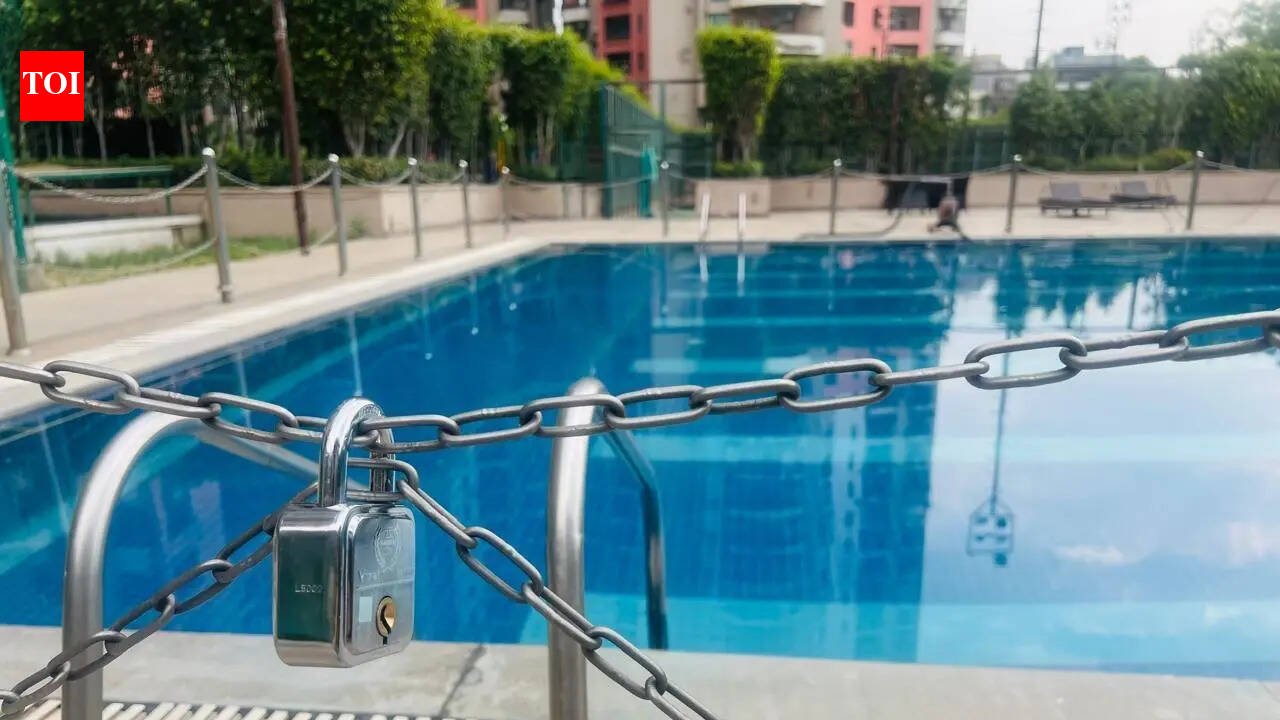
Ghaziabad: What should have been a routine summer exercise of reopening residential swimming pools turned into a bureaucratic hurdle for AOAs and RWAs across Ghaziabad.Hundreds of housing societies across Ghaziabad have been unable to open their swimming pools this summer after the district sports department introduced a sweeping set of compliance conditions for obtaining a no-objection certificate (NOC), leaving apartment owners’ associations scrambling to meet requirements many claim are designed for commercial facilities, not residential complexes.Of an estimated 200 societies with pools in the district, only around 10 have secured the mandatory NOC, and most of them are newer projects still under builder management, according to the sports department’s own data. The federation of AOAs in Indirapuram estimates that at least 90% of societies in Indirapuram and Vaishali have yet to open their pools.“There are barely four to five months when pools are used. For the past 15 years, no such NOC was required. This year, notices have been issued, and many societies were not able to comply within the short window,” said Deepak Kumar, president of the Federation of AOAs in Indirapuram. Annual renewal application has to be submitted every Feb.While the district administration has required NOCs for swimming pools for years, this is the first time it has introduced a rulebook.The documentation checklist runs across multiple categories. Societies must disclose ownership structure, provide names and contact details of pool owners, operators and managers, and submit qualification certificates and photographs of coaches and instructors. Both male and female lifeguards with documented credentials must be appointed — a condition introduced last summer. Societies must also furnish copies of permissions and NOCs from the district administration and multiple departments for original pool construction, attach layout plans, and specify water capacity, source of supply, and pool dimensions.Infrastructure requirements include a maximum depth cap, mandatory display of depth markings, anti-skid tiles on pool decks, proper drainage, and a boundary wall of at least 8 feet around the pool. Certification is required from fire safety, electrical safety, and public works and irrigation departments — the last for earthquake-resistance clearance. Societies must also install CCTV cameras, maintain separate entry and exit points, keep user registers, and stock lifesaving equipment, including lifebuoys, ropes, oxygen cylinders, and first aid kits. Hygiene norms, separate changing rooms for men and women, and operational filtration plants are also mandated.One condition requires AOAs to maintain health certificates for every resident using the pool and submit them to the administration in advance, and has drawn particular criticism.“How can we ask every resident using the pool to submit a health certificate? And how can we submit it in advance to the administration? This is absurd,” said Amit Aggarwal of Gaur Green City AOA in Indirapuram. He flagged an equally contentious condition on the water source. “The rules require that we don’t use groundwater. What else should we use? We don’t have any other source of water,” he said.District sports officer Abhishek Kumar defended the health certificate requirement, saying it was aimed at preventing the spread of infections. “Anyone with a skin disease or other health issue may spread it in the pool. The rules have been framed to safeguard users from any mishap,” he said.Residents in Orange County in Indirapuram told TOI their pool has not been opened so far this season. “Some of the rules are absurd. As one says, a pool should have an 8-foot wall on the periphery. Which society pool has such a wall? The builder made the pool 15 years ago after taking the required permissions. How do we now ensure such infrastructural changes?” said Sushil Sharma of the society’s AOA. He added that the cascading nature of the requirements compounds the difficulty. “Multiple department NOCs are required, and those NOCs require further sets of rules to be fulfilled. It seems as if the administration doesn’t want societies to run their pools.”For smaller societies, the financial burden adds another layer of strain. “We are a small society of 84 flats and have been running the pool for the last 20 years. However, this is the first time we received a notice for an NOC with a fee of Rs 15,000,” said Anil Poddar of Eldeco Apartments AOA in Vaishali. “The administration should maintain a record of pools in the district, but why charge a fee? What are they providing in return? We are not earning from the pool, so how do we justify paying for an NOC?” he asked.A handful of societies have chosen to comply despite the cost. At Ashiana society in Raj Nagar Extension, residents managed to open their pool after meeting the requirements. “It is true that the rules are difficult to comply with, but we are bearing the costs and trying to fulfil each one,” said a resident who gave his name as Arvind.In neighbouring Noida, where the rules are unchanged from the last year, NOC has been already issued to 178 societies.For most others, the choice this summer is between navigating a costly and complex compliance system or keeping the pool shut. As temperatures rise, the latter is what most societies appear to be doing, not by choice, but by compulsion.
