



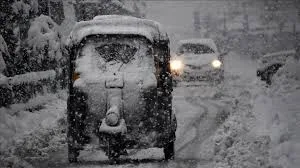
Srinagar, Mar 09: Amid growing speculation on social media about the possibility of “black snow” or “toxic rain” in Kashmir due to the ongoing tensions in the Middle East, weather experts and scientists have said there is no immediate risk of such an event, terming the circulating claims largely misleading.
Experts noted that phenomena like black snow or chemically significant acidic rainfall occur only under exceptional environmental conditions, usually linked to massive and prolonged emissions of pollutants such as soot and sulphur dioxide.
Director of the Meteorological Centre Srinagar, Mukhtar Ahmad, said that the current situation in the Middle East does not resemble events that could trigger such an environmental impact thousands of kilometres away.
“There is no scientific basis at present to suggest that Kashmir could witness black snow or toxic rainfall because of the ongoing tensions in the Middle East. Such occurrences require extremely large-scale emissions, particularly from burning oil fields or refineries over extended periods,” Ahmad said.
He explained that even if smoke or aerosols are released during limited military strikes or fires, the pollutants tend to disperse and dilute significantly in the atmosphere before travelling long distances.
Director of the Meteorological Department in Ladakh, Sonam Lotus, also dismissed fears of any immediate environmental fallout in the region.
“For pollutants to travel thousands of kilometres and affect precipitation, there must be sustained and massive emissions combined with specific wind patterns and atmospheric circulation, which is not the case at present,” Lotus said.
He added that Kashmir lies roughly 1,800 to 4,000 kilometres away from major Middle Eastern conflict zones, and emissions from short-duration fires are unlikely to remain concentrated enough to influence weather systems over such distances.
Independent weather forecaster Faizan Arif said historical examples show that black snow events require extraordinary circumstances.
“Kashmir witnessed black snow in 2021 largely due to soot particles transported from distant pollution sources under particular atmospheric conditions. However, the present situation in the Middle East does not indicate emissions anywhere close to the scale required to trigger such an event,” Arif said.
Environmental scientists from the University of Kashmir echoed similar views, saying that the phenomenon generally occurs when massive quantities of soot and pollutants are injected into the upper atmosphere for prolonged periods.
Dr Parvaiz A. Shah, an environmental scientist, said that historically such impacts were observed during major conflicts like the 1991 Gulf War, when hundreds of oil wells burned continuously for months.
“Those fires released enormous amounts of soot and sulphur compounds that travelled across regions and influenced atmospheric chemistry. The current situation does not reflect anything of that magnitude,” Shah said.
Experts emphasised that the incidents reported so far in the Middle East largely involve localised strikes or short-lived fires, many of which were brought under control quickly. Such emissions typically disperse long before they can influence weather or precipitation patterns thousands of kilometres away.
Scientists urged people to rely on verified scientific information rather than social media speculation, noting that atmospheric transport of pollutants over such long distances requires a complex combination of sustained emissions and favourable wind patterns.
“For now, there is no credible evidence or meteorological indication suggesting any risk of black snow or toxic rainfall in Kashmir due to the current geopolitical situation,” experts said.


