



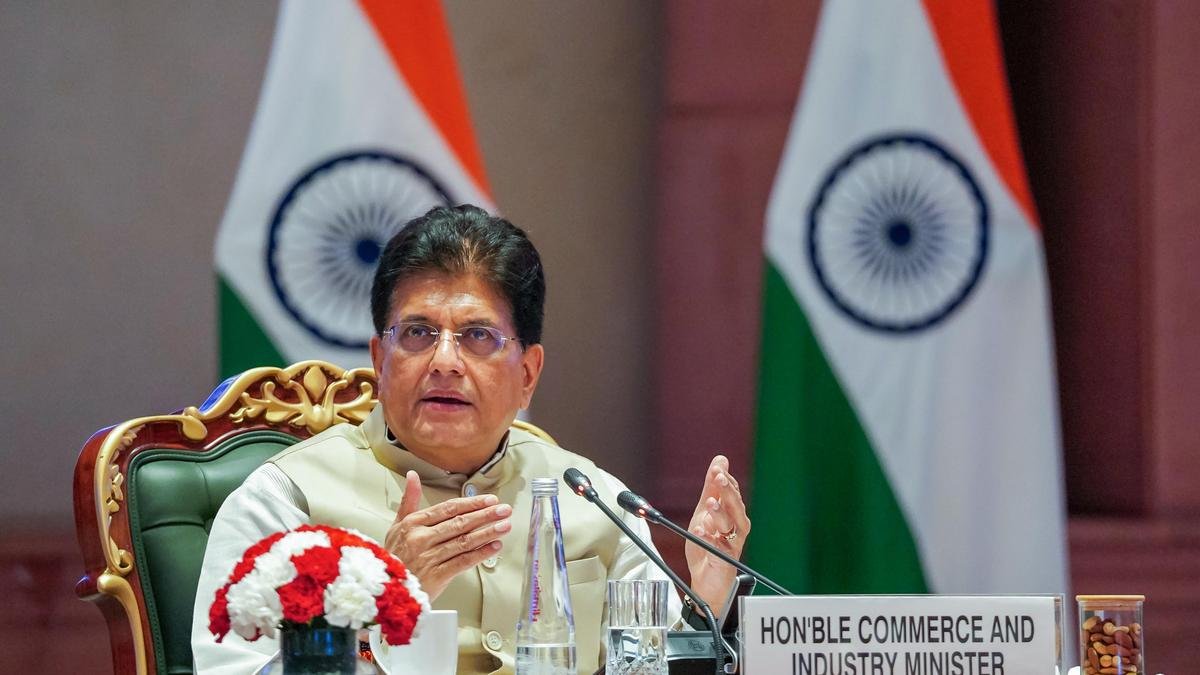
Union Commerce and Industry Minister Piyush Goyal addresses the ‘National Workshop on Leveraging FTAs – Outreach Programme’ at Bharat Mandapam, in New Delhi
| Photo Credit: ANI
Commerce Minister Piyush Goyal said India’s textile industry can no longer blame external factors for its weak export performance, noting that most developed markets now impose tariffs on Indian textile imports that are at par with or lower than those levied on key competitors such as Bangladesh and Vietnam.
Speaking at the national workshop on ‘Leveraging FTAs: an Outreach Programme’ organised by the Ministry of Commerce, Mr. Goyal emphasised the need for a concerted effort to translate India’s expanding network of free trade agreements (FTAs) into greater export opportunities for businesses across the country.
“The nine FTAs that India has entered into with countries accounting for $60 trillion of GDP will give us preferential access to nearly two-thirds of global trade,” Mr. Goyal said.
More deals in the works
He added that the other FTAs in the works, such as with Canada, Mexico, Chile, the South American Mercosur nations, the South African Customs Union bloc, the Gulf Cooperation Council nations, and with Israel, combined with India’s efforts to review the deals with Korea, Japan, and the ASEAN, will give India access to 75% of global trade at rates lower than its competitors.
“We have FTAs with Mauritius, Oman, UAE, Australia, the UK, and the EFTA nations already live,” Mr. Goyal noted. “New Zealand will get live soon, the EU will get live, and as soon as the U.S. is able to give us that preferential rate in comparison with our competition, we’ll finalise the treaty and announce it.”
Ball in the Indian court
In the context of the textiles sector, Mr. Goyal explained that for years the Indian textiles industry could not compete with Bangladesh and Vietnam because of a combination of the advantage Bangladesh continues to receive as a least-developed country (LDC), and the terms Vietnam has negotiated in various trade deals with developed countries.
Several developed countries offer zero duties on imports from LDCs.
“Vietnam had done FTAs with many developed countries, and they were paying lower duties or zero duties on their exports to the developed world, whereas we were paying high duties,” Mr. Goyal added.
He said that the Indian trade analysts had observed that the duty structure in the developed world is such that high-tech items have been kept at low duty or no duty and labour-oriented goods have been kept at a higher duty.
“We were not able to stand in competition to Bangladesh and Vietnam,” Mr. Goyal said. “Now that story has changed. Our rates will be better, or the same if it is zero, than those offered to these geographies in almost all the developed world. We have no more excuses left except performance. The ball is now entirely in our court.”
Maximising FTAs
During his speech, Mr. Goyal also called for a “focused, inclusive and nationwide effort” to maximise the utilisation of FTAs to expand India’s trade across the world and ensure that the benefits of enhanced market access reach businesses across the country.
He said the initiative should rapidly take root across the country and reach the last person, smallest business person, trader, entrepreneur, startup and woman entrepreneur across all 780 districts of the nation.
The Minister said India had set a $1 trillion export target for the current year, representing about 16% growth. He added that exports during the first four months of the current year had reached about $317 billion, compared with $280 billion during April-July last year.
Published – September 03, 2026 04:10 pm IST


