


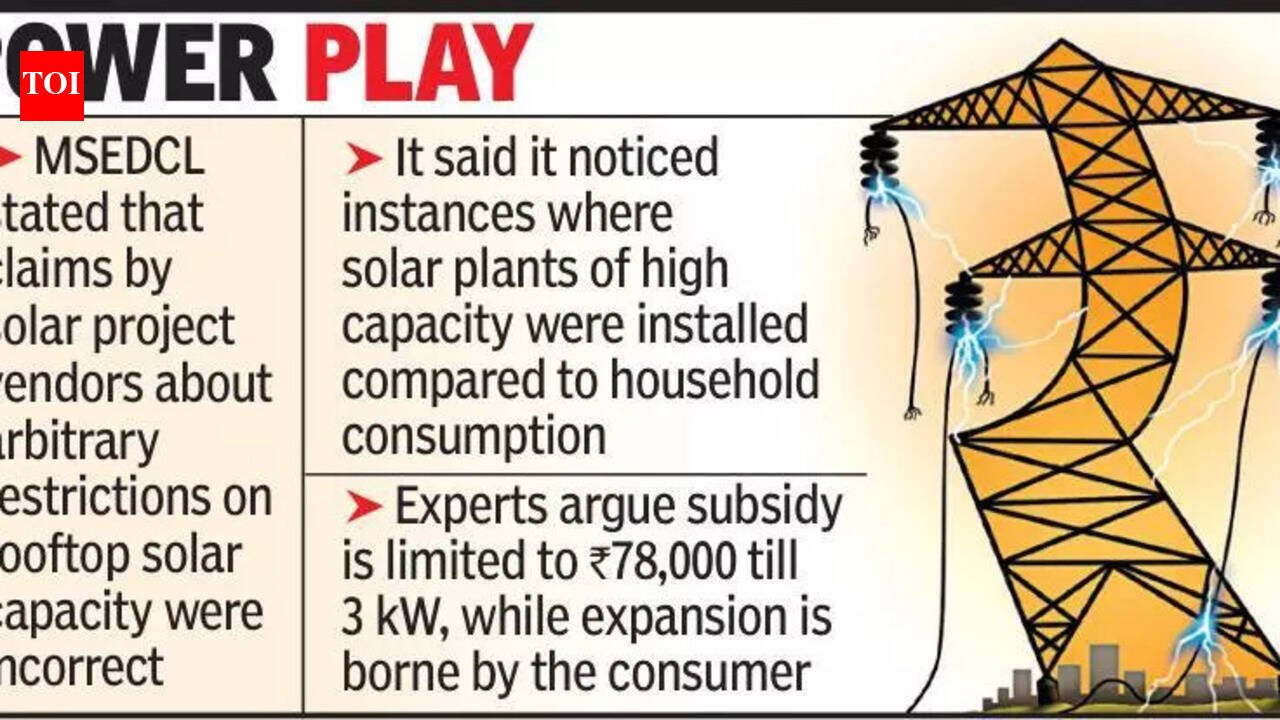
According to MSEDCL, the scheme is primarily intended for ordinary domestic consumers. The utility said it noticed instances where solar plants of high capacity were installed compared to household consumption, subsidies were availed from the Central govt, and later the electricity connections were converted to the commercial category, leading to alleged misuse of subsidy benefits.However, solar industry representatives argued that the subsidy is limited to 78,000 till 3 kW solar rooftop, while further capacity expansion is borne solely by the consumer.The power utility also said complaints were received that vendors were pressuring consumers to opt for higher-capacity systems, even when their requirement was limited to 1 kW or 2 kW, thereby increasing their financial burden. To address this, MSEDCL introduced an automated system linking permissible solar capacity to sanctioned load and past consumption data. Requests for capacity beyond regular usage are subjected to physical inspection.However, the solar industry strongly contested MSEDCL’s stand. Industry representative Sudhir Budhay alleged that the clarification is ‘misleading’ and does not reflect ground reality. “Even consumers with higher sanctioned loads are not getting approvals as per their entitlement. The issue is not restricted to domestic connections. Commercial and industrial consumers are also facing similar hurdles,” he claimed.Industry experts argue that delays and restrictive interpretations are slowing down solar adoption and affecting investor confidence.Under the scheme, the Central govt provides subsidies of 30,000 for 1 kW, 60,000 for 2 kW, and 78,000 for 3 kW installations. Maharashtra emerged as one of the leading states in implementation, with 4.53 lakh consumers installing rooftop solar systems with a combined capacity of 1,722 MW and receiving 3,162 crore in subsidy so far.


