



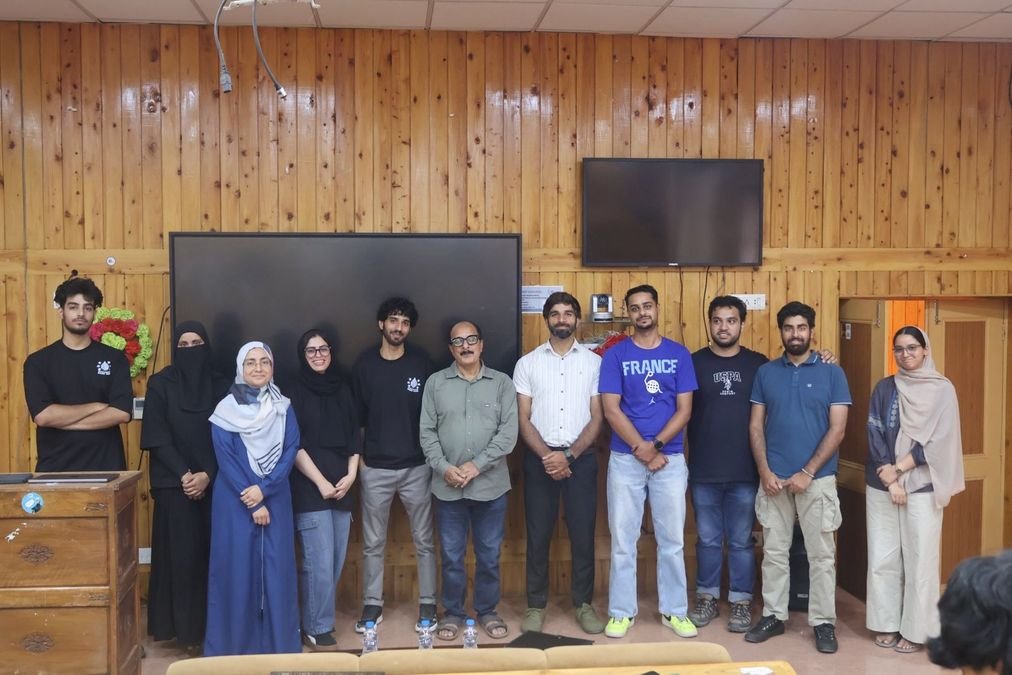
Srinagar, Aug 22: The National Institute of Technology (NIT) Srinagar hosted KATHE 2026: AI Challenge for Kashmiri Language Translation, a national-level initiative aimed at advancing artificial intelligence and machine-learning applications for the Kashmiri language.
It focused on English-to-Kashmiri machine translation, bringing together students, academics, linguists, technology professionals and volunteers to address challenges associated with low-resource language technology.
The event was organised by Gaash Lab, NIT Srinagar, in collaboration with the Bureau of Indian Standards (BIS), with the University of Kashmir as the academic collaborator and GitHub as the primary sponsor.
The programme was attended by Prof. Roohie Naaz, Dean, Research and Consultancy, NIT Srinagar; Prof. Aadil Amin Kak, Professor of Linguistics and Director, Sheikh-ul-Alam Centre for Multidisciplinary Studies, University of Kashmir; and Prof. Shabir Ahmad Sofi, Head, Department of Information Technology, NIT Srinagar. Dr Janib Ul Bashir and Dr Iqra Altaf Gillani served as coordinators of the event.
Speaking during the programme, the experts highlighted the growing role of artificial intelligence in language technology and the need to develop digital tools for regional and low-resource languages.
Prof. Roohie Naaz, Dean, R&C, NIT Srinagar, said KATHE 2026 reflects the Institute’s focus on applying AI to real-world challenges and promoting technology for regional and low-resource languages.
She appreciated the organisers, academic collaborators, technology partners and participating teams for bringing together expertise from different domains.
Prof. Shabir Ahmad Sofi, Head IT, said the challenge provided students an opportunity to apply AI and NLP to Kashmiri translation while encouraging research in language-specific technologies.
Prof. Aadil Amin Kak and Pranjal Chitale delivered expert perspectives on “AI in Language and Its Future”, focusing on the opportunities and challenges involved in applying AI to languages with limited digital resources.
As part of the challenge, participating teams presented their machine-translation systems and explained their methodologies. The entries were evaluated on performance against a confidential test set as well as the quality of the presentations.
TeamHD from Heidelberg University, Germany, secured the first position, followed by TeamIJ from IIT Jammu in second place and Team Tabaq Maaz from NIT Srinagar in third place.
Three consolation awards were also presented. Noore from Heriot Watt University Edinburgh received the Young Achiever Award, Team Kåv from NIT Srinagar was presented the Innovation Excellence Award, while KatheBathe from GDC Anantnag received the Low-Resource Innovation Award.
The initiative provided students with hands-on exposure to the complete machine-learning workflow, including data preparation, model development, training, validation and error analysis.
The organisers said that research on Kashmiri and other low-resource languages can contribute to broader advances in multilingual artificial intelligence, including transfer learning, efficient model adaptation and human-in-the-loop evaluation.


