



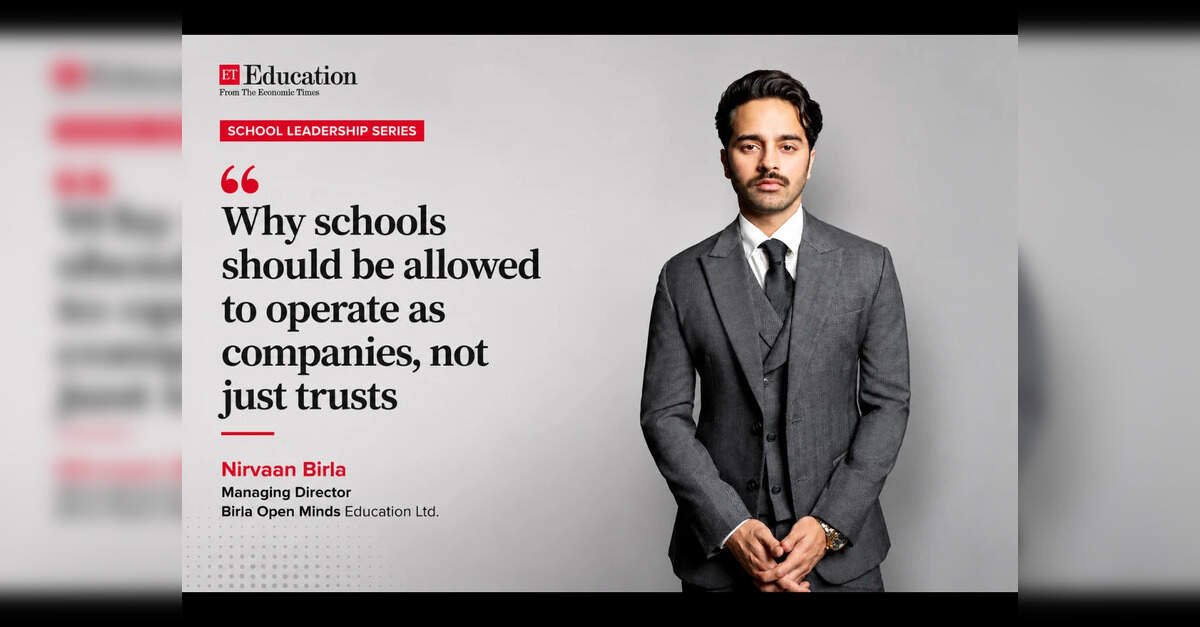
India’s organised K-12 education sector is entering a defining phase. As the National Education Policy (NEP) 2020 reshapes classrooms, institutional investment gathers pace and artificial intelligence begins to transform learning, school leaders are increasingly debating not just what students should learn, but how schools themselves should be governed, regulated and scaled.
In this edition of ET Education’s School Leadership Series, Nirvaan Birla, Managing Director of Birla Open Minds Education Ltd., reflects on six years of NEP 2020, discusses the growing role of AI, changing parent expectations, teacher development, school governance, fee regulation and the future of India’s K-12 ecosystem. Birla Open Minds today has a network of more than 280 educational institutions across over 160 cities.Q. It has been six years since the National Education Policy (NEP) 2020 was introduced. Looking across a network of more than 280 institutions, where have you seen the biggest changes on the ground, and where do schools continue to struggle with implementation?
Nirvaan Birla: The biggest on-ground change has been the emphasis on skill-based education. Making vocational and future-focused skills part of the curriculum, with graded assessments, was a much-needed reform, particularly within the CBSE system. It creates a stronger link between school education and future careers.
At Birla Open Minds, we have introduced financial literacy, AI and robotics, and communicative English as skill subjects. These are not taught only through textbooks but through practical learning, dedicated laboratories and experiential activities. Students learn concepts such as financial planning, interest rates and currency exchange, while AI and robotics encourage innovation and problem-solving from an early age.
Where schools continue to struggle is teacher preparedness. The NEP is comprehensive and well-designed, but successful implementation depends on teachers. More workshops, classroom observations, audits and continuous professional development, particularly in Tier-II and Tier-III cities are essential for translating policy into classroom practice.
The NEP has also helped narrow the gap between CBSE and international curricula. Earlier, CBSE largely focused on traditional academic pathways. Today, with careers becoming far more diverse, students require experiential, practical and multidisciplinary learning. The inclusion of experiential learning and skill development has made CBSE education significantly more progressive than before.
Q. AI is transforming classrooms faster than policy can keep pace. If you were redesigning a school today for a child entering Grade 1 and knowing AI will reshape the next 15 years, what three things would you stop, what three things would you build, and why?
Nirvaan Birla: AI will fundamentally reshape schools much sooner than many people expect. Within the next five or six years, teaching methods, infrastructure and learning models will begin changing significantly.
If I were designing a future-ready school, there are three things I would strengthen.
First, sports infrastructure. As AI increases screen time and reduces human interaction, sports will become even more important for children’s physical and mental well-being. I would dedicate nearly half the campus to outdoor activities and sporting facilities because teamwork, resilience and social interaction cannot be replaced by technology.
Second, mental well-being. At Birla Open Minds, we have introduced a curriculum called Soul Science, which uses stories from different religious and philosophical traditions to teach leadership, stress management, motivation and emotional resilience. Students also participate in community service, visits to old-age homes and orphanages, and outdoor storytelling sessions inspired by the traditional gurukul model. Even as technology advances, schools must preserve these human and cultural foundations.
Third, global exposure. Students should begin interacting with peers from different countries much earlier through exchange programmes and cross-campus collaborations. Exposure to different cultures broadens perspectives and prepares children for an interconnected world.
There are also three things I would consciously minimise.
The first is mobile phone usage within schools. Children already spend significant time on screens outside school, so the campus should encourage face-to-face interaction.
Second is junk food. Nutrition directly influences physical health, concentration and learning. Schools should take greater responsibility for promoting balanced diets rather than leaving food choices entirely to convenience.
Third is bullying. While it can never be eliminated completely, schools must create a culture where every child feels included regardless of background, religion or economic status. Sports, collaborative activities and team-building exercises are among the most effective ways to foster belonging and reduce bullying.
Q. Birla Open Minds operates across diverse geographies and school segments. What differences do you see between metro and Tier-II and Tier-III cities in terms of parent expectations, student aspirations and school readiness?
Nirvaan Birla: The differences are significant and become evident when operating a nationwide network.
In southern states such as Telangana and Andhra Pradesh, parents generally place greater emphasis on science, robotics, coding and technology, reflecting the region’s strong engineering and technology ecosystem. Language subjects are important but are often secondary to STEM education.
In contrast, many parents in northern states including Uttar Pradesh and Bihar place much greater importance on English and Hindi proficiency, while expecting schools to avoid overburdening students with excessive extracurricular activities.
This creates an interesting challenge for a national school network. We have debated whether different regions should have different curricula, but ultimately we decided to remain committed to a common educational philosophy.
Our approach is that every child deserves the same strong academic foundation. Up to Grade 7, students across the country receive equal emphasis on science, languages and extracurricular development. From Grade 8 onwards, they can gradually pursue subjects aligned with their interests and aspirations.
While regional adaptations, particularly around languages and academic calendars, are necessary, the core philosophy of holistic education remains consistent across all Birla Open Minds schools.
Q. Parents today are spending more on education than ever before. Has the definition of return on investment changed? What should schools be delivering beyond marks and college admissions?
Nirvaan Birla: Education is one of the few sectors that remains resilient regardless of economic cycles. Parents today are willing to invest a significant share of their income in their children’s education because every parent wants their child to achieve more than they did.
That also places a greater responsibility on schools. If a school charges a premium fee, it cannot limit itself to delivering the core curriculum. Just as a premium product is expected to offer superior quality and value, a premium school must provide a richer learning experience beyond academics.
Students should have access to quality sports coaching, performing and visual arts, leadership opportunities and exposure beyond their own campuses. At Birla Open Minds, we organise annual national sports meets where students from schools across different states compete and interact. We also conduct regular quizzes, cultural exchanges and inter-campus activities that help students learn from peers across India.
One initiative that had a lasting impact was bringing students from Kashmir to spend time at one of our Telangana schools, allowing them to experience a completely different culture, language and way of life. Such experiences build empathy and broaden perspectives in ways that textbooks cannot.
Schools should also collaborate with the best institutions in different domains. We have partnered with organisations such as the Rohit Sharma Cricket Academy and the Paddle Tennis Federation to ensure students receive professional coaching from experts rather than limiting themselves to in-house resources. Parents today expect schools to nurture well-rounded individuals, not just produce examination results.
Q. Teacher recruitment and retention continue to be among the biggest challenges for schools. In your view, what will it take to build and retain a high-quality teaching workforce over the next decade?
Nirvaan Birla: There are three essential requirements.
The first is fair compensation. Teachers should receive competitive salaries and meaningful performance incentives. Schools cannot expect excellence while compromising on teacher welfare.
Second is continuous professional development. When an institution invests in training its teachers and helps them grow professionally, it creates stronger commitment and loyalty. Upskilling should not be treated as an occasional exercise but as an ongoing process.
Third, India needs a robust teacher academy that not only trains educators but also helps place them in schools, much like recruitment and training organisations in the corporate sector.
With this objective, we have established Birla Learning, a hybrid teacher development platform that combines online learning with internships at our schools. The idea is to create an ecosystem where teachers receive structured training, understand our curriculum, gain classroom experience and are then placed in schools.
Today, demand for high-quality teachers far exceeds supply. Building a strong pipeline of well-trained educators will be critical to improving learning outcomes across India’s school education system.
Q. School education is becoming increasingly competitive, with consolidation, franchising and technology-driven models gaining traction. How do you see India’s K-12 landscape evolving over the next five to ten years?
Nirvaan Birla: I believe schools will gradually move towards a more hybrid model. Technology and AI will change how learning happens, and that could eventually reduce classroom hours as learning becomes more personalised.
School infrastructure will also evolve. Rather than focusing primarily on classrooms, campuses will increasingly invest in sports, extracurricular activities and collaborative learning spaces that technology cannot replace.
Another critical factor will be government participation. India needs to increase public investment in education, and I believe public-private partnerships (PPPs) can significantly improve quality and scale.
The government already has extensive land and infrastructure dedicated to education. By partnering with experienced private operators, it can accelerate the development of high-quality schools across the country.
Over time, I also expect consolidation within the sector. Instead of hundreds of fragmented operators, there may be fewer school brands, but those that remain will be larger, stronger and more focused on delivering consistent quality.
Q. If you could recommend three reforms to policymakers that would have the greatest impact on Indian school education over the next decade, what would they be?
Nirvaan Birla: My first recommendation would be to make teacher training mandatory. Every school should conduct a minimum number of workshops, conferences and upskilling programmes annually for teachers at every level from new recruits to experienced educators. Continuous learning for teachers is essential if we want better learning outcomes for students.
Second, I would recommend a transparent framework for fee regulation. Instead of arbitrary fee caps, governments should establish clear benchmarks linked to infrastructure, facilities, educational quality and parent satisfaction. If schools meet defined standards, they should be allowed to charge fees accordingly. A transparent system would benefit both schools and parents.
Third, I believe India should consider allowing schools to operate as companies, and not just as trusts or societies. Such a reform would attract greater institutional investment, encourage long-term capital infusion and enable professionally managed school networks to expand responsibly. It would also bring more innovation and accelerate the overall development of the K-12 education sector.
Q. Looking at the education sector today, what is one trend that you believe is overhyped, and what is one issue that deserves far more attention than it currently receives?
Nirvaan Birla: The most overhyped trend today is undoubtedly AI replacing teachers and classrooms. Every education conference seems to focus on that narrative. I don’t believe AI will replace teachers, it should strengthen and support them. Technology should enhance learning, not eliminate the human element that is central to education.
The issue that deserves far more attention is student mental well-being.
This cannot be addressed simply by appointing one or two counsellors in a school. Many children hesitate to seek help even when support is available. Schools need to embed well-being into the curriculum through projects, sports, community engagement and activities that help children build confidence, friendships and emotional resilience.
The years from early childhood through adolescence shape a person’s mindset and personality. Creating a happy, supportive school environment is one of the most valuable investments an institution can make.
Q. Birla Open Minds has expanded to more than 280 institutions across over 160 cities. What have you learnt about building quality at scale, and is it possible for a rapidly expanding school network to maintain consistent academic standards across such diverse geographies?
Nirvaan Birla: Rapid expansion and maintaining quality simultaneously is extremely difficult. Every school we add to the network goes through an extensive evaluation process. We assess the locality, infrastructure, academic potential and, where applicable, the capabilities and long-term commitment of our partner.
Growth cannot come at the expense of quality. We believe in strengthening our core values first and expanding gradually rather than pursuing numbers alone.
Whether a school is company-owned or operated through a partnership model, maintaining consistent academic standards requires patience, rigorous quality checks and a long-term commitment to educational excellence. Sustainable growth is built step by step, not through rapid expansion alone.


